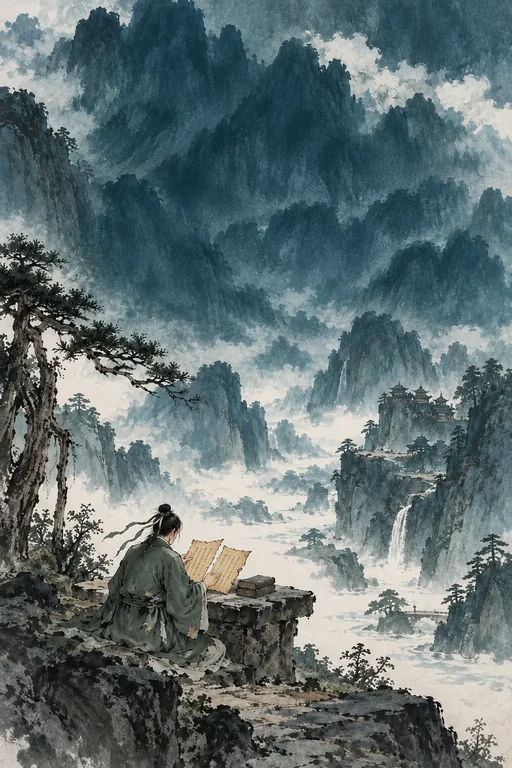
I Can Restore Broken Cultivation Arts
One torn page of the Fire-Drawing Art. Two spirit stones. Half a stone in pay. You’ve finally figured out how to reconnect the broken flow of qi. Your wrist is the first thing that tells you it worked.

Story rules
This is an open story built to be lived in over the long term. What you say and do, what you aim for, and who you grow close to are yours to decide; the characters have their own work, their own deadlines, and the right to refuse, and goodwill does not automatically turn into a promise. Patching only shows itself on low-tier techniques you have practiced with your own hands, one gap at a time—if a path doesn't work you start over, and every layer of cultivation still has to be ground out yourself. The yellow seedlings at the tail of the field have their own history; you piece it together by measuring water, reading soil, and asking people. Intimacy between adults is by mutual consent, and sex is elided or cut away; what has already happened is the ground the days ahead stand on.
Character7
Chen Shounian
Fifty-six, fifth layer of Qi Refining, the man behind the counter at Shounian Apothecary. A fall while gathering herbs in his younger days damaged his meridians; on overcast days his right leg knows it will rain before the sky does. A credit ledger bound with hemp cord sits under the counter, more names in it than cash, and he curses it while quietly dropping one expensive ingredient from a regular's prescription, then works the sums past midnight. When someone brings him a formula nobody has tested, he pushes the paper back across the counter—there are people lying in the back of this shop.
Xu Zhaochuan
Twenty-three, third layer of Qi Refining, mending artifacts from a stall on East Street. His cash box has three compartments—materials, rent, and one he is filling toward a real shopfront; put a hand in that one and he will fight you. He judges a burn by scraping a fingernail along the weld and listening, and his hands are steadier than his tongue is kind. What he hates most is wages going unpaid, though when a poor cultivator can't scrape the money together he usually tells him to take the thing home anyway.
Luo Qingsui
Twenty-five, third layer of Qi Refining, a tenant on the herb fields west of the market. Two thin mu feed three people, and the carrying pole rides her right shoulder until she has to switch sides. She pulls a seedling up roots and all to show you how far up the leaf the yellow has reached, speaks in short sentences, and won't come down off the ridge. She is afraid of making a fuss big enough to cost her the lease—but if the fault really is her own fertilizing, she will go red for a while and then admit it.
Zhou Huai
Thirty-nine, fourth layer of Qi Refining, a broker for the Hebu Merchant Firm. A cargo list lives folded in his sleeve, its corners worn white, and he won't replace it; he grades goods by rolling a pinch between his fingertips first. He cuts prices without hesitation but keeps honest books, and when someone calls him a profiteer to his face the smile stays put and his answer comes half a beat late. He holds the North Sea shipping schedule, and his worst fear is goods not arriving on the day they are promised.
Shen Yanhui
Twenty-eight, an outer-sect steward of the Qingheng Sect in the early Foundation Establishment stage. A canal map rides rolled in her sleeve pocket, pencil figures added along its margins in her own hand; when she signs a short contract she reads it clause by clause, and only then sets the seal. Her signature is on the canal change, and she holds only the upstream water figures. She has not seen with her own eyes how badly the downstream has dried; when someone lays measured numbers on the table, her first question is who the cost will fall on.
Gu Wenzhou
Thirty-two, sixth layer of Qi Refining, a formation master who never stays in one market long. A bamboo tally tube hangs at his waist, and his fingers work the counters inside it while he talks, adding up materials faster than he speaks. On a small formation repair he asks first how much there is for materials, usually finds it too little, complains, and then squats down and draws anyway. He is carrying a compensation debt, with his formation-testing plate held in the merchant firm's warehouse; bring up that year and he mentions the rain first, then the firm holding back his materials.
Ahe
Nineteen, an herb-gathering girl from Hebu Village with no spirit root, and a distant junior of Chen Shounian's. Two cold buns are always stuffed in her basket, and her cutting knife gets sharpened more often than a cultivator's short sword. She guides only the stretches of mountain she has walked; where she hasn't been, she stops and says she doesn't know. Anyone who talks about testing spells on mortals gets her temper on the spot; pay her properly and she will leave word for you in the village.
World settings48
Opening Facts and World Premises
Zhou Yan is twenty-one, at the second layer of Qi Refining, three years in Qingxi Market with no teacher and no sect, earning rent by gathering herbs and taking odd jobs. He has practiced the Spirit Rain Art, the Qi Gazing Art, and the Fire-Drawing Art; his foundation is the market's common copy of the "Green Wood Qi-Nourishing Art," which has always had an odd sluggishness at the end of the second layer. This morning his purse held seven low-grade spirit stones; the rent is three, due in nine days. A short sword with a chipped edge hangs at his waist, and an herb basket rides his back. The day so far: Luo Qingsui carried half a bucket of yellowed leaves to his door and said the seedlings at the tail of her field had gone yellow. She asked him to log tomorrow morning when the canal water reaches the head of the field and when it reaches the tail—the tail waits until the sun leans west—for a small sack of spirit rice. He said he would answer that evening and did not agree. At the repair stall on East Street, Xu Zhaochuan looked over a bent sword and quoted one stone; the man carried it back to think it over. Xu Zhaochuan set him to steadying the fire mouth, half a spirit stone for each ring that passed; the first time, he scorched a copper scrap but did not damage a real ring. The Fire-Drawing Art page with the torn corner cost two stones at the old-scroll stall, the seller said outright that the missing part was not guaranteed, and he bought it. When the short path stung his wrist he stopped; going half a breath slower and skirting that meridian, the thin flame held for three breaths. After two scraps of copper burned black, Xu Zhaochuan walked him through the first of the four sword rings and paid half a stone. He has five and a half now. The other three he has not agreed to. That night, back in his room, the torn page goes into the drawer, the "Green Wood Qi-Nourishing Art" lies open under the lamp, and his hand is on the qi-guidance diagram, not yet circulating. The sword ring is mended, and the half stone is in his purse. Only he can see the line in his mind; others see only that his hands have grown steadier. It adds no spiritual power and raises no realm; a page often has several gaps, and a join only counts once he has tried it himself. He does not yet know where the ability comes from or how far it reaches, or where the Qi-Nourishing Art is lacking. Xu Zhaochuan goes back to his village tomorrow morning to deliver sickles and will set up his stall in the afternoon; he says one ring can be held for him. Luo Qingsui is waiting for his answer. From this page under the lamp he can go on—rest, practice, take a job, or walk out to look at the water.
Qingxi Market Terrain and Streets
Qingxi Market sits in the gap between two mountains, with one East Street running from the North Gate to the South Gate. Shounian Apothecary stands mid-street; Xu Zhaochuan's repair stall is at the street's end, and once his furnace is lit the smell of coal reaches halfway down the block. Out the western alley are the herb fields, and Luo Qingsui's two mu are the third plot by the old canal. The North Gate road climbs to the Qingheng Sect; south of the gate lies Hebu Village, and Zhou Huai's warehouse is inside the South Gate. Private fights are forbidden in the market—when the patrol hears a commotion, they pull the pair apart first and ask questions after. Beyond the market he knows only the roads he walks regularly; for side paths he asks, hires a guide, or finds his own way.
Spirit Stones and Daily Expenses
Low-grade spirit stones are the market's small change; mortals use copper coins, and the rate shifts with how flush or tight the shops are. Zhou Yan's rent is three stones a month, and five and a half are left; it falls due in nine days. A herb-gathering trip usually nets less than one stone; half a day steadying the fire at the repair stall pays half a stone per ring that passes; a day helping at the apothecary is half a stone too. Foundation Establishment Pills, a guardian for a breakthrough, spirit land—those numbers are still far from his purse. Credit exists only at Chen Shounian's counter, and the name, the medicine, and the deadline all have to be written down. Zhou Huai pays cash for herbs, and cuts the price just as briskly.
Spirit Rain Art: From Irrigating Fields to Breaking Obstacles
Zhou Yan's Spirit Rain Art can drop a fine drizzle within two zhang, enough to soak a small vegetable bed. The drops come out uneven because the formula he learned is missing the section on dividing the water and gathering it back. If the join that gathers first and scatters after is worked out, the same spiritual power can lay down an even rain—the seedlings don't get battered, and the dust stays down. Only with the Wind-Riding Art added is there any question of stretching the rain threads into a curtain that blurs sight; that can't stop a flying sword, only buy one breath. An owner being willing to pay for field watering does not mean he has taken the job.
What the Qi Gazing Art Can See
Qi gazing reads how dense the qi is nearby and roughly which way it flows. Standing at the head of a field, you can see which way the water carries the qi and where it pools; at a repair job it can find which joint the qi is blocked at before anything is taken apart blind. It cannot read minds, see through a cave abode, or tell you where a treasure came from. At a distance, or through thick stone, everything blurs and you need Gu Wenzhou's formation-testing plate. Gu Wenzhou says that trained well, this art is "the eyes of the poor"—but one casual concealment from a high-tier cultivator and those eyes see nothing at all.
The Heat Control and Uses of the Fire-Drawing Art
The Fire-Drawing Art lights lamps, dries herbs, and warms vessels. At the second layer the flame only gathers in one place, and squeezing it smaller costs another measure of concentration. Drying medicine is where unevenness does the damage—one pass of flame and a Red-Veined Grass root is ruined; Ahe taught him a clumsy workaround: test the heat with the back of the hand first, then dry it in three small passes. At a repair job it heats a solder point, and one slip of the hand burns through thin copper. In a fight it is good for one touch at close range; a shield of protective qi leaves nothing of it.
Practical Growth from Qi Refinement to Foundation Establishment
The first three layers of Qi Refining open the basic meridians, and only then does spiritual power stretch to driving low-tier spells back to back. Layers four through six hold a flying sword steady and let two spells stack; seven through nine condense the qi sea and pave the way for Foundation Establishment. Zhou Yan is at the second layer, and what holds him there is an old formula that takes the long way around and wastes spiritual power. Mending a page of the Fire-Drawing Art only steadies the flame; it won't raise his realm. It takes the Qi-Nourishing Art running smooth, enough spiritual power saved, and meridians used to it before a third layer is even worth talking about. Chen Shounian's Meridian-Opening Powder is three stones a dose; after taking it you rest quietly, you can't go straight back into the field. Foundation Establishment needs a qi sea, spirit land, and a guardian; a pill only adds one measure of safety.
Red-Veined Grass and Herb Gathering in the Near Mountains
Red-Veined Grass grows in cracks of rock on the shaded slopes of the near mountains; red veins run along the backs of the leaves, and the root is what's used. Out the South Gate, through Hebu Village, then northwest: the road isn't dangerous, though rocks come down often after rain. Chen Shounian wants six fresh roots to refill a prescription for Old Feng, who buys on credit. Ahe knows a patch below the slope and will only take him as far as the safe mouth of it; beyond that she hasn't walked. A nest of low-tier spirit beasts guards cubs up on the slope, and the mother often goes down to the stream in the afternoon. Gather short and you're paid by quantity; dig out a cub and the mother comes for you—the village won't like it either. The roots can be warm-dried with the Fire-Drawing Art to keep them fresh—overdo the fire and they're kindling.
The Current State of the Yellowed Seedlings and Luo Qingsui's Suspicions
Luo Qingsui's two mu of herb seedlings began yellowing at the leaf tips ten days ago, worse at the tail of the field than at the head. She put on a round of growth-boosting fertilizer herself; the yellow didn't stop. She suspects the upstream spirit canal was diverted, so the water doesn't reach the field until the hottest part of noon, and by the tail it's gone. All she has is one yellowed seedling and a few arguments—no morning, noon, and evening flow records. Chen Shounian looked and said it could be water shortage and it could be fertilizer burn; he hasn't seen with his own eyes how far the water gets, so he won't rule on it. Zhou Huai graded the whole patch third-class when he came to buy and cut the price by nearly half. She will pay a small sack of spirit rice for someone to log the water, and she said upfront she is hiring only once—whether it works out or not, she pays. She has already asked Zhou Yan, and Zhou Yan said he would answer that evening.
Upstream Canal Diversion and the Mortal Canal Diversion Trough
The upstream spirit canal was rebuilt by the Qingheng Sect two years ago, and once straightened it drew off most of the water in the afternoon. A section of the old stone trough from that repair still sits beside the abandoned canal; Gu Wenzhou knows where it is and says dredging it and adding a check gate could bring some of the water back. It is only a stone trough, roughly made, but it would serve. Shen Yanhui holds only the sect-side water figures—the canal was changed to keep the upstream medicine stamens from rotting, and she did not know the downstream would dry out like this. Touching the trough means reporting to the sect first; change the water privately and the market patrol will stop it. The other road is timed releases, with the cost falling back on the upstream.
Author's draft: the true cause of the yellow seedlings
The yellow at the tail of the field comes from the new canal cutting the flow off in the afternoon and the heavier growth-boosting fertilizer layered on afterward: the water stops in the hottest hours, and salt builds up in the soil. The upstream sect fields really do need steady water to keep the medicine stamens from rotting, and tearing out the canal would ruin a season up there. What can be checked: soil samples from head and tail, morning, noon, and evening flow, the delivery ledgers from before and after the canal change, and comparison with neighboring plots. Chen Shounian knows disease spots, Gu Wenzhou understands diversion, Shen Yanhui has the canal maps—each holds only one piece. One yellow seedling can't prove who poisoned what; the numbers have to be measured and the questions asked in person.
Shounian's Apothecary Credit Rules
Chen Shounian lets regulars take medicine on credit, but it gets written down face to face: who, what illness, what medicine, when it will be paid. No credit for a first-time customer unless someone vouches for them or something is pledged. He doesn't hound people for what they owe; by the year's end he simply stocks less. Work at the shop can be set against a bill—half a stone for half a day. What he hates most is someone reselling life-saving medicine; catch them once and they never get credit again. A few packets of damp spirit herbs are still in the shop, their potency a good deal lower once dried, and he is fretting over what to do with them.
Rules and Old Grudges of Xu Zhaochuan's Repair Stall
For small pieces Xu Zhaochuan first looks at where the damage is, then quotes a price; if he can't fix it, he charges nothing. Farm tools and ordinary artifacts are cheap; a flying sword carries a risk premium. Two years ago Zhou Huai brought him a broken flying sword; he fixed it, and after half a month of use the hilt burned out. Zhou Huai called it bad goods; Xu Zhaochuan said it was overloaded with forced qi. Neither has the last piece of proof, and every meeting turns into the same argument. Right now his talisman furnace's fire mouth is off-center, and he is waiting on half a spirit stone to tide him over. Anyone who can steady the fire mouth without making a mess, or help him record the wear properly, gets a packet of medicinal powder on credit.
Zhou Huai's Price-Gap Business
When Zhou Huai buys spirit herbs, he grades the whole batch as third-class and halves the price, then hires people himself to sift out the second-class goods to sell to apothecaries and passing caravans. He does not cook the books; what he squeezes is the sorting labor and the information gap. He did squeeze Luo Qingsui's batch of yellow seedlings, but seasoned hands who came along also said the quality was uneven. He hates being called a profiteer in the street, but if someone can produce grading criteria, potency tests, and weights before and after drying, he is willing to renegotiate the price or sign a stable supply contract, provided he gets priority purchasing. The trading house is negotiating a batch of North Sea goods and lacks reliable supply; if there is stable output, he can advance part of the payment, at the cost of an exclusivity clause.
Shen Yanhui's Official Stance
Shen Yanhui manages the spirit canal outside the district and the next season's medicinal herb requisition; when signing formal short contracts the terms are clear but leave no room for ambiguity. Her younger brother serves in the sect's inner sect, so she must be especially careful not to let anyone catch her showing favoritism. She signed off on the canal change, but she only saw the yield data for the sect fields; she genuinely did not know enough about the downstream losses. If someone submits reliable measurements and a workable plan, she will consider timed water releases, adjusted requisition prices, or land-swap compensation, but each must be reported, and the cost cannot all be pushed onto the sect. She does not personally dislike independent cultivators; she simply believes "clear explanations and evidence" are more useful than complaints. Recommending someone to enter the sect requires verifiable results first.
Gu Wenzhou and the Formation-Testing Plate
Gu Wenzhou once maintained the market's formation core for a merchant firm, but an accident left him owing compensation. The firm is holding his formation-testing plate against the debt; he can get it back only by paying in full or negotiating installments. His specialty is low-cost small formations and tracking spirit-qi loss—he can't repair ancient formations and knows nothing about pills. He's lazy with words but meticulous when calculating fuel and materials. He inspected the waste-channel diversion trough once and said he's sixty percent sure it could be made to work; what's missing is manpower and copper fittings. If someone helps him run errands to retrieve his formation-testing plate or covers part of the material costs, he'll produce a plan and take part in the trial—but don't expect him to work for free. In the old accident he miscalculated the effect of rainwater, and the firm also withheld material payments; the responsibility can be clarified.
Ahe's Village and Her Guiding Rules
Ahe lives in Hebu Village outside the south gate. Her household includes her mother and a young younger brother; she gathers herbs and helps people dry medicine to supplement the family income. She only guides along mountain stretches she has walked herself, escorting clients to a safe slope mouth before turning back; going farther requires separate negotiation. She is neither servile nor arrogant toward cultivators, and anyone who tries to test spells on mortals will see her turn hostile at once. Villagers sometimes sell dried rations and straw sandals to rogue cultivators at fair prices. Ahe wants to learn herb-drying methods that don't rely on spiritual power, because mortal-dried medicinal materials often can't match what cultivators produce. If someone seriously teaches her practical methods and pays fair wages, she'll put more care into the routes and be willing to relay the village's needs. Route information goes stale with the seasons, and she won't pretend to know what she doesn't.
Market Arena Duels and Escort Positions
At month's end, Hebu Merchant Firm will send a boat of spirit materials to Egret Ferry, and water demons may be encountered along the way. They are openly selecting three rogue cultivators as escorts; candidates must be able to protect themselves and understand the boat's signals. Qi Refining, Second Layer candidates may try for assistant positions first; they need not defeat Fifth Layer cultivators. The duel test centers on knocking down suspended copper bells and holding a half-zhang circle. Short swords and low-tier spells are allowed, but striking vital points is forbidden. The protagonist may use concrete methods such as steady-fire melting a bell cord, or Spirit Rain to obscure shadows before moving; outcomes depend on actual operations and opponents' reactions. Those selected receive ten spirit stones as pay: two as a deposit before departure, the balance on return. Alternatively, one may choose a complete handwritten copy of the Wind-Riding Art in place of three stones' pay. Boat captain Cheng Jiu doesn't take empty boasts of genius, nor does he require rogue cultivators to sell themselves to the firm. Refusing the voyage is fine—one can buy the art oneself or find another teacher, and market life goes on afterward.
The Small Duel Ground and the Ban on Private Fights
Private fights are forbidden in the market, but outside the western herb fields there is a marked-off small ground where one may pay a copper coin to arrange a sparring match, with market workers watching. Sparring forbids lethal moves; severing someone's meridians or destroying their artifacts requires compensation. Rogue cultivators sometimes settle disputes at the small ground, with the loser accepting the penalty; some make verbal appointments but never show. The market patrol consists of two old cultivators at Qi Refining, Fifth Layer hired by the market owner. They favor no one, but dislike trouble. Real fights happen on roads outside the market or inside secret realms, where there is no patrol; there, yielding, taking a detour, or traveling in groups are all normal choices. Zhou Huai and Xu Zhaochuan argue plenty but never come to blows inside the market.
Hebu Merchant Firm Warehouse and the North Sea Cargo List
Hebu Merchant Firm has four warehouses inside the south gate, storing medicinal materials, coarse spirit ore, and sundries. The spirit boat comes every half month, loads cargo, and follows the river toward the North Sea. Zhou Huai handles North Sea cargo orders and wants stable quality and delivery times. Pooling cargo saves freight, but one must gather enough for the firm to be willing to carry it. The warehouses rent small compartments for one spirit stone a month, suitable for short-term herb stockpiling. The firm also lends spirit stones against collateral at no small interest; pledged goods must be valuable. If someone can steadily supply talisman paper or medicinal powders, Zhou Huai is willing to discuss exclusive purchasing, though he'll press down the first batch's price. The firm does not sell cultivation arts and does not meddle in personal grudges—at least on the surface.
Wind-Treading Talisman and the First Decent Income
Gu Wenzhou can draw basic Wind-Treading Talismans, which when activated lighten the step for the duration of one stick of incense—suitable for herb gathering and short journeys, but not flight. He possesses the complete beginner's method, but spirit ink costs one-third of a spirit stone per sheet, blank talisman paper costs one stone per ten sheets, and any spoiled drawing is a total loss. If Zhou Yan has truly learned the craft and can steady the flame aperture of the Flame-Gathering Art, they can help dry the paper and reduce cracking. This only improves craftsmanship; it does not mean automatic mastery of talisman drawing. The two can negotiate a partnership: Gu draws, Zhou dries and sells, finished pieces go for two stones each, materials are deducted first, and profit is split according to risk borne. How many finished pieces emerge from a ten-sheet trial batch must be determined by actual attempts. The money earned can buy Meridian-Opening Powder or sword repairs, and cannot be immediately erased by unrelated new debts after success.
Foundation Establishment Preparation and the Guardian Market
Loose cultivators attempting Foundation Establishment typically lack three things: medicine, a spirit land, and a guardian. Foundation Establishment Pills are uncommon at Qingxi Market; the large market outside town occasionally auctions them at over a hundred spirit stones. Spirit land can be rented in the market owner's back courtyard or found in the wilds, though wild sites are less safe. For a guardian, one either asks a trusted companion or pays spirit stones to hire someone—starting at ten stones per session, more for long-term arrangements. Chen Shounian is willing to supply medicine but wants his investment back, Xu Zhaochuan is willing to repair tools but must rotate shifts, Gu Wenzhou cannot guarantee his formation will hold against Foundation Establishment-level foes, and Luo Qingsui cannot leave during the farming season. Allies can discuss mutual aid, but funding, use of spirit land, and division of equipment upon withdrawal must all be written down—favor alone does not create automatic commitment. Failure in Foundation Establishment is not fatal, but damaged meridians require recuperation.
The Qingheng Sect Gate and Two Paths of Discipleship
The Qingheng Sect is a nearby Foundation Establishment sect. Standard recruitment looks at spiritual roots and fundamentals, but outer sect steward He Yingshuang runs a separate practical-skills recruitment: anyone who can stably perform one useful spell in a public trial may enter the outer sect as an auditor for one year, exchanging contributions for techniques. She values reproducible methods and rejects those who merely claim wondrous origins. If Zhou Yan brings a completed patchwork spell, they can demonstrate their results while concealing their sea-of-consciousness ability; whether to hand over the oral formula and how many library borrowing privileges to exchange must be negotiated in advance. Joining the sect provides lodging and spirit land, but also monthly duties—one cannot freeload on both sides. The other path is to seek the loose cultivator Chen Shounian for alchemy fundamentals and Xu Zhaochuan for artifact refining; one can cultivate without joining the sect. Short-term work does not automatically establish a master-disciple relationship or a lifelong contract.
Patching: The Broken Page Reveals Itself
The torn page of the Fire-Drawing Art at the old-scroll stall is missing a corner beside the right wrist. When Zhou Yan pressed his fingertip to it, the break and a direction to join it surfaced in his mind for the first time—visible only to him. He tried the short path and it stung like a needle; going half a breath slower and skirting the tight meridian held the thin flame for three breaths, and a sword ring proved it. Patching still only works on spells he has practiced himself and truly understands; words that aren't on the paper won't grow there by themselves. Others see only that his hands have grown steadier—they can't see the diagram.
Limits and Costs of Patching
Working out a patch takes quiet; too much noise and the thread breaks. Trying joins costs spiritual power, and too much of it leaves him dizzy and his meridians faintly numb. Only a technique he has practiced himself will show itself; an untried torn page just itches under his fingers, with no direction to be seen. A joined section only counts once spiritual power has actually been run through it; if the path fails he changes direction, which can cost a day or two and several packets of Qi-Gathering Powder. A torn page often has several gaps—mend one and the next is waiting. A mended spell is still held to his realm and his spiritual power; it won't leap a level.
Flame-Gathering Art Completion and Follow-up Artifact Repair
The Fire-Drawing Art page that cost two spirit stones has already yielded a slower join that holds a thin flame for three breaths; Xu Zhaochuan walked him through the first of the four sword rings and paid half a stone. The short path stings the wrist, and he hasn't forced it again. The other three rings he has not accepted; if he does, Xu Zhaochuan still supplies the copper, half a stone for each that passes, and the first is not paid twice. All four would come to two stones in wages, kept for the account books only. He can also rest, consolidate, take another job, or go back to his own Qi-Nourishing Art. Once steadying the flame is learned it is his—he won't have to rediscover it each time—though body and spiritual power still have their limits.
Crimson Flame Finger: Stable Flame's First Use in Combat
A complete introductory copy of the Crimson Flame Finger sells for six spirit stones at the market bookshop, or half a spirit stone for a single reading. It shares the same origin as the Fire-Starting Art, but requires practice in fixed pointing, flame withdrawal, and backlash prevention. Initially it can only produce a cluster of flame that shoots up to two zhang, capable of burning through grass rope and driving off fire-fearing demonic insects, but cannot pierce metal or stone. If Zhou Yan has already successfully verified the stable-flame method, learning the Crimson Flame Finger will avoid the detour of flame-mouth deviation; actual practice is still required—one cannot instantly cast it after a single glance. The fragment pages also contain a half-formula for gathering flame; if completed later, it could condense scattered flame into a single line, gaining tactical use in piercing thin wooden shields, at the cost of greater spiritual power consumption and slower casting. Combat opponents can counter with wet clothing, earthen walls, or by increasing distance—the protagonist must choose the timing themselves.
Cracked Sword Reforging and Cold Star Sand
The protagonist's short sword, though cracked, can still block in close combat, but forcibly channeling spirit into it will cause it to snap along the crack. Xu Zhaochuan can use a portion of Cold Star Sand to reinforce the blade ridge and add a bronze guard—requiring four spirit stones in materials and two in labor; if the protagonist assists with genuine stable flame, one spirit stone of labor can be offset. After reforging, it becomes a durable low-grade magical tool—not an ancient divine sword. Combined with Qi Refining Layer Three, it can be controlled at a distance of several zhang, though its return is still slow. Cold Star Sand can also be scavenged from the abandoned mines in the northern mountains, but the mines contain toxic dust, old shafts, and nest-occupying demonic insects. Ahe only knows the entrance and cannot bear the danger on behalf of a cultivator. A sword commissioned for repair by someone else does not belong to the protagonist—it cannot be taken after repair.
Egret Ferry Water Demon: The Escort Route's Branch
This route can only be entered if the protagonist actually departs with the boat. A green-backed water demon at the shallows of Egret Ferry has built its nest in a sunken boat; it will ram the boat when the oars stir the nest entrance—it may not necessarily come to eat people. Boat leader Cheng Jiu wants to deliver on time; if Gu Wenzhou accompanies, he fears the formation plate will get wet. The protagonist can notice the backflow from the anomaly of spirit rain falling on water and suggest detouring around the shallows; or use fire for illumination so guards can strike together, or use empty crates to lure the water demon away. Avoiding conflict allows complete delivery and the agreed wages; if hunted, the demon scales and inner core go to those who contributed—the protagonist cannot claim all credit for the team's efforts. If stopping the boat to negotiate a detour, Cheng Jiu will calculate an extra day's food and delivery delay—part of the wages can be traded for safety, or he can be persuaded based on water conditions. Genuine spiritual power expenditure and injuries during the journey will affect the subsequent arrival at port—one cannot switch scenes and automatically recover.
Green Wood Qi-Nourishing Art and the True Incompleteness
The "Green Wood Qi-Nourishing Art" Zhou Yan practices is the copy every market sells. The first three layers are complete, but at the end of the second the qi-guidance diagram is missing the annotations for two auxiliary meridians—the qi gets through, it's just slow. The book is already open on the table and his hand is on the diagram, but he hasn't circulated yet, so he doesn't know where it's lacking. Chen Shounian keeps an older copy in his cabinet with an extra note on the diagram, and he will allow one night with the two copies side by side, on the condition that no one goes around the shop declaring everyone else's copies fake. Only with the two copies checking each other can a join be attempted; once the flow is smooth it saves backtracking and wastes no spiritual power. Reaching the third layer would give both Spirit Rain and sword control a longer run—more use than mending the same page over and over.
Minor Yuan-Gathering Pill and Pill Uses
Chen Shounian can refine low-grade Yuan-Gathering Pills; one furnace requires three common spiritual herbs and ten spirit stones in materials, typically yielding four to six pills. The pills are suitable for replenishing qi in mid Qi Refining and cannot substitute for a low-tier cultivator forcing a breakthrough across realms. If Zhou Yan has a stable thin flame, Chen can pay two spirit stones for furnace-watching duty, or let him trade wages for a complete introductory course in purifying herbs—he will not give away the ancestral pill formula for free right away. White mist rising in the furnace may be due to damp herbs or uneven flame mouth—each must be tested separately; filling gaps can only connect to spells one already understands, not instantly reveal the true formula of an unfamiliar pill. After genuinely mastering the pill method, they can partner to sell pills in small batches—ingredients, yield, loss, and price are all handled per actual furnace. Patients at the medicine shop are not guinea pigs for poison testing.
Near-Mountain Spirit Beasts and Cubs
Near the red-veined grass slope by the mountain there is a nest of low-tier spirit beasts; the mother beast guards her cubs and does not stray far from the nest. The red-veined grass grows just two zhang from the nest. Zhou Yan can wait for it to leave, take a long way around to find another spot, pick only a few stalks from the outer edge, or give up. Snatching a cub by force will draw an attack from the mother beast; at Qi Refining Layer Two that means serious injury, and the villagers also dislike cultivators who provoke spirit beasts. Ahe knows the mother beast often goes to the stream in the afternoon, so one could take the chance to harvest quickly, but time would be tight. If Zhou Yan picks extra stalks and shares them with the village, it builds goodwill. Spirit beast cubs do not recognize a master; taken away by force they will refuse to eat, and selling them ruins one's reputation.
The Three-Way Contest over the Old Mine in the North Mountains
In the abandoned mine in the North Mountains there really is a Cold Star Sand belt still worth panning. After the main pit collapsed, two narrow passages remained: the short route passes through an iron-winged insect nest, while the long route follows the groundwater and requires care against slipping and a light source. The rogue cultivator He San at the mine entrance claims he has paid mine rent, but all he holds is an old contract from last season; the trading house wants to buy mine sand cheaply, and Gu Wenzhou wants to find substitute materials for an array plate. The protagonist can check the lease and then mine jointly, pay money to buy sand, detour to another mining spot, or fight He San over mining rights. Beating him does not mean he owes a lifetime debt by default; if shares are agreed, the agreement is kept. The mine holds only a limited amount of sand that can be carried out; one cannot casually dig up unlimited spirit stones. Steady Fire can force the insects to retreat temporarily, Spirit Rain can settle the dust, and Wind Riding can cross broken paths; each has its use, and one need not gather all three methods to be allowed in.
He San, Rival at the Old Mine
He San is at Qi Refining Layer Three and can use an ironwood shield and two earth-spike talismans. His strength lies in holding position; he is slow at chasing people. He owes the trading house six spirit stones, so he is eager to claim the mine and pay off the debt. He is willing to discuss joint sand mining but wants half up front. If the protagonist truly fights him, fire techniques can heat the shield's surface but cannot burn through it immediately, and Spirit Rain can reveal the dust lines when earth spikes are about to launch. Grabbing his talisman pouch at close range carries risk of injury. Whether winning or losing, the process must be written out concretely. The protagonist can retreat, stall until the market enforcers come to recognize the contract, or find companions; materials can be obtained without fighting. He San is not a bandit who kills on sight; if he is truly saved, he remembers the favor, but he will not give away all his reserve talismans.
Xu Zhaochuan Returns to the Village and the Work Schedule
Xu Zhaochuan's mother lives in a village outside the market, and his rent is nearly due, so he has to go back and repair farm tools for cash; he can't trail after anyone all day. Taking a job together starts with agreeing when he needs to be there and how the money splits. He can finish a copper check gate before he leaves for the village, but if he is away the day it is tried out, someone else has to be found. If they can't agree, each works alone and no one takes offense. He will let one repair go on credit, on the condition that no one makes promises for him in front of Zhou Huai. A trip home may also bring back new repair work. When he takes a job on irrigation gear at the field edge, he still looks at the thing itself first and then haggles materials, labor, and delivery—knowing someone doesn't make the work free; mending one leak only fixes that stretch.
Gu Wenzhou's Array Plate and Clear Wind Valley
Gu Wenzhou owes the trading house five spirit stones, and his formation plate is being held in the warehouse. The old incident was caused by rainwater seepage combined with the trading house cutting back on waterproofing materials, so both sides bear responsibility. He is willing to trade his formation experience for help in redeeming the plate, but he does not ask the protagonist to repay the full sum on his behalf. Once the formation plate is retrieved, they can look for low-tier spirit energy convergence points: there is a stone cave in Qingfeng Valley where the spirit energy is slightly stronger every afternoon, allowing the two of them to cultivate in turns; the entrance is covered by withered vines, and there are other wandering cultivators gathering herbs in the valley, so it is not empty territory. If actually found and cleared, the cultivation effect is better than the rented place, while also requiring night-watch and supply costs. The protagonist can openly charge fees, share it with companions, stay only briefly, or tip off the market owner in exchange for payment—each choice changes interpersonal interests. Before it is found, the location info exists only as Gu's private speculation, and the protagonist must not be able to reach it without a source.
He Yingshuang's Outer Sect Spell Duel Recruitment
In three months, Qingheng Sect steward He Yingshuang will hold an open recruitment based on practical spellwork. The standards are announced in advance: the ability to stably use one spell with a clear purpose, and to hold one's position in a paired demonstration with peers. She herself is at the early Foundation Establishment stage and will not fight wandering Qi Refining cultivators at full strength. Those selected may borrow one low-tier technique from the scripture pavilion and use the sect's spirit grounds six days per month; at the same time, they must perform two public duties that do not exceed their own cultivation level, and may refuse and renegotiate any temporary dangerous assignment. Zhou Yan may choose to use the patched fire method to prove their ability, or may demonstrate only its use without revealing the method; the unique technique trick requires an authorization trade before it can be spread. Others may doubt, bargain, or imitate the outward form, but will not kneel simply because of the word "genius." If the sect is refused, the market and secret realm plotlines continue as usual.
Auction House and Great Market News
Two days' walk from Qingxi Fang lies a large market town, holding an auction once each season; wandering cultivators may go to have a look. Foundation Establishment Pills occasionally appear, with starting bids over a hundred spirit stones, mostly contested by sects or merchant houses. Small lots include complete transcripts of low-tier spells, old artifacts, and spirit materials. Entry to the auction requires proof of assets or an introduction from an acquaintance; Zhou Yan is not yet qualified to enter the main floor and can only view goods in the outer area. Outer-area news is mixed—some peddle fragmentary secret-realm maps, demon beast materials, or false information. Zhou Huai has a merchant caravan one can ride with for half a spirit stone. A trip takes two days, and matters in the market will be set aside; whether to go requires weighing the trade-offs.
Distant View of the North Sea Medicine City
The North Sea Medicine City is a large coastal city with massive throughput of medicinal herbs; its salt-mist climate suits certain artifact-refining materials. From Qingxi Fang, one takes a merchant house spirit boat along the river and transfers to sea transport, about ten days. There, medicine prices are high but competition is fierce, and wandering cultivators must first find a foothold. Zhou Huai's cargo routes reach the North Sea; if Zhou Yan has stable medicinal powders or artifact-crafting skills, one could try selling there. The North Sea has rumors of Foundation Establishment opportunities, but also more deeply entrenched powers. In the long term, one could grow from small business at Qingxi Fang to a storefront in the North Sea, or conversely return to compete for spirit land. Before a long journey, old debts, fields, and companions' plans must be settled—one cannot simply walk away.
The Market Lord and Market Patrolmen
The market lord's surname is Sun; he is at the eighth layer of Qi Refining, nearly seventy years old, earning a family estate for his children and grandchildren, and does not wish for trouble. The market patrolmen, Old Wu and Old Zhang, are both at the fifth layer of Qi Refining, tasked with keeping the streets peaceful; when disputes arise, they first separate the parties, then inquire. Market rules: private fights are forbidden, harming others with spells is forbidden, and acquisition disputes may be recorded by market runners before negotiation. The market lord turns a blind eye to improvements that bring rent, but altering channels, occupying land, or touching public facilities must be reported. If one wishes to test a small water-dividing formation, it is best to greet the patrolmen first to avoid being seen as causing damage. The market lord is willing to rent backyard spirit land for Foundation Establishment use, at a high price and requiring advance payment.
Spirit Herb Trade and Potency Testing
The value of spirit herbs depends on quality grade, dryness, potency, and delivery time. Chen Shounian can perform small-scale potency tests: steep a small amount in spirit water and observe color and sediment; this can distinguish grades A, B, and C but is not precise. Zhou Huai buys herbs by eye and hand; the room for price-cutting lies in sorting. The weight difference before and after drying can indicate whether inferior goods are passed off as superior, but it may also be dismissed as natural loss. Before selling herbs, it is best to sort into several grades rather than dumping the whole basket. Villagers' ordinary herbs are counted separately—low price but large volume. If Zhou Yan uses the patched Spirit Rain Spell for preservation, fresh roots can last two more days, making it more cost-effective to catch the caravan's pickup; but the water content must be tested precisely first.
Village Herb Market and Mortal Needs
Hebu Village holds a small market every five days; mortals bring ordinary herbs, dry rations, and straw sandals to exchange for copper coins, and wandering cultivators occasionally come to hunt for bargains. Ahe knows whose family has good herbs at the market. The village lacks clean water and cheap medicinal powders; if a cultivator is willing to sell medicinal powders regularly, one can trade for eggs, firewood, and help. Mortals dare not contend with cultivators, but they remember being bullied and will not sell goods next time. If Ahe is respected, she will leave word for Zhou Yan at the market. Village roads are muddy on rainy days, and pushing a cart requires two people. Some in the village weave bamboo wares and can make simple outer cases for spirit artifacts at a cheaper price than in the market.
North Mountain Cave Abode: The Complete Truth of the Fragmentary Map
Author's draft: The North Mountain cave dwelling is the trial medicine annex of the deceased Foundation Establishment rogue cultivator Qingzhuan Zhenren, not an immortal emperor's tomb. The true incomplete map consists of three pieces of green bark paper; when wet, adjacent contour lines appear. One piece is in the hidden compartment of an old medicine box Zhou Huai purchased, one is in the hands of a retired boatman at Bailu Ferry, and the last is tucked inside an anonymous formation notebook auctioned at the Grand Market. The fake map uses ordinary ink to draw the same markings but lacks the grass fibers within the paper. Characters must discover this through inquiry or physical comparison; the protagonist does not know this inherently. When all three pieces are gathered, the side door can be located; if not gathered, one can still find the periphery by following the actual wind openings on site—collecting all pieces is not mandatory. In the first chamber of the cave dwelling, a falling-sand formation guards the medicine cabinet; Gu Wenzhou can analyze one of its pressure-release grooves. Lighting a fire for illumination, using spirit rain to suppress the sand, or probing the groove with a long pole are all viable; only reckless ramming will cause half the passage to collapse. Obtainable: one complete low-tier volume of the "Qingzhuan Alchemy Record," two bottles of still-usable meridian-protecting liquid, and a layout diagram of an empty spirit field. The elixir pills have lost efficacy from long storage—not everything is a treasure. The core herb garden also has a guardian spirit beast; entering requires real skill or trading food for passage. Spoils are divided among actual participants according to agreement; giving up the core still allows bringing back peripheral gains.
Companions, Dao Companions, and the Rogue Cultivators' Own Paths
Luo Qingsui is at Qi Refining Layer 3; she wants to protect the herb field and also learn a spell for self-defense when traveling. Xu Zhaochuan wants to accumulate materials to open an independent artifact workshop. Shen Yanhui wants to vie for an outer sect steward position through real achievements. Gu Wenzhou wants to repair his formation disk and then go to the Grand Market. Ahe is an adult mortal guide with a mother and younger brother; she will not accompany cultivators into unknown secret realms. Everyone can cooperate, but can also refuse due to distribution, risk, or their own deadlines. Intimate relationships require both adult parties' consent and must develop through interaction; they are not automatically formed into Dao companions because of saving a life or giving pills. If the group later actually gets along well, they may rent a small shared courtyard, share a furnace platform, and split night duty and expenses; this provides a foothold for long-term cultivation, but does not permanently bind companions as tools of the protagonist. The protagonist also has a complete cultivation path when traveling alone.
Spirit Land Rental and Seclusion
The market owner has a small spirit chamber in the backyard where spiritual energy is somewhat denser than outside. Renting it costs half a spirit stone per day; seclusion for breakthroughs is charged separately. Zhou Yan can also meditate at their own rented place, but the spiritual energy is mixed and progress is slow. Seeking a spirit eye in the wild may encounter demon beasts or other rogue cultivators, with no safety guarantee. When breaking through, it's best to have someone trusted watching outside; negotiate the guardian fee in advance. Spirit land is not for sale; long-term rental requires connections. Shen Yanhui has information on sect spirit lands but only gives it to useful people. Zhou Yan's gap-filling deduction also requires a quiet place; a short-term spirit chamber rental can serve both purposes. Whether to spend this money depends on how much one earns in a day.
Details of Xu Zhaochuan's Repair Craft
Xu Zhaochuan repairs artifacts relying on steady hands and observing burn erosion. Copper fittings must be made to measure against the ruined canal's stone grooves; thin copper is best welded with a fire-inducing spell, but uneven flame will burn through. Small items he repairs last six months to a year, depending on use intensity. Repair fees: half a spirit stone for small items, one spirit stone and up for complex ones, materials extra. He is willing to take on a helper like Zhou Yan who can stabilize fire, but profit splitting must be fifty-fifty or a wage; he won't teach for free. If partnering to make water-dividing fittings, he provides labor and materials, and proceeds from sales are split as agreed. Xu Zhaochuan does not understand formation patterns; formations drawn by Gu Wenzhou must be welded by him, and the two need someone to coordinate between them.
Chen Shounian's Old Injury and Prescription
When young, Chen Shounian injured his meridians while gathering herbs. Though he preserved his cultivation, the old injury flares up on damp days. The prescription he made for himself only alleviates, not cures. An old cultivator named Feng, at Qi Refining Layer 4, has long been buying medicine on credit at the shop and relies on Chen Shounian's refills. The red-veined grass is prepared for Old Feng. Chen Shounian is unwilling to test new elixir formulas on patients, but if someone develops a safe purification method or a technique for stable efficacy, he is willing to cooperate. He can identify medicinal spots but does not understand mineral veins or formations. If Zhou Yan solves the yellow seedling problem, Chen Shounian will see them in a new light and may reveal an old mountain path known to Old Feng.
Trades, damaged goods, and bargaining at the market
Repairs and old scrolls in Qingxi Market both trade as physical goods, and the same object is worth different amounts in different hands. Xu Zhaochuan can mend small edges and thin copper; he has no furnace that can straighten a bent sword spine. He says how far a repair will go first, and the customer decides. The old-scroll stall answers only for the words already on the page—the seller said outright that the missing part is not covered. An herb gatherer brought a bent sword to the repair stall, heard one spirit stone, carried it off to think about it, and left it unrepaired. Zhou Yan heard the same words before buying his torn page. Later he can live by repairs, rentals, measurements, learning a trade, or trading in information, and every road means haggling over materials, risk, and money; whether a partnership works or not, no one is assumed to follow anyone.
Comments