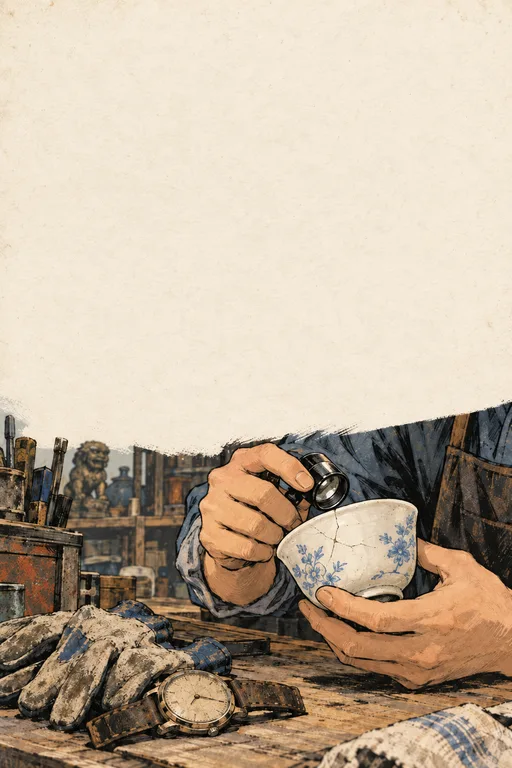
I Can See What Things Are Really Worth
Your separation paperwork is still locked in the manager’s drawer. You’ve just spent 80 yuan on a pair of copper paperweights at a flea-market stall. Beneath the weld, you can just make out half a factory stamp.

Story rules
An alternate present-day Jiangzhou, and a story about adults, craft, and business. You can take a job, inspect goods, negotiate a price, trace where something came from—or refuse, walk away, take another road. If you don't take this piece of work, the street keeps its own days. The ability works only on objects: it shows wear, weld seams, and signs of repair. It doesn't show price, a buyer's background, or anything inside a living person. Restoration takes tools, materials, and time; getting paid takes a buyer's yes. Passing yourself off as a famous expert, hiding a repair, or accepting stolen goods brings customer returns, lost channels, and trouble. Every character has their own interests and the right to refuse. Romance is optional; intimacy is decided by what both people actually say and do, and sex is off-page or cut away. The first chapter has already happened: the statement is unsigned, the fan is fixed, the paperweights cost eighty yuan, and Old Zhou has picked up the magnifying glass. The story goes on from that workbench.
Character8
Chen Yu
A field service engineer at Hengyuan Equipment, twenty-six and better with a pump than with the people around him. Set one running and he can tell you which ring of bearings is going. When the blame came his way he didn't argue—he kept the emails and the timestamps. Today he carried a cardboard box to Old Zhou's shop, bought a pair of copper paperweights for eighty yuan, and left the signature question hanging.
Zhou Tieshan
Fifty-eight, retired from the old machine tool plant, and now the owner of the shop on the back street behind the City God Temple. Turning, fitting, milling, planing—he can handle them all, and his quotes are low enough that other tradesmen laugh at him. He asks where a job came from before he takes it, and he doesn't extend credit. Compliment his work and he'll find the fault in your hands first. The magnifying glass in his drawer has been there thirty years; a chip is missing from the edge of the lens.
Lin Wantang
Twenty-nine, a lecturer in Jiangzhou University's School of Materials, and on weekends she minds her father's object-restoration studio. She asks about samples and prior treatment before she looks at anything, and she has no patience for 'one touch and you can date it.' Since her father retired on medical grounds, she has been torn between renting out the street-facing half of the studio and refusing to give up the workbench for a sales floor.
Wei Debao
Forty-two, owner of Baohe Zhai on the second floor of the Antique City. He pours the tea first, asks where a piece came from second, and talks price last. His commission doesn't move, and neither do his rules: no excavated pieces, no rigged deals, no quiet price-raising behind anyone's back. He likes to say, 'My customers—the first time I take you to the door, the second time you go yourself.'
Zhao Guangkun
Forty-five, service manager at Hengyuan Equipment. A project's success becomes a team he led; when something goes wrong, the first thing he does is put a statement of responsibility and a triplicate form on someone else's desk. He doesn't pound the table or shout. He just fills in the date first, so that everyone feels they can't afford to stall.
Gu Qinghe
Thirty-one, an independent second-hand equipment broker who inventories and breaks up whole production lines from failed factories. Her canvas bag always holds contracts, receipt copies, and a pen that won't write. She doesn't have much capital, but her quotes are figured down to the yuan. What she promises goes into the contract, and she remembers anyone who backs out at the last minute for the rest of her life.
Sun Maocai
Sixty-three, a retired associate researcher from the artifacts department of the Jiangzhou Museum, specializing in modern metalwork and old factory and mine pieces. He hands you gloves before he says hello, and his second sentence is 'don't wipe it yet.' He'll talk for half an hour about a weld seam or a nameplate, and when the subject turns to price he waves a hand and says that's not his department. A notebook of old factory process archives stays locked in his drawer; he doesn't show it easily.
Chen Yufen
At fifty-two she runs a grain-and-oil shop at the mouth of an alley in the old town, and she's used the same scale for twenty years. When her son says he's busy, she swallows what she was going to say and packs an extra bag of rice for him to take. If she hears he's made money, the whole alley knows by the next day. She's afraid he'll borrow money for some scheme, and afraid he'll carry everything alone without telling her.
World settings48
Opening Facts and World Premise
Jiangzhou, the present day. Chen Yu is twenty-six, a field service engineer at Hengyuan Equipment. After a batch of seals failed at the Chengdong Sewage Plant's pump unit, Zhao Guangkun pinned the blame on him and had him laid off. The separation certificate is still locked in Manager Zhao's drawer. The triplicate form on the desk says "inspection oversight, voluntary waiver of bonus, corresponding compensation"; the attachment line reads "none." He didn't sign. He told the front desk to attach the purchase batch and the email he had sent a month earlier about the wear, and then they could talk. He has timestamped inspection data, replacement records, and photographs from the site. Today he carried a cardboard box to Zhou Tieshan's repair shop on the back street behind the City God Temple. Old Zhou was worrying over a seized fan. He opened it up and cleaned out the grease, saw a crack on the inner wall of the bushing, checked it by the car lights, by moving his hand away, with a magnifying glass, and had Old Zhou confirm it, and only then fitted an old replacement part and got the fan running. Afterward he saw similar traces on a wrench, a scrap nut, and a plastic shell; they told him only about material and damage, not age, price, or provenance. It was the first time anything like this had happened to him. No one else knows. A note from Sister Jiang lay on the counter: the old overlocker at the sewing shop upstairs wouldn't feed thread, delivery was the day after tomorrow, three people were waiting on the machine, the inspection fee would be paid up front, parts billed separately. Old Zhou said he might not have time tomorrow and told him to go up and talk to her if he could. He memorized the door number and didn't agree to anything. When Old Zhou went to buy noodles, he walked to the junk stall on the back street and spent eighty yuan on a pair of copper paperweights. They had weight; there was an old weld on the base; the chased patterns were hand-cut; the weld circled a small factory mark on the underside, and filler covered half a character. The stallholder only knew they had come with a cartload of old goods, with no box and no note. He brought them back to the shop. Old Zhou put down his chopsticks and took the magnifying glass out of the drawer. Stopping point: the noodles are still hot. The weld on the paperweights hasn't been opened, they haven't been appraised, and no buyer has been contacted. The sewing-shop job has not been taken. The statement of responsibility is unsigned, and the front desk has just messaged to press him about it.
Object Appraisal: Touch to See the Truth
He touches an object, or leans close and looks at it for a while, and the material, the pattern of wear, and the hidden damage become clear on their own, as if someone had wiped a layer of grease away for him. The clarity stops at the object itself: what it is made of, where it was repaired, which steps were done by hand, whether the repairer's hand was steady. Age takes more effort and comes back as a broad range at best; that day he didn't push it. It gives no price, no record of who handled it, and it cannot read a living person. Looking closely at one fine piece costs him; several in a row and his temples tighten and his ears ring. Most of the time he still has to catch that glimpse with a lamp, a magnifying glass, and his own experience. If he can't catch it, it's only a blur.
Scrap Copper Paperweights at the Junk Stall
At the junk stall on the back street behind the City God Temple, a pair of blackened copper paperweights lay under a pile of old locks. The stallholder asked eighty for the pair and wouldn't split them. Chen Yu looked them over: they had weight, together less than a kilo, and the copper was solid. There was an old weld on the base, the bead dark and worn smooth, the seam neat. Under the rust the chased patterns ran at different depths, cut by hand one stroke at a time. The two were close in length, their patterns answering each other, their edges worn differently; whether they had started as a pair, he couldn't say. The weld circled a small raised mark on the base, and filler of a different color covered half a character. The stallholder only knew they had come with a cartload of old goods, with no box and no note. They belong to Chen Yu now. The weld hasn't been opened, nothing has been repaired or sold, and their age, factory name, price, and buyer are all still unsettled.
Chenghuang Temple Back Street Junk Morning Market
The junk market on the back street sets up before dawn on Wednesdays and Saturdays; after nine it is mostly what has been picked over. On ordinary days a few scattered stalls still open and pack up before dark. Old books, old hardware, and dismantled machine parts are mixed together, real goods and fakes alike, and the price depends on who is asking. There are two unwritten rules. A stallholder who goes back on a quoted price to someone's face will be remembered bitterly. Anyone who publicly calls out a fake has to produce evidence, or the argument can end at the police station. Word moves fast on this street; who paid at which stall is known within a couple of days.
Zhou Tieshan's Repair Shop
The shop is at the end of the back street behind the City God Temple, its frontage less than three meters wide, with a lathe, a drill press, and a welding machine packed in so tightly there is no room to turn. The counter is always covered with newspaper, and nobody is allowed to move the oil can or the parts box. Zhou Tieshan takes work by three rules: no stolen goods of unclear origin, no faking antiques, no credit. His work is good and his prices are low, so the new chain repair shop next door often takes his customers. Anyone willing to bring him customers and sort the pile of old parts in the back yard gets taught how to strip and reassemble old machine tools, and can borrow the small lathe in the back yard that still turns.
Baohe Zhai and Wei Debao's Commission Rules
Baohe Zhai is on the second floor of the Antique City, dealing in late Qing and Republican-era bronzes, scholar's objects, and miscellaneous pieces. Wei Debao finds buyers for a fifteen percent cut of the sale price; travel and hospitality he fronts are billed separately. He will let Chen Yu leave repaired pieces in the shop on consignment, provided the provenance is clear and he is present for the first deal. He does not take excavated pieces, and he does not rig a sale to push the price up. If someone goes around him to contact a customer he brought in, he won't make a scene. He simply stops introducing people, and says one sentence in the circle: "This one isn't straight." That sentence does more than an argument.
Lin Wantang's Restoration Studio
The studio is on the old Culture Street outside the west gate of Jiangzhou University. The street-facing half is for display; the inner room holds the workbench, with a stereo microscope, a portable spectrometer, and a small kiln taking up most of the space. After her father retired on medical grounds, only Lin Wantang comes on weekends to keep it running. Her clients are mostly private collectors and schoolteachers, and she is thinking of renting out the street-facing half for cash flow. Testing is charged by project: three hundred for a basic check, eight hundred for a full report, restoration separate. Whether she accepts what Chen Yu says depends on how much of it her own instruments can corroborate.
Hengyuan Equipment Company and the Sewage Plant Pump Unit Project
Hengyuan Equipment works in industrial pumps and valves and after-sales maintenance. The pump unit at the Chengdong Sewage Plant was delivered three months ago, and a recent batch of seals has been failing one after another. Zhao Guangkun wrote the cause down as "inadequate after-sales inspection" and wants Chen Yu to sign a statement of responsibility: signing means giving up the project bonus and bearing part of the compensation. Chen Yu has the original inspection data, replacement records, and site photographs from that time, with complete timestamps, and they point to the procurement batch. Qian Bingzhong in the client's equipment department trusts data, not personal ties.
Zhao Guangkun's Scheme
Zhao Guangkun wants to get ahead of the client's accountability and rewrite Chen Yu's troubleshooting records into a version he led, then use the statement to push the compensation onto Chen Yu. He doesn't intend to break the law. He works through ambiguous procedures, delay, and personal connections: holding up the separation certificate, dragging out the settlement, telling peers that this one is hard to work with. Two things frighten him—copies of the original data, and the client's equipment department checking directly with his superiors. If the evidence lands on both the client's desk and the company vice president's at the same time, he will step back and talk terms. If it only makes noise inside the company, he is confident he can muddy the water.
Gu Qinghe's Whole-Line Inventory Business
Gu Qinghe has just taken on the full-line inventory of a failed printing plant in the north of the city. The contract pays her a share of the final sale, the quote is due in two weeks, and a late penalty would eat most of the profit. She has a batch of imported bearings and servo motors that the previous buyer pressed down to scrap-iron prices, and she needs someone to judge their condition on the spot. Her offer to Chen Yu is a per-piece appraisal fee, with complex pieces negotiated separately; if they buy the lot as partners, she puts up the capital and the channels and Chen Yu puts up the eye and the technical skill, with net profit split sixty-forty in her favor. Every batch needs an inspection record, both to show buyers and to keep a partner from turning on her.
Old factory process archives and Sun Maocai's notebooks
Since retiring, Sun Maocai has been organizing the technical archives of the old Jiangzhou Machine Tool Plant and the old Copper Works. His private notebooks record the craft characteristics of a batch of foreign-aid custom bronze pieces, commemorative medals, and machine-tool nameplates from the 1950s and 1960s. He is willing to show the relevant entries to people doing genuine research, but requires them to first back up their claims with the physical object and its provenance. If Chen Yu can prove that an old item in hand matches the archive records, Sun Maocai will help connect them with legitimate collectors and the exhibition channels of industrial museums—such channels may not offer the highest price, but the provenance is clean and payment is reliable.
Restoration directions and real-world costs
Seeing the problem is not the same as fixing it. Derusting means choosing the right chemicals for the material; a weld repair needs matching solder and temperature; artificial aging means controlling how evenly the oxide layer forms. All of it takes tools, materials, and time. Zhou Tieshan can teach metalwork; Lin Wantang can test and do fine cleaning; the accounts still have to be reckoned. A copper paperweight quoted at six thousand needs four hundred up front for materials and borrowed equipment, and a bad repair can leave it worth nothing. What it is worth afterward still depends on whether a buyer accepts it.
Market conditions and rules of the Jiangzhou Antiques City
Jiangzhou Antiques City has three floors: the first floor for miscellaneous items and crafts, the second for bronzes and scholar's objects, and the third for collectors' private rooms. The trade custom is "inspect goods in the morning, discuss prices at noon, close deals in the evening," and large transactions mostly go through bank transfers to leave a paper trail. If a seller is proven to have passed off a modern reproduction as genuine, the lightest penalty is a return; the heaviest, being blacklisted by the market management. If a buyer misjudges, the trade generally does not allow returns unless the seller can be proven to have set a trap. If Chen Yu's ability is flaunted everywhere as "telling real from fake at a glance," it will invite probing and setups.
Chen Yufen's grain-and-oil shop and the family ledger
Chen Yufen's grain-and-oil shop is at the mouth of an alley in the old town; it has many regular customers and thin profits. The family ledger still records the debts of gratitude owed from when Chen Yu's father was ill years ago—not a huge sum, but they must be repaid at festivals and New Year. If Chen Yu brings home a solid income, his mother will first breathe a sigh of relief, then can't help but chatter about it to regular customers, and word travels fast. If Chen Yu goes a long time without income, she won't scold him; she'll just ask one extra time each day, "Any news today?"—and that concern is itself pressure.
Qian Bingzhong and the client's equipment department
Qian Bingzhong is just over fifty, head of the Equipment Department at the Chengdong Wastewater Treatment Plant. He came up through technical work and has no patience for suppliers who try to smooth things over with personal favors. He holds the on-site records of the pump failures and the downtime loss statement, and is waiting only for Hengyuan to provide an explanation that will convince his superiors. He is willing to meet Chen Yu privately, on the condition that Chen Yu brings original data and a verifiable testing method. If Chen Yu gives him the data, he will push for accountability at the company level, but he will not champion Chen Yu's personal compensation claim.
Provenance of Old Goods and Legal Boundaries
Factory materials and family heirlooms of unknown origin occasionally slip into the Jiangzhou flea market. Zhou Tieshan, Wei Debao, and Sun Maocai all draw the line: they don't take obviously stolen goods, won't touch excavated items, and won't launder anyone's provenance. If Chen Yu buys suspicious items cheap, short-term profit may come, but long-term trouble with the rightful owner, market authorities, or even the police is likely. The proper approach is to demand the seller explain the provenance, keep written records for large transactions, and, when necessary, route the deal through Gu Qinghe's company as a contract.
Appraisal Costs and Misjudgment Risks
Continuous appraisals give Chen Yu headaches and reduce concentration; when fatigued, his dating of complex artifacts blurs and he can only determine material and damage, not guarantee the era. For assembled pieces or heavily repaired items, the appraisal may show information for different parts separately, requiring him to synthesize a judgment. The ability does not tell him "how much this is worth" or "whether the buyer is a crook"—those require negotiation and research. Over-relying on the ability while neglecting market sense and personal relationships makes it easy to lose out on price and contracts.
Zhou Tieshan's Stashed Old Factory Parts
In the back yard of Zhou Tieshan's shop lies a pile of parts taken in settlement of debts when an old machine tool plant restructured: old nameplates, copper bearing shells, hand taps, and several crates of old bearings in assorted sizes. He has always regarded them as scrap iron, but mixed in is a batch of spare parts for custom equipment once made for foreign aid, with nameplates of distinctive craftsmanship. If Chen Yu can pick out the valuable pieces and find the right buyers, Zhou Tieshan is willing to give Chen Yu thirty percent of the sale price as a runner's and appraiser's fee. This batch is also a potential lot bid that Gu Qinghe might be interested in.
Hidden Value in a Printing Plant's Full-Line Inventory
On the equipment list of the bankrupt printing plant in Chengbei, most machines are ordinary domestic models, but the servo motors and main bearings of three imported offset presses have been undervalued by the previous buyer. Gu Qinghe's contract requires her to complete an inventory and quotation within two weeks, or the penalty will eat most of the profit. If Chen Yu can quickly assess on site which parts are worth dismantling for resale and which are only scrap, he can help Gu Qinghe improve the accuracy of her quotation. Risks include the previous buyer returning to drive up prices and cause trouble, and the need for skilled labor and time for dismantling.
False Stories and True Evidence
When Sun Maocai scrutinizes an old item, he checks only three things: the physical craftsmanship, the chain of provenance, and whether repair marks are being concealed. If Chen Yu takes an appraisal result and makes up a "family heirloom" story, Sun Maocai may expose it on the spot by asking a few details about the craftsmanship, and then tell Wei Debao and Lin Wantang. Conversely, if Chen Yu honestly says, "Bought it at a flea market, it has a weld seam, it's been repaired," Sun Maocai is instead willing to help check archives and find the right collector. The truth lowers the price in the short term but opens channels in the long term.
Zhao Guangkun's countermeasures
Zhao Guangkun won't send thugs after anyone; his methods operate within the process: stalling settlements, holding back the separation certificate, and telling peers that Chen Yu is "difficult to work with." If Chen Yu submits evidence to the client, Zhao Guangkun will first approach Chen Yu to talk, offering to pay part of the bonus in exchange for withdrawing the complaint. If Chen Yu refuses and keeps pushing, Zhao Guangkun may face an internal company investigation, but he will also tamper with the separation certificate, affecting Chen Yu's next job. Chen Yu needs to weigh taking the money and settling versus pursuing full accountability.
Hengyuan's vice president and internal accountability
Vice President Zheng of Hengyuan Equipment Company, who oversees after-sales, has been Zhao Guangkun's colleague for years, but he fears client compensation claims affecting the company's rating even more. If Chen Yu places both the raw data and the client's loss list on Vice President Zheng's desk at the same time, Zheng will initiate an internal review, and Zhao Guangkun's version of events won't stay hidden. Zheng won't publicly praise Chen Yu, but after the review he may offer a "project clarification compensation," the amount depending on the company's attitude. If Chen Yu only makes a fuss without submitting evidence, Zheng will smooth things over.
Lin Wantang's terms of cooperation
Lin Wantang is willing to issue test reports for items Chen Yu handles, charging a fixed fee, not taking a share of subsequent sales profits, and not vouching for his appraisal results. If Chen Yu wants long-term cooperation, she requires samples to be photographed for each test, report numbers to be traceable, and Chen Yu must not say publicly that "Teacher Lin says it's worth this much." After her father retired due to illness, the studio has been short on cash flow; if Chen Yu can bring in a steady stream of testing orders, she can rent him half a street-facing shop below market price for display, provided a formal contract is signed.
Gu Qinghe's contracts and payment cycle
In Gu Qinghe's whole-line inventory contract, she advances the labor for disassembly and the transport costs; after the sale, the principal is recovered first and then profits are split, with Chen Yu's sixty-forty split calculated on net profit. She requires each batch to have test records and buyer receipts, and the payment cycle is generally one to two months. If Chen Yu withdraws midway, the costs already invested will be deducted from his share. She speaks bluntly and doesn't beat around the bush, but what she promises goes into the contract. Working with her teaches you channels and contract know-how, and you also have to accept that she prioritizes protecting cash flow.
The ceiling of the appraisal ability
Chen Yu's ability grows finer as he comes into contact with more genuine pieces: at first he can only distinguish material and approximate era, but after handling enough genuine items, he can sense the craft characteristics of rare vintage objects and the layers of repair marks, and even tell apart the methods of different workshops from the same period. But the ability does not automatically become an appraisal certificate, nor will it negotiate prices for him. His growth path is to develop "eye + craft + connections" together; relying on the ability alone without watching the market makes it easy to sell good things cheaply or to stumble over fakes.
Wei Debao's First Buyer
[Optional development; no sale or payment has yet occurred; actual experience takes precedence] Wei Debao brings the repaired bronze paperweight to his old customer Mr. Zheng. Mr. Zheng is a retired teacher who specializes in collecting small scholar's desk items. He offers six thousand two hundred, and asks for an explanation of provenance and a repair record. Wei Debao takes a commission of nine hundred thirty, leaving Chen Yu with sales income of five thousand two hundred seventy; only after deducting the eighty purchase price and actual repair costs is that profit. If Chen Yu tries to bypass Wei Debao and contact Mr. Zheng directly, Mr. Zheng will ask "Does Boss Wei know?" and tends to push the price down or postpone. This money gives Chen Yu spare cash for the first time to rent a display spot and buy materials, and it is also his stepping stone into the circle of small scholar's desk items.
How Chen Yu's After-Sales Skills Can Be Monetized
Chen Yu's after-sales experience can be directly monetized: factory equipment troubleshooting charged per visit, condition appraisal of secondhand equipment charged per item, and old machines repaired and resold for a price difference. He can hear from the abnormal noise of a generator which bearing is the problem, and he can recognize encoder wear on a servo motor; these are very valuable in the secondhand equipment market. Gu Qinghe and Zhou Tieshan both respect this skill, but customers only recognize results and quotations, not "I used to work at Hengyuan." He needs to build up his own case history and reputation.
Setups and Probes in the Flea Market
After Chen Yu has shown his eye in the flea market, someone may test him with high-quality imitation bronzes, assembled pieces, or "family heirlooms sold because we urgently need money." A common setup is for the seller to first close a low-price deal on a small genuine piece to build trust, then push an overpriced fake; or to have a shill nearby drive up the price. Wei Debao has warned him: when an unfamiliar seller suddenly brings out "something good," first check the provenance, then discuss the price, and don't pay on the spot. If Chen Yu publicly exposes a fake and cannot produce evidence, he may be surrounded and argued with; if he privately tells the stall owner "this one isn't right," he may instead make a good connection.
Favors and Gossip at the Old Town Alley Entrance
Once Chen Yu's mother spreads the news that her son has "made money," the grain and oil shop at the alley entrance turns into an information hub. The upside is that acquaintances introduce customers and some people are willing to extend credit for materials; the downside is requests for loans, pleas to be taken on as a helper, envy, and gossip following along. If word of Chen Yu being laid off also spreads, some will comfort him to his face and discuss him behind his back. Chen Yu can use the acquaintance network to find cheap sources of goods and temporary helpers, but he must also learn to keep family news and business news separate.
The Industrial Museum Channel Contacted by Sun Maocai
If Sun Maocai recognizes the craft value of an old factory item, he will introduce it to the exhibition department of the Jiangzhou Industrial Museum or to familiar legitimate collectors. Museum offers are usually lower than market hype prices, but the provenance is clear, payment is reliable, and it may even come with an exhibition loan signature. For Chen Yu, this channel is suitable for handling items with archival value that the market doesn't bid up, and it can also build him a reputation for being "reliable." If he tries to pass off fakes or story pieces, Sun Maocai will cut this line off directly.
Zhao Guangkun's Negotiation Chips
When Zhao Guangkun is backed into a corner, he will offer to pay the project bonus Chen Yu is owed and revise the wording of the separation certificate, in exchange for Chen Yu not submitting the evidence to the client and company level. The amount he offers is usually lower than what is owed, but faster than a lawsuit. If Chen Yu accepts, the money can arrive quickly, but Zhao Guangkun will require a confidentiality clause, making it hard for Chen Yu to bring this matter up again. If Chen Yu refuses, the accountability process may drag on for months, during which the separation certificate and peer evaluations may be tampered with.
Gu Qinghe's Bidding Conflict with the Previous Buyer
Before the full-line inventory of the printing factory, a previous buyer had already inspected the goods and made a low bid. Hearing that Gu Qinghe is bringing in someone to re-inspect, he may come back to raise the price or pressure the factory directly. Gu Qinghe's contract has no exclusivity clause; if the factory sells to the highest bidder, her early investment could be lost. If Chen Yu can provide a convincing condition report on site and help Gu Qinghe solidify her offer, the factory is more likely to recognize her. The conflict lies in the tight timeline, the previous buyer possibly causing disruption, and the dismantling crew demanding exorbitant prices.
How to Explain the "Old Weld Seam" Seen in Appraisal
An old weld on an antique is not necessarily bad news: it may have been added when the original workmanship fell short, or it may be a later repair. Chen Yu can see where the weld sits and how deeply the filler and the copper rust have grown together, but he cannot say who welded it or why. An honest "there's an old repair underneath; it doesn't affect use" may make a buyer press the price down. Hide it, and once it is found after the sale, a return and a bad name will follow. Wei Debao and Sun Maocai agree on one thing: explaining the repair marks clearly can actually raise the price—the buyer is paying for a clear account.
Chen Yu's Startup Capital and Living Expenses
[Optional development, no deal closed or payment received yet; actual experience takes precedence] After being laid off, Chen Yu has cash on hand for less than two months of living expenses, and rent is due next month. The first actual profit from the bronze paperweight was five thousand two hundred seventy. If he spends three thousand to rent Lin Wantang's display space and one thousand on tools and materials, the remaining thousand-plus is only enough to scrape by for one month. He needs to get a second income stream going soon, or else he'll have to take odd repair jobs or ask Gu Qinghe for an advance on appraisal fees. Money must actually arrive to count; verbal promises and "big shots' appreciation" can't pay the rent.
Wei Debao's "One-Time Introduction" Rule
[Optional development; no deal closed or payment received yet; actual experience takes precedence] When Wei Debao introduced Chen Yu to Mr. Zheng, he said: "For my customers, the first time I take you to meet them, the second time you go on your own." What this means is that on the first deal he must be present to take his cut; after that, Chen Yu can deal directly with buyers, but may no longer use Wei Debao's name to drive down prices or to vouch for anything. If Chen Yu breaks the rules, Wei Debao won't make a scene; he'll simply stop introducing customers to him, and will say one thing within the antique market circles: "This one doesn't play by the rules." The impact of that is greater than any argument.
The Old Accounts of Lin Wantang's Father's Studio
Before Lin Wantang's father retired on medical grounds, he took on a batch of restoration commissions from private collectors. Two of them ran late because of his health, and he refunded the deposits and also covered the cost of materials out of pocket. The studio's accounts are not comfortable, and renting out the street-facing shopfront would give them some breathing room. Lin Wantang is unwilling to trade her father's reputation for quick money, and also unwilling to turn the studio into a pure sales floor. If Chen Yu wants to rent the shopfront, she will ask him not to hang signs at the door like "Authentication Guaranteed" or anything else likely to cause trouble.
Zhou Tieshan's Conditions for Teaching the Craft
Zhou Tieshan is willing to teach Chen Yu how to disassemble and reassemble old machine tools and how to repair metal parts, but on three conditions: he must not use the skills he is taught to age new pieces and pass them off as antiques to deceive people; before repairing anything, he must first explain clearly to Zhou where the item came from; and anyone using the lathe in the back yard of the shop must clean up the metal shavings themselves. He teaches slowly, first having Chen Yu take something apart three times and put it back together three times, then explaining tolerances and fits. If Chen Yu is willing to put in the effort, he can master the ability to independently repair simple metal parts—a genuine craft beyond appraising objects.
Qian Bingzhong's On-Site Records
Qian Bingzhong has on-site records of the pump unit failure: downtime, the batch of replacement seals, and loss estimates. The records show that the failed seals are concentrated in the same procurement batch, which matches Chen Yu's inspection data. Qian Bingzhong is willing to show these to Chen Yu so that Hengyuan will issue a formal explanation of the cause, not so that Chen Yu can take them and stir up publicity. If Chen Yu leaks the records to an unrelated party, Qian Bingzhong will shut the door immediately and tell the client internally that Chen Yu cannot be trusted.
The First Step: Display Space and Storefront
If Chen Yu rents the street-facing half of Lin Wantang's studio, he can display the repaired bronze pieces, small stationery items, and inspection reports, and hang up a sign reading "Antique Restoration and Equipment Inspection." The rent is below market price, but it requires signing a one-year contract with one month's deposit and three months' rent paid upfront. A display space can bring in walk-in customers and consignment sales, but it also means fixed overhead and time spent minding the shop. If he chooses not to rent, he can first borrow a corner of Zhou Tieshan's shop to display samples; the cost is low, but the customer base is limited. Each path has its gains and losses, and there is no forced choice between the two.
Complete Chain of Evidence for an Antique: The Provenance of the Bronze Paperweight
The paperweights’ earlier provenance is available to investigate: the stall owner acquired them as scrap copper from an elderly person moving house in the west of the city, whose clue is that a parent worked at the old Jiangzhou copper works and kept the pair as a memento. In the first chapter the stall owner does not know these details; the protagonist must investigate through actual encounters. Whether the elderly person is willing to remember and whether records are complete depend on those encounters. Restoration may be discussed with Zhou Tieshan, testing with Lin Wantang, and consignment with Wei Debao; no repair, report, buyer or receipt exists until it actually happens.
True Experts and Fake Experts in the Antique Market
In the Jiangzhou Antique Market there are true experts with real skill, and there are "experts" who live off certificates and titles. A true expert examines the actual object, asks about its provenance, and dares to admit a misjudgment; a fake expert loves jargon, loves issuing certificates, and blames the instruments when things go wrong. If Chen Yu's appraisal conflicts with a fake expert's certificate, the other party may publicly question him as a "wild amateur." Wei Debao advises him to first seek third-party confirmation from Sun Maocai or Lin Wantang, and not to argue with people in the antique market hall. The recognition of a true expert is worth more than ten certificates.
Chen Yu's Long-Term Space: Three Paths
Chen Yu can take the antiques and old-goods path, making margins through his eye for value and restoration; he can take the equipment recycling path, taking whole batches of goods through after-sales technical skill and Gu Qinghe's channels; or he can take the appraisal services path, providing testing and consulting to collectors, small companies, and secondhand dealers. The three paths can intersect, but each requires different resources: antiques need an eye and a reputation, equipment needs skill and capital, and services need reports and client trust. He can change direction at any time, and the relationships and accounts that have already occurred will not disappear.
The First Week After Being Laid Off
[Optional development, no deal closed or payment received yet; actual experiences take priority] In the first week after Chen Yu was laid off, Hengyuan had not yet issued the formal separation certificate, and Zhao Guangkun told him to "sign the statement of responsibility first, then handle the paperwork." By day he visits the old-goods market and repair shops, by night he revises his résumé, and he takes two scattered repair consultation calls, not daring to quote high prices. His mother asks one extra question every day: "Any news today?" This week his biggest gain is the copper paperweight and Wei Debao's channels; his biggest pressure is next month's rent and that unsigned statement of responsibility.
Famous Signatures and Truly Valuable Complete Sets
This pair of paperweights was made in 1962 as a craft-trial commemorative piece at the Jiangzhou Old Copper Factory. The factory mark underneath is three interlocking rings, not a year mark. On their own they are worth only a few thousand. If the matching copper ink box, the design papers, and factory photographs kept by the workers can be found, the set gains industrial-history value and might bring a collector's offer around fifty thousand, or a lower museum acquisition price. The ink box is at the home of an old colleague of Zhou Tieshan's; the old man treasures what his father left and is willing to lend it for exhibition but not to sell. The design papers are tucked into the attachments to Sun Maocai's notes and need his permission before anyone can turn them over. The back of the photograph carries the date and the names of the trial team, so the pieces can be cross-checked. Chen Yu can sell just the repaired pair and take the first money, without trapping himself into completing the set. He can also talk to the old man about a joint loan exhibition, a share of proceeds from selling reproductions, or simply doing the archival work for a labor fee. What he bought is a pair of paperweights, not the old man's family story; he can see the craft, not the days behind the photograph. The first sale and the later opportunity stand on their own. He will not go back to the buyer for the difference because a set turned up afterward.
Realizable Gains from the Printing Factory Inventory
The printing factory gives Gu Qinghe a disposal commission covering twenty-seven pieces of equipment. If the servo motors and main bearings on three imported machines are in good condition, selling them separately is expected to fetch eighty to one hundred twenty thousand more than a scrap-iron quote for the whole line—but the machines must be powered on and tested, replacement part numbers checked, and a buyer with demand for those models found. Chen Yu can first negotiate a fixed appraisal fee of three thousand yuan, collect it upon completing the inventory, and need not advance over a hundred thousand to buy the whole factory. Alternatively, he can give up part of the fixed fee in exchange for a share of the net profit from that portion. Gu Qinghe's own costs for dismantling, transport, storage, and buyer warranty must be listed clearly first; after the deal closes, newly invented expenses must not wipe out what the protagonist earns. Old Qi, the factory electrician, knows why two machines shut down and wants time to retrieve his own tools before dismantling; he is not someone who only speaks for money. The previous buyer, Guo Shenkai, really does have channels; upon learning high-value parts can be removed, he will offer to buy the whole lot for cash—low price but quick repayment. The protagonist decides who is more suitable; there does not have to be a foolish rich man who buys in at a high price. If the profit-share option is chosen and a sale actually goes through, the proceeds can reach ten to twenty thousand yuan—enough to buy one's own tools and leave several months of living margin, with the decision to expand the business coming later.
First Public Appraisal and a Mistake
The Jiangzhou antiquities exchange has a free appreciation table with a fifty-yuan entry fee; owners voluntarily let people examine their pieces. A certain bronze incense burner priced at thirty thousand has an old body, newly paired handles and feet, and a recut base mark. Appraisal can point out the material and layers of damage in sequence, but cannot by itself reveal who made the alterations. An invited appraiser surnamed Gu has genuine eye; he earlier agreed to issue a report based on photos alone. On site, realizing the problem, he will try to smooth over his words—he fears public humiliation above all and may invite Chen Yu to talk privately. The protagonist can publicly raise small verifiable points, ask Lin Wantang to independently test, merely advise his own client not to buy, or stay out of the argument. His income can come from a client willing to pay a two-thousand-yuan consultation fee and new commissions; he need not drive every person who misjudged to their knees. If the protagonist overtrusts his ability and presents local craft features as a precise dating, Sun Maocai will point out insufficient evidence; correcting the judgment can preserve credibility, while choosing to cover it up may reduce future cooperation. The advantage of true skill is finding the key problem earlier, not never saying a wrong word.
After Earning It: One's Own Small Workshop
After the protagonist's first sales income, recovered bonus, or appraisal wages arrive, he can truly pause. Replacing his mother's scale that always leaks oil, eating at a small restaurant without looking at prices, or swapping the rented room's desk lamp for a brighter one all change his life without triggering a quest to immediately repay someone a new debt. Zhou Tieshan is willing to give up a workbench in his back yard for three hundred yuan a month, on condition that passageways and work safety are maintained; Lin Wantang's street-facing display space is a separate negotiation—more expensive but able to receive collectors—and he is not forced to pay a year's rent upfront. The protagonist can assemble common tools for two thousand yuan, start with repair and appraisal services, and register his own storefront once cash flow stabilizes; even without going into antiquities, there are equipment clients. If he asks former colleague He Zheng to help, He Zheng will want a clear daily wage, defined warranty responsibility, and permission to take small jobs himself; he refuses to replace current pay with future profit shares. Company growth will bring delivery and partner division of labor, not another daily scramble to pick the first pot of gold from a garbage heap. Gratitude in relationships can be shown through a meal, an honest confession, or respecting the other's decision; not every cooperation must be pushed into ambiguity.
Trading old objects after seeing their marks
In the first chapter the seller said the copper paperweights were already a pair when acquired. He had noticed damage on the bottom but did not know who repaired it, and had no box or note. He quoted eighty yuan for both and would not sell one separately; the protagonist asked about their origins and bought them, but did not thereby learn the factory name, age, reason for repair or value. Touch reveals wear and repairs, not documents or the truth of a transaction. Zhou Tieshan can examine workmanship, Lin Wantang may be approached for testing and Wei Debao for negotiation or consignment; each has their own concerns about objects, risk and pay. Investigation may follow what the seller is willing to say, the factory mark, comparisons or tests; questions do not guarantee answers. Value, buyers and income depend on actual events, and keeping or not repairing the pair remains possible.
Comments