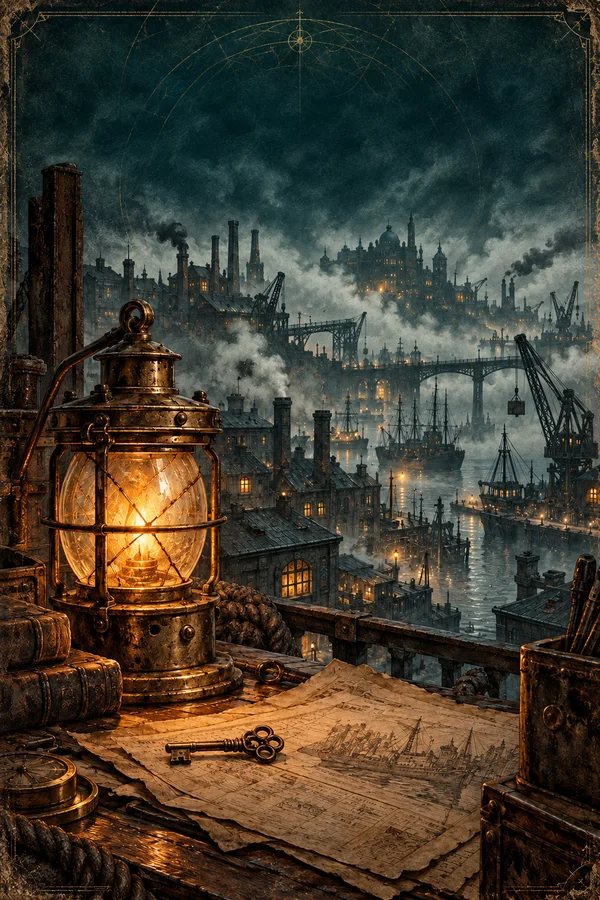
Fog Harbor Relics Bureau
Gu Xun has been dead six months, yet his lamp-watching allowance is still being collected—and the proxy line on the pay book is in your name. You only meant to settle one account, but you carried home an old lamp that refuses to go out.

Story rules
An adult industrial mystery. Xu Zhi'an is twenty and every character is an adult. Cooperation, trust, and affection happen only when all sides are willing and the terms are clear; intimacy stops at the door and the scene cuts away, and sex is left off the page. Already established: he collected only his own nine dollars in wages, and Gu Xun's allowance remains at the counter. The old lamp is covered by a heavy coat; he has not taken on the lamp-watching or relic duty, nor borrowed any power from it. The male infant on the old ticket is not yet proven to be him. The story continues from this night in the rented room and does not replay the pay collection or the opening of the box. Characters know only what they themselves have seen and heard; secrets do not become the protagonist's knowledge through narration. You may investigate the accounts, hand over the object, return to the docks, or attend to your own life first.
Character12
Lin Yanhui
Thirty-six, head of the Sixth Office at the Relics Bureau, previously a marine damage surveyor for an insurance company. A follow-up sheet is nailed behind her office door: whenever an object's recheck is still outstanding, she marks it in pencil, and only replaces the sheet when it is full. One rib of her umbrella is broken and held with copper wire. She asks how many people were on scene and how many came out before she discusses whose fault it was; concealment angers her more than a mistake. She requires others to put the cost in the record. She herself owes the mutual aid society a medical loan, and the corner of the follow-up sheet carries a single figure with no repayment date. Auntie Xie knows her; the protagonist has only heard her name.
Yuan Sheng
Twenty-seven, a nurse at Gray Bay Hospital who works Sixth Office scenes in her off hours. Three pottery shards live in her white-coat pocket, each penciled with a date and a temperature; she soaks them in warm water before use. The flowerpot on her windowsill always goes dry when she is on night shift. She speaks softly. When someone is putting on a brave face, she picks the harshest line and throws it back at them—then comes back and changes the dressing properly.
Meng Zhao
Twenty-four, a port handover clerk. His brass steelyard weight is wrapped in an old handkerchief and tucked in his coat's inner pocket, where it taps softly against his ribs as he walks. He remembers money better than names; anyone who owes him twenty cents will not get away. His laugh is loud, but when it comes to signing and owning the account he drags his feet, asking first, “If I sign, whose is it?” He and the protagonist have met around the docks, though not yet at a level where they could trust each other with their lives. The closer his father's old warehouse case gets, the more he fears that innocence and skill can keep only one.
Han Shuo
Thirty-one, a field officer with the Sixth Office. He is tall enough that his shoulders clear a door frame before the rest of him. A short wooden door bar rides in his pack's side pocket, worn smooth and bright. While waiting for people he likes to shim a crooked chair leg level, and says nothing about it afterward. Whenever a lockdown comes up, he always asks whether anyone is still behind it and whether there is a second door. Most days he says fewer than ten sentences; repairing tables and chairs comes easier to him than comfort. He has not yet spoken formally to the protagonist.
Shen Yanzhou
Twenty-two, a copyist at the Shiqing Printing House, with a ring of blue that never washes out from between his fingers. He carries two blank glass negatives and a small bottle of his own tide-line ink, its mouth sealed with wax. He gives the conclusion first and then goes back for the reasons, and halfway through he often corrects himself. He wants examination to be cheap enough for ordinary people to use; when he is short of money he takes commissions from the merchants' association, and does not quite dare tell his companions. He cannot read minds, and he cannot recognize the person behind a scheme at a glance.
Chen Du
Forty-three, head of the Boatworkers' Mutual Aid Society. His right foot is short two toes, and when he walks fast he veers left. A folded stack of IOUs lives in his trouser pocket, their corners furred; when a family's child falls ill he pulls one out. His voice carries across the docks, and he agrees quickly. When something truly cannot be done, he dredges the words up slowly, and his own face darkens first. He hopes the next generation will not have to trade their lives for a meal.
Yu Tan
Thirty-three, a director of Silver Bay Shipping. She wears a dark suit even into the shipyard, and takes off her white gloves to tuck them into her ledger. She opens a negotiation with “How long do you need, and how much do I carry?” She can order a ship abandoned in fog, and the next day fold the rescue voyage into the freight rate. The return box traveled on a Silver Bay cart; no one has yet asked whether she looked inside. When accused of chasing profit she does not pretend to be selfless—she pushes the loss sheet across and lets people see for themselves.
Mo Jia
Twenty-five, a lamp master of the Lamp Delivery Society, who lays out the dead and returns old belongings to their families. Entering a house of mourning, she first brings a basin of warm water for people to wash their hands, a white cloth over the rim; she sings saltwater songs herself, starting very softly, pausing when she reaches a place name. Usually brisk, she grows sharp when old matters of Little White Bay come up—and when the sharpness passes she goes back and empties the basin. Some in the society think she speaks too readily for the Relics Bureau.
Lu Huaisheng
Fifty-seven, owner of the Countercurrent Collection Hall, from a shipowner family. He speaks slowly and habitually offers tea first. The ground-floor gallery is free; the key ring for the basement hangs at his own waist. The family of a tailor's measuring rule has come to ask for it three times; each time he poured fresh tea and did not change his answer. He believes he understands relics better than any public institution, and he will not admit that keeping things back is reluctance to let them go.
Auntie Xie
Fifty-one, owner of the noodle shop on Salt Street, real name Xie Sulian, called Auntie Xie by the neighborhood. A sleeve guard sits on her left wrist, and the web of her hand has a yellow callus from the long-handled ladle. She keeps stirring the pot while she scolds someone, and when the scolding is done she still adds an extra ladle of soup. Her daughter is on the mountainside preparing for nursing school; the fee notice is pressed under the soy sauce bottle and never mentioned to customers; all she does is wipe down the price card for the cheap late-night noodles and write it out again. She knew Xu's mother, and she has known Gu Xun for decades. What is inside the old lamp, she does not know.
Qin Bo
Twenty-nine, a liaison for the Nameless Contracting Society. His clothes are always clean, his cuffs free of oil spots. He draws a blank name card from inside his coat and lets the other person write what they most want to trade for; he does not interrupt while they talk, and waits until they name what they lack most before quoting a price. He once took a dangerous short contract for his sister's medical fees, and later learned to apply the same method to other people. Every month his sister sends dried scallops by ship. He accepts them, and writes back only “Enough.”
Wen Ying
Nineteen, an apprentice mechanic at the water-purification tower. She taps bearings with a brass rod from her tool bag, reading the wear in the echo more accurately than a gauge. She wears men's work clothes with the cuffs rolled three times, and fresh scratches cross the back of her hand. If anyone tries to put a relic into a machine, she gets in their way first. Her brother is listed as missing in the Broken Dike memorial ledger, and the family received only a small temporary subsidy. When compensation papers come up she talks faster and faster; when she reaches her brother's employee number she stops and bends her head to wipe the brass rod.
World settings90
Letters, Lamps, and Old Ledgers After the First Chapter
Xu Zhi'an is Xu Zhi'an, twenty years old, a temporary cargo handler on the Fog Harbor docks. His father works with the ship-repair crew at the outer harbor; his mother sews for people on the mountainside. He rents one room on the second floor of a Salt Street house, and he is eleven night shifts short of the recommendation his foreman would write to make him a regular worker before winter. Gu Xun, in life, was a pilot at Pier No. 7. He taught the boy knots, and once blocked a carter who tried to cheat him into carrying wet sand. The old man died half a year ago; the register says sudden heart failure. Today Xu Zhi'an went to collect nine nights' pay, and the cashier pushed out an extra brown-paper packet: a month's lamp-watching allowance, twelve dollars. The collection column of the pay book said Gu Xun; beneath it, “collected by Xu Zhi'an,” in handwriting that was not his. June, July, August—every page he turned had it. He took only his own nine dollars. The allowance stayed at the counter, and the old ledger clerk kept the original slip. The old clerk would say only that the consolidated ledger had been sent down from the north. The cargo handler waiting behind him asked whether, if Old Gu's slot came open, there might be one more regular place. The cashier did not answer, except to say to ask the shift office. At the noodle shop, Auntie Xie told him that Gu Xun's coat had come back with a ship only a month after the burial, the comb in its pocket still whole. A few people had put the funeral together, and one of them had never come in for a bowl of noodles since. At the Salt Street returns room Xu Zhi'an identified the box and signed only for temporary custody: a gray wooden box, a whitened lead seal, a waybill reading “For Gu Xun,” the ink in the recipient column newer than the cargo number. Inside were a cracked-shade brass lamp, a letter addressed to him, and a stub of a ticket from twenty years ago. The letter said not to sell the lamp, and to take it to the Relics Bureau if he was willing; if not, they could come and fetch it. “I'm not asking you to take my post.” The second-to-last line of the old ticket read “male infant of the Xu family, mother present, transferred at West Slope.” It matched his age and his family's move, but the ticket did not carry his name. The old ticket seeped water in his hand, and a small patch of gray-white light came up inside the lamp's shade: small muddy shoes, rough hands lifting a child high, a voice saying “Last shift.” He did not answer. He covered the lamp with his heavy coat, and the gray light and the water both stopped. Auntie Xie came and asked whether he had promised anything; he confirmed he had not. The lamp went back into the box, the coat still over it, and the two of them meant to ask Lin Yanhui in the morning. They had not yet left the room. By old custom the lamp-watching post was two people to a shift: one kept the lamp, one walked the dike. In the consolidated ledger, only Gu Xun's name had carried the responsibility these six months. The transfer slip named Gu Xun as the box's receiver; the sender's column had been rubbed out, half a surname left. Who the second person was, and who erased the name, remained unknown. The northern ledger, the proxy-collection handwriting, and the recipient column on the return box were three separate lines. Whether the male infant on the old ticket was him had also not been proven. At present he is in the rented room; Auntie Xie is with him; the lamp is in the box under the coat; the old ticket and the transfer slip lie on the table; the letter home is half written.
Year One of the Sea Debt and Old Coastal Trades
One hundred and twenty-seven years ago, when the first great tide went out, the people of the port found that the things the dead had used every day were beginning to do their work by themselves. A ferry pole dipped itself into the water; a carpenter's plane shaved a door at midnight; an old pot on the stove kept its warmth for night workers who never came home. Those who finished the dead's work for them gradually learned to borrow a little of the tool's skill. Those who seized or burned the implements often turned one household's affair into an accident for half an alley. Every port calls that year Year One of the Sea Debt. The almanacs were printed as before; the relic ledgers opened a separate column, recording how many years of sea debt had passed. Some say that year was a rumble from the sea floor, others that the thing which kept the tide had gone. In the earliest rescue ledgers of the three ports, most names are written in variant dialect forms, and no family has yet pieced them all together.
Life Above and Below Copper Ridge Mountain
Fog Harbor is wedged between Copper Ridge Mountain and Twin Bays. The reservoir, the school, and the harbor affairs office sit at the summit; textile mills, the night school, and rows of lane houses cover the mountainside; the docks, fish stalls, and old dike lie in the lowland. Seven tide gates each govern a stretch of waterway, and dockworkers know their shifts by the gong at the gate: the first call to work, the second to change shift, the third to knock off. The upper city stays dry, but coal, water, and cargo still have to be carried up from the lowland; lowland children learn to read the tide before they learn to read shop signs. Under the arcades are stalls selling noodles, mending shoes, and writing letters; the temple yard hosts opera on festival days and dries nets on ordinary ones. Xu Zhi'an grew up in this quarter. He knows the streets and the faces, but he has not yet understood the old duties that are still on shift in the fog at night.
The Difference Between Black Tide and White Fog
White fog is condensed seawater mixed with the residue of relics; mostly it makes direction and sound go wrong. The Black Tide is different: several unfinished duties tangle together, and it produces the same kind of accident over and over. Before the Black Tide arrives, nearby implements often urge contradictory things—a lifeboat bell calls people aboard while a platform sign insists passengers get off. At the scene, look first for the conflict of duties and for beneficiaries who are still alive, then take it apart piece by piece through lockdown, evacuation, and fulfillment. No chant will put the whole city back the way it was. After the tide goes out, the collapsed houses, the broken food supply, and the injured are still there; a lamp flaring once does not mean daily life has been reconnected.
Pier No. 7
Pier No. 7 reaches from the end of Salt Street into the inner bay, and retired steam pilot rails still lie under its wooden deck. The deck was widened twenty years ago to let the new freighters berth; the old rails were never fully removed, and at low tide their copper teeth show through the gaps. By day the pier unloads sugar, coal, and frozen fish; by night watchmen and temporary ticket inspectors trade shifts. Gu Xun used to live in the lamp-watching room behind the pier. After he died the door was rekeyed, and the lighting work was divided among ordinary watchmen. The old connecting path east of the waiting shed is closed, though the inspection channel still runs under the pier. The cargo office and the returns room are separated by Salt Street, and waybills often arrive first while the goods come a day later. Xu Zhi'an knows the current cargo numbers; the abandoned rails and the old lamp-watching rules, he knows much less.
The Soup Noodle Shop Under the Arcade on Salt Street
The arcade pillars on Salt Street habitually gather white salt. Before a typhoon, each household numbers and takes down its door planks so they will not be put back wrong the next day. Xie Sulian's shop sells radish-and-beef-bone soup, fishball noodles, and oyster cakes; regular night-shift customers can keep a three-day tab, and at the end of the ten-day period they get an earful. Gu Xun used to sit on the last stool by the stove, always complaining there was too little meat, always turning his bowl a full circle when he finished. Auntie Xie says aloud that everyone owes her, but when a workmate is really hurt she sends congee along with whoever is heading that way. The rent is going up, her daughter is on the mountainside preparing for nursing school, and the fee notice is pressed under the soy sauce bottle; she cannot bear to stop selling cheap late-night noodles, and she is afraid of wearing herself out.
Trams, Steam Ferries, and Letter-Carriers
The tram runs around the mountainside, five cents a ride, last car at ten, and market-goers' vegetable baskets are often stuffed under the seats. The cross-bay steam launch runs once an hour by day; with the tide it reaches East Dock in twenty minutes, a ticket ten cents. In heavy fog it is delayed, and those waiting go drink tea under the arcade. When the tide gate closes, some take the dike road to save a fare and end up with soaked shoes and socks. The merchants' association, the warehouses, and the big stations have a few telephones; ordinary people rely on errand runners, letter-carriers, and word passed by familiar boats. The postman rests at the noodle shop when he reaches Salt Street, and brings letters with no findable address to Auntie Xie to ask about. Private news therefore keeps its own pace: sometimes it arrives before the person does; sometimes the person is home and the letter is still at sea.
Silver Dollars, Copper Coins, and Dock Pay Packets
Fog Harbor uses silver dollars and copper coins: a dollar is ten jiao, a jiao ten fen. A temporary cargo handler earns eighty cents a day, with extra for night shifts; a small room on Salt Street rents for three dollars sixty a month, a bowl of noodles is ten cents, meat extra. Regular workers get a bronze-edged pay badge, cold-weather boots, and injury leave. Apprentices in the Sixth Office start at six dollars a month, and attendance allowances are checked the following month. Lowland people pay the rice shop and coal shop their old debts first; only with spare cash do they go to the opera or buy new shoes. Gu Xun kept a few exchange-house receipts whose payees were not all surnamed Gu; those small remittances connected to people he had looked after. The lamp-watching allowance was higher than an ordinary night shift, which is why the name on that post was always contested.
Carried Water, Wooden Tallies, and a Winter's Coal
The Copper Ridge reservoir supplies the lowland taps, and water carriers charge by the load. Several Salt Street households share a big vat, and whose turn it is to fill it is written on a wooden tally hung on the wall. Coal prices rise in winter, and workers' lodgings often move the stove into the shared corridor; landlords fear fire, neighbors fear cold, and the same quarrel comes back every year. Sea fog makes water in open barrels salty; boiling and cloth filtering still prevent sickness, but when the purification tower stops, half the city scrambles for the mountain wells. Someone sells holy water outside the temple, while the pottery jar that truly removes salt slowly came from a dead stove-maker and is made in very small numbers. Coal-shop hoarding, leaking pipes, and objects acting up all happen in the same daily life, and even an expert has to check each one.
Ordinary Law and Inheritance Certificates
Harbor law recognizes that a dead person's tools can be inherited, but physical ownership, the taking-up of a duty, and eligibility for anomalous use are three separate matters. A family may inherit a lamp yet not be suited to light it; the Relics Bureau may impound a dangerous object, but it must issue a receipt stating the recheck deadline. Implements with no family enter the public vault only after thirty days' public notice; in an emergency, rescuers may act first, and no one should be left drowning while waiting for a stamp. Taking up a duty must have its scope stated clearly; a vague signature cannot be used to push a dead person's lifelong debts onto a novice. A witness testifies only to what they have seen. When a will is forged, old work badges, payroll books, and the real commission must be checked against it. The harbor court does not treat an object's reactions alone as final evidence.
The True Origin of Relics
A relic forms from a duty someone genuinely carried over the long term and still had a clear beneficiary for at the time of death; not everything a dead person used has power. Rescue, care, transport, maintenance, even debt collection can leave an implement behind. People who did evil can also leave a strong and dangerous duty. Anomalous effects grow along the original tool's use and cannot be endlessly expanded by metaphor: a pilot lamp can light a stretch of the way for someone entrusted to it, but it cannot show everyone's future. What the implement holds is fixation and a way of working, not a whole soul, and it does not guarantee that the original owner was kind. An inheritor must first find out who still needs that work, and may also refuse. Sealing it, dismantling it, and returning it to the family are all conditional ways out.
The Boundary Between Taking Up and Refusing
Taking up a duty happens when one touches the original object, recognizes the work, and answers willingly. Salt Street says “bring it ashore,” “guard until dawn,” or “deliver to a certain doorstep”; a short commission has a real beneficiary and an ending condition. Veteran inheritors often stop a novice before they speak, because someone once heard “take it one stretch” as “take it the whole way.” The public vault holds thirty-seven concluded short commissions, nineteen of them from the night of the wind disaster. In each case the implement was either returned to the family or continued in use by another taker. Refusal creates no new debt of its own; work already begun and then set down affects only the person who actually took it on. Gu Xun's letter left Xu Zhi'an a way to hand over the object without taking up the post.
Skills of the Borrowing Stage
The borrowing stage relies on the original object and a duty currently being carried out, and shows only the single link directly connected to that work. Port novices learn to read a shoreline; hospital apprentices learn to keep a breath going during transfer; handover apprentices compare the weight of the same batch of goods before and after delivery. The Sixth Office puts ordinary-tool lessons ahead of borrowing lessons, because after a lamp lights a path someone still has to tie ropes, read the tide, and steady a person. What Xu Zhi'an saw was the passive residue Gu Xun left behind; borrowing has not begun. No mark has been left, and holding the lamp has not cost him warmth. That the old lamp makes sound and seeps water while no one has taken it up means only that it has unfinished work—not that the person who saw it has agreed to anything.
The Mark-Leaving Stage and Independent Craft
Only when an inheritor completes the same duty through different practical difficulties, and understands which results come from the tool and which from their own judgment, can the implement perhaps leave a stable mark. Leaving a mark lets them retain, for a short time away from the original object, one very narrow skill—such as distinguishing echoes in fog along a familiar path—but they must keep the original object, or a substitute implement genuinely handed over, as an anchor. There is no fixed count of three tasks or a kill quota; saving the same person along the same route again and again will not refresh a new tier. A larger scope of use leaves related fatigue in the body, and must be tested gradually. Leaving a mark also does not let someone who does not wish to inherit advance automatically; they may simply do an ordinary job, keep the professional knowledge they have already learned, and the anomalous ability fades slowly as they withdraw.
The Inheritor Stage and Multi-Person Relay
Inheritors can organize multiple people to share work that previously depended on a single individual, so that the relic covers a ship, a street, or a joint evacuation. The power comes from genuine collaboration and clear handovers, not from standing before a crowd and declaring oneself leader. Each participant bears only the portion they agreed to, and during shift changes there are real windows for rest and handback. Inheritors can break down personal anomalies into stable, tool-based methods, and thus often become mentors, team captains, or heads of public works—yet they must also contend with differing opinions and the allocation of resources. If teammates withdraw, the coverage shrinks; one cannot force others to burn their lifespans to maintain it. This stage's greatest fear is a commander who treats duty as authority: suppressing feedback will cause the artifact to reenact the original owner's final act of arbitrary rule.
Growth Choices of Establishment and Final Duty
A more mature inheritor may choose to establish a practice, turning the duty into public work that no longer depends on their own survival, or choose a final task, to investigate and complete that last matter that has always weighed on the relic. The former requires facilities, shared rules, and long-term claim by the living; the latter may render the relic ordinary, its power diminishing or even vanishing. Someone who can lead a city's people away from the Black Tide may still be threatened by ordinary firearms in close combat. A final task does not resurrect the original owner; the losses the original owner caused remain in the ledgers and in human debts; establishing a practice also carries the risk of being taken over by a consortium. The satisfaction of growth comes from truly being able to do more, and from having the ability to choose to continue, hand over, or end.
Lingering Warmth and the Cost of Missing a Shift
Every time a relic is borrowed, sensory lingering warmth from the original owner's final work remains—perhaps frostbitten hands, the smell of nonexistent coal smoke, or mistaking an acquaintance for an old crewmate. Moderate lingering warmth fades with rest, food, and checking against real, present-day things; sustained overwork leads to missing a shift, mistaking the person before you for a beneficiary from the past and handling reality as if it were a past danger. The cost varies with each specific relic and does not uniformly manifest as coughing blood or losing lifespan. Others can help recalibrate using the current date, clear names, and what is actually happening; one cannot cure all severe symptoms by scolding someone awake. The most dangerous thing is when an inheritor actively treats missing a shift as a powerful state and delays withdrawing. Accidental harm already caused must be borne and repaired; rest only handles the burden, it cannot erase consequences.
The Limits of the Original Owner's Memory
Relics can retain fragmentary sounds, habitual actions, and matters of final intense attention, usually incoherent. A contactee sees an old dock scene but can only know the object was once connected to that scene; they cannot conclude the scene is complete, accurate, or personally witnessed by the protagonist. People the original owner misunderstood may also be misnamed as murderers in the resonance. Relic-listeners record the original words, sensory fragments, and their own interpretations separately, then cross-check against wage ledgers, wounds, or living witnesses during investigation. The protagonist has no memory of transmigration and has not read a novel about this world; his ordinary experience of the port comes from growing up here.
Concurrent Inheritance and Mutual Conflict
The same person can come into contact with multiple relics in succession, but whether they can be used at the same time depends on whether the duties are compatible at the same scene. A lifeline requires everyone to leave the ship, yet the pot-watch hammer requires the boiler to remain attended; forcing one person to inherit both will drag him into two mutually negating commands. The solution is to swap people, adjust the scene, or complete one before the other—not to suppress all relics with a stronger will. A small number of compatible objects can form cooperation, such as the pathfinding streetlamp and the lifeline, but the scope of inheritance and each one's cost must be investigated separately. More objects do not mean more power; maintenance, safekeeping, and caring for the injured will crowd out daily time. There is no shortcut of devouring relics to directly gain all abilities; damaging the original object may instead lose key evidence of duty.
Countermeasures Against Relics
To counter a relic, one must first understand whom it is currently serving. One can evacuate those it still treats as service targets, cut off the triggering action, replace the credentials misleading it, or let a legitimate successor complete a true handover. Conventional physical destruction may work, but it will release the stored accident all at once; if the seal-breaker stands close, they too will be caught by the released accident. White stone powder is used to mark the edges of resonance, and cotton-wax earplugs can lessen urging voices; both are conditional, not universal seals. Attacking the inheritor does not necessarily stop the relic; death may add a new gap to the duty. Ideal handling preserves evacuation routes for ordinary people and, when necessary, allows abandoning valuable objects. Villains likewise study these weaknesses; the protagonist cannot be exempt by virtue of being the protagonist.
The Narrow Use of the Backlight Lamp
The Backlight Lamp is the cracked-shade brass lamp Gu Xun left behind. Its wick is salt-cured hemp thread, and his double knot is tied in the cloth on the carrying ring. When actively piloting, it follows a real passage and reveals a stretch of old footsteps leading toward the agreed bright place; it burns kerosene and takes warmth from the bearer's hands. If a bridge is truly broken, it shows only the break. Finding someone across the city and seeing the future are outside its use. When no one has taken it up, it occasionally gives off a very weak residue: the fragmentary sounds and lights Gu Xun last held in mind. What Xu Zhi'an saw—the muddy shoes, the lifting hands, the voice saying “Last shift”—is of this kind. Covering the whole lamp body with heavy cloth can muffle that stirring. The salt frost inside the shade has not yet fallen away, and the marks from the North Pump House are still hidden in it.
The Mending Shears and the Boundary of Care
Yuan Sheng's mending shears came from a disaster relief nurse and can temporarily hold together tissue not yet fully severed along its original structure, buying time for hemostasis and transport. It cannot regrow missing limbs, eliminate infection, restore breathing to the dead, or replace suturing and debridement. Each time the shear's mouth closes, the user loses a measure of temperature judgment; excessive continuous use may cause burns to oneself. Yuan Sheng calibrates with pottery shards marked with temperatures, and after each shift an ordinary doctor rechecks her. Many call her a miracle doctor; she hates the title, because exaggerated efficacy makes the poor delay treatment. The shears' unfinished duty is a group of wounded who never reached the shelter, and the list is still missing three surnames.
The Weight and the Truth of Trade
The bronze weight Meng Zhao holds can compare how much mass a clearly delivered batch of goods lost between handover and now, counting foreign objects hidden in packaging, but it does not tell who stole it or why. With different batches or no original physical baseline, only limited results can be obtained. After activation, for one hour he will mistake some light object for a heavy one, so companions must recheck his carrying to avoid treating a cardboard box as an iron ingot or vice versa. Merchants want to use him to prove all contracts fair; he will only do physical delivery. The weight's original owner died in a frame-up warehouse fire; investigating the old case may complete its final task; Meng Zhao therefore both wants the truth and fears losing the skill that sustains his livelihood.
The Door Bar and Blockade
The patrol house door bar can temporarily keep a real, originally closable door shut, resisting mistaken opening and boundary-crossing resonance in the fog; it cannot create a wall at an open street corner. Han Shuo must personally check whether anyone is still trapped behind the door; sealing it without confirmation intensifies echoes and makes him repeatedly hear knocking and cries for help. Conventional forced entry, windows, and other exits still exist; even a master of inheritance cannot lock up the whole city with a piece of wood. The door bar's original owner was a night-shift shelter gatekeeper who once followed orders to lock down an infected ward, leaving a conflict between rescue and isolation. Han Shuo does not apply the old decision to every evacuation; he insists the living first see the scene clearly before discussing what must be held.
Tideline Ink and Records
Tideline Ink is mixed with sea-silkworm glue and fine copper powder; applied to the surface of old tools, it briefly reveals the sequence of wear, helping distinguish freshly carved characters from long-term gestures. It cannot read all history, still less see a murderer who never touched the object. Each bottle holds only a small half-cup, and it blurs on contact with water, so the scene must first be photographed or rubbed; preserving negative results is likewise meaningful. Shen Yanzhou improved the formula so copyists need not press close to relics and listen for evidence, but the chamber of commerce has not approved bulk purchase. Someone is willing to pay for the formula and monopolize the inspection business; he wants to use the money to save a printing house on the brink of closure, yet fears making it impossible for lower-class workers to afford proving their innocence.
The Public Duties of the Relic Bureau
The Mistport Relic Bureau is jointly funded by the Harbor Authority and the Boatworkers' Mutual Aid Association, with the old customs house converted into offices; downstairs handles returns, temporary storage, inheritance consultation, and lost property, while upstairs holds risk files and handling rooms. Room Six takes miscellaneous relics from transport and public facilities; Lin Yanhui leads six formal staff and several short-term apprentices. The bureau's funding is allocated under two items, accidents and maintenance; routine follow-ups often do not cover travel fare, and the chamber of commerce is willing to trade equipment for priority access. Aunt Xie once delivered meals to a nursing apprentice and knows Lin Yanhui; she is preparing to bring the protagonist to ask about the old lamp; as of the first chapter there is no formal intake record.
Lin Yanhui and Room Six
Lin Yanhui, thirty-six, was formerly a marine insurance surveyor; eight years ago a misvaluation caused life-saving equipment to be processed as scrap. She saved two divers but could not save her master, who was responsible for the review, and afterward transferred to Room Six of the Relic Bureau. She excels at identifying the part each person truly bore in an accident and does not treat newcomers as disposable consumables. She insists on recording costs in writing, and also acknowledges that in emergencies one saves people first and records afterward; these records serve future rest, compensation, and correction. She owes the mutual aid association an old medical loan; that is not evidence of taking money to release people. She hopes to expand public handling capacity but refuses to trade unlimited authorization for Harbor Authority funding; the Harbor Authority has delayed her two staffing requests over this.
Bureau Archives and Tiered Access
Archives use yellow seals for property ownership, blue seals for usage risk, and black edges for spread accidents. If Xu Zhi'an comes to ask as an object holder, he may first check the publicly released risk page and transfer procedures for the Backlight Lamp. Gu Xun's on-duty records are held at the harbor office, his death registration in the neighborhood, and relic usage records separately in a blue seal; the three sets of materials are not fully cross-referenced. In earlier years the same name was transcribed into several forms due to dialect; Shen Yanzhou spent half a month assembling one family's compensation forms. Among the sealed pages are some protecting patients' addresses and some meeting summaries management delayed disclosing; the cover color indicates only the method of keeping, not a prior judgment of whether the contents are true.
The Apprentice Life of an Inheritor
Room Six apprentices first learn knots, first aid, equipment maintenance, and how to ask panicked family members for their exact words, then encounter anomalies on missions with companions. The training room uses retired fishing boats and a controlled fog box to simulate lost direction; it does not deploy real trapped civilians as exams. Wages are paid weekly, dormitory beds are limited, and those living far away may apply for a transport allowance; after hours, legal ordinary part-time work is permitted, and dangerous private jobs require declaring conflicts. Confirmation depends on whether one can independently judge when to call for help, not on killing some kind of monster. Apprentices have technical rivalries and resource disagreements, but also lend meal tickets and copy course notes for each other; professional growth needs these daily supports.
The Boatworkers' Mutual Aid Association
The Boatworkers' Mutual Aid Association is funded by seven dock work crews and handles disability benefits, funeral assistance, and hazard-pay negotiations. Chen Du knows the shift schedules and often vouches for temporary workers, having already advanced several sums that were slow to be recovered. The association both supports the Relic Bureau's public risk disclosure and opposes taking all family-inherited tools into the public treasury; a number of widows still rely on the deceased's implements to mend nets and sew clothes. Liu Shuan, Zhou Dasheng, and A Cheng of the Third Loading Crew are current porters who know Gu Xun's old post and the Silver Bay delivery trucks; they have not encountered a fog-tide accident in the new first chapter. The three disagree on whether to keep the high-hazard-pay lamp-watching post: some want to fight for a formal establishment, others think it should long ago have been changed to multi-person rotation.
The Silver Bay Shipping Company
The Silver Bay Shipping Company controls forty percent of cross-bay freighters and two lifeboat docks; director Yu Tan is skilled at turning public-safety investment into long-term freight-rate advantage. She offers to fund the Relic Bureau's equipment purchases while demanding accident data be opened to the company in advance. She did once give up an expensive hull in heavy fog to save passengers, and is not a paper villain purely chasing profit; she will indeed use rivals' suspensions to seize business. The return crate passed through a segment of the company's delivery network, proving a logistics link but not yet that the director knew what was in the box. She and Lin Yanhui have an old-case acquaintance; their trust accumulates through concrete cooperation.
The Lamp-Sending Society and Household Funerals
The Lamp-Sending Society was originally formed by several incense-candle shops, coffin shops, and dock widows; after the great tide it collected the bodies of the unclaimed, and later took on affordable funerals, grave relocations, and the return of household old objects. The society worships no god who commands the whole port; the elders argue over whether the dead with unfinished matters should borrow again, while the young resent being bound by rules when bereaved families cannot afford the work. Mo Jia apprenticed under a female mortician and can tell whether an object is still urging; she does not speak for all the dead. The society holds old obituary cards and mourning-clothes measurement books, and filling in names often requires finding the tailor of that year. Cooperation with the Relic Bureau is to accomplish concrete funerals and to contest whose methods are more reliable.
The Harbor Authority and the Guilds' Boat-Levy Ledgers
The Harbor Authority collects boat levies and cargo taxes and manages the tide gates, the guard, and water purification; shipowners have guild halls, workers have the mutual aid association, and the lanes send ward heads to negotiate. The great shipowner Yu family and several warehouses contribute the most and often hear news first; Salt Street wanted to repair a drainage ditch but it was delayed two seasons. The Tide Merchants' Council advocates centralized relic storage with risk-based fees; rich merchants find it convenient, but the woman who mends clothes with her late husband's tools fears she cannot afford it. In the new year the tax revenue must cover both pump-house repairs and added relic night shifts; the Harbor Authority and several guilds wrangle repeatedly, and who pays less and who draws more leave different numbers in the contractors' two sets of ledgers.
The Nameless Contracting Society
The Nameless Contracting Society takes on relic duties the rich are unwilling to bear, using people with no relatives or attachments as short-term inheritors, paying per item and concealing long-term lingering warmth. It grows by exploiting real poverty and loopholes in the relic system; some members only believe they are doing high-paying maintenance work and do not fully know the core dealings. Recruitment often gives a blank name card and lets the job seeker fill in what they most wish to exchange for; the card itself has no binding contractual force, and the deception rests mainly on misstating the scope of work. One faction in the society wants to prove duties can be bought and sold like goods; another seeks only profit. After stopping one black-labor project, one must still resettle unpaid workers and contaminated tools, or the next contractor will soon appear.
The Counter-Tide Collection House
The Reverse-Tide Collection is housed in a mansion behind the old gun emplacement at the top of the hill. Its owner, Lu Huaisheng, collects objects that have already completed their final duty yet still carry the faintest residues, claiming he can use them to prove that relics are not the source of the calamities. He opens the first floor as a free exhibition hall, where ordinary apprentices can view reproduced rubbings by appointment; the truly valuable pieces are kept underground, sourced from both legitimate donations and disputed private purchases. Lu Huaisheng once used his own fortune to pay out shipwreck compensation, but later came to believe that public institutions can never keep long-term promises, and his temperament turned cold. He is willing to trade intelligence or lend instruments, but he will not give away a divine artifact for no reason. The family of a tailor's measuring ruler in the collection came to demand it back three times; he judged it to have research value and always refused, and eventually had to call in the original donation handler to reconcile the accounts.
Husks and Derelicts
A relic with no living beneficiary and no one who can clearly state where its work ends may gradually degrade into a husk, merely repeating its original owner's final actions. A husk crewman will haul nonexistent cargo; a husk cook keeps chopping and preparing rotting ingredients; the horror often lies in dragging the living into the process by mistake rather than in inevitable bloodthirst. If the true beneficiary is found or the duty is confirmed to be over, it can be helped to stop; if instead an innocent person is substituted to fill the gap, the husk falls briefly silent and then continues to spread. A derelict is the distortion left behind when a successor deliberately betrays a scope already accepted, and its power often twists toward evading responsibility. The two cannot be distinguished by appearance alone; investigation requires the original tool's purpose, the manner in which victims on site were harmed, and old handover evidence.
The Old Customs Breakwater Case
Twenty years ago, the Inner Bay breakwater breach caused over three hundred casualties, and the official cause was attributed to a rare black tide. Surviving ledgers show that the lifeboats were reassigned to protect the cargo warehouses a week before the accident, but it remains unclear whether this was a mistaken decision, fraudulent insurance claims, or a larger conflict of duty. Gu Xun once piloted a boat that night, and Lin Yanhui's master handled the subsequent compensation; different generations thus left different versions. The truth cannot bring the dead back, but it will change compensation eligibility, harbor gate repairs, and who should bear the old orders that continue to be carried out. No single resonance suffices to declare the whole case concluded.
The Shutdown Order at the North Pump House
The North Pump House is a drainage node built after the breakwater breach, and in recent months its rotor has turned backward on its own at night. In the duty log, every reversal is preceded by an old work order marked 'normal shutdown,' whose watermark belongs to the abolished Customs Office. No. 4 Rotor's old nameplate is connected to the scoring inside the reflector lamp's shade, a link Xu Zhi'an has not yet seen. The pump house operates as usual during the day, and the nearby Salt Street lies low; a single long shutdown would flood three alleys. Mechanic Wen Ying remembers that the river had not risen when the reversal occurred, so she suspects it is not ordinary backflow. The current manager wants to maintain discharge volume first, while the young mechanic wants to halt operations for one shift to investigate; both sides hold part of the real risk.
The Return Cargo Box and the Mistyped Recipient
The gray wooden return box reached the Salt Street returns room on a Silver Bay delivery cart. The lead seal is not the Relics Bureau's current pattern, and the cargo number is in the old format. The ink of “Received by Gu Xun” in the recipient column is newer than the cargo number beneath it; someone changed the delivery target during sorting. Inside are the Backlight Lamp, a letter in Gu Xun's own hand, and a stub of a twenty-year-old ticket. The letter asks Xie Sulian to pass it to Xu Zhi'an and states plainly that he is not required to take over the post. On the transfer slip the receiver is Gu Xun, while the sender's name has been rubbed out, half a surname left and a patch of paper fuzzed by an eraser. Xu Zhi'an signed for temporary custody; box, lamp, letter, and ticket are all in the rented room and have not yet reached the Relics Bureau. Whether the person who altered the recipient column is the same one who wrote “proxy collection” in the pay book is unproven. The original cargo number, the delivery cart's shift, and the source of the consolidated ledger are three lines that must each be traced. The returns-room clerk remembers the cart arriving during a shift change. The receipt book and the driver's route sheet are stored separately; one must ask their custodians before either can be recovered, and a rewritten recipient column cannot stand in for the whole route.
Gu Xun's Last Shift
Gu Xun died at sixty-three. In life he was a pilot at Pier No. 7 and often corrected temporary cargo handlers' knots. Xu Zhi'an knew his working habits but did not know he had long been carrying a relic's duty. The death register says sudden heart failure; yet his coat was only returned by another ship a month later. The Backlight Lamp's first duty began on the night the dike broke, carrying seven children out of the dark water. Six names can be traced; the last is written only as “transferred at West Slope.” Gu Xun stayed on night shifts at the harbor afterward because he wanted to find that last beneficiary; he asked at seven old transfer stations along the north shore. He may also have kept things back because he believed he was right—his death does not make him a man who never erred. Only when the true endpoint of the last shift is confirmed will there be an answer to what the lamp must carry next, and who has the right to say it is over.
The Third Loading Shift and Gu Xun's Daily Life
Liu Shuan handles receiving delivery carts, Zhou Dasheng often sorts empty carts at the ferry shelter, and A Cheng knows most of the night-shift carters. The three have different impressions of Gu Xun's last half year: Liu Shuan remembers he often bought extra kerosene, Zhou Dasheng saw the old coat being brought back, and A Cheng heard the old man asking about small cargo trucks heading north. None of them witnessed the whole sequence. Liu Shuan is currently demanding unpaid wages, Zhou Dasheng fears overtime will affect his child's medical visits, and A Cheng is saving to buy his own cart; these schedules determine when they have time to talk. In the new first chapter, all three work safely and have no experiences of being trapped, losing boots, or being rescued.
The Copyist's Tool Kit
A Relics Bureau copyist carries thin paper, soft charcoal, measuring rulers, numbering cords, and two blank glass negatives. The camera is heavy, and magnesium flash may startle relics that depend on darkness, so it is used only when it is confirmed the scene will not be altered; fine rubbings are often more reliable than photographs. Ink marks, salt stains, and wear should be preserved separately; one should not wash them clean first and then say one is looking for evidence. Copying requires no anomalous talent, and a careful novice can see more accurately here than a veteran successor. Evidence handovers bear both parties' signatures, intended to prevent displacement, case mixing, and private sale; Shen Yanzhou once recovered a lamp shade mistakenly placed in an old case cabinet by means of a receipt signed by two people.
The Renovation History of the Salt Stain Examination Room
The old examination room on the second floor of the Relics Bureau was originally a Customs tobacco fumigation room, and salt stains remain within the walls. After Lin Yanhui took office, she converted half of it into a controlled fog box: ordinary road signs were laid out first, then one section was obscured, and two fake pilot lamps that only illuminated wet wood rather than pointing the way were detected. Participants are usually formal employees receiving stipends, with Yuan Sheng recording hand temperature in the next room; after a materials leak, the whole room was closed for seven days, and apprentices went to the glassworks to learn rubbings. That closure strained the budget, yet it allowed a complete recovery curve to appear in the records for the first time. Several examination forms left by the previous head, containing only successful conclusions, are still on file, and Shen Yanzhou is looking for the names of that year's participants.
The Hospital and Bodily Injuries
Gray Bay Hospital treats both ordinary illnesses and relic-bearing injuries; surgeons handle fractures, bleeding, and infection, while listening-masters help identify sensory afterwarmth. Mystical injuries are no excuse to neglect disinfection and rest; severe frostbite of the fingers will affect one's grip on a lamp and will not fully recover after a night's sleep. Public beds are allocated by condition; Bureau members enjoy work-injury reimbursement but cannot push aside ordinary people in emergency care. The hospital cooperates with the Lamp-Bearers' Society to accompany patients who cannot recover, and will also refuse to dangerously prolong reliance on relics. Medicine costs, lost work hours, and family caregiving constitute real costs. Yuan Sheng works part-time here and once changed dressings for three months for a lamp keeper with frostbitten fingers; after the wound healed, that person still could not hold a lamp too long in damp cold during winter.
Communication and Lost Contact in the Fog
White fog will displace the direction of loud shouts, and long whistles more easily attract imitators. The accepted method at the docks is to agree beforehand on three short rope pulls, meaning stop, return, and currently passing an obstacle respectively; this method is effective only when the rope is actually connected and cannot convey meaning across a street. The Relics Bureau has wired telephones to the major pump houses and tide gates, but the lines break once corroded by water. If a person is missing beyond the agreed time, check the last location, weather, and companion records first, then decide whether to send people. The Sixth Room changes a short passphrase for every departure, because a sunken ship's bell once faithfully repeated a familiar person's old stories yet could not answer the knocking sequence agreed upon by companions that day.
Firearms and Ordinary Violence
Harbor police are equipped with single-shot pistols, batons, and rain capes; merchant ship escorts commonly use shotguns, and ammunition is expensive and subject to harbor tax registration. Low-tier successors can still be wounded by gunfire, and detecting anomalies does not grant superhuman speed; many experienced people also choose to find cover, withdraw, or negotiate first. A gun can bring down a relic-wielder but may not resolve the relic itself, so disposal teams carry long hooks, wet cloths, and non-harmful isolation barriers. Dock fighting damages cargo, draws police response, and affects ordinary people's livelihoods; even victory has real consequences. No one naturally prevails over another because of rank; tool function, position, preparation, and companion coordination determine advantage. The protagonist's reflector lamp excels at preserving routes, and head-on confrontation is not its initial value.
Lin Yanhui's Miscalculation
Lin Yanhui once judged several batches of rescue equipment not worth repairing according to the company's old price schedule; her reason was not corruption but a belief that figures which withstand auditing are always more reliable than boatmen's oral accounts. Her master Gu Chengyuan privately borrowed money to repair one of the submersible pumps, which saved two people during a mission, yet he died because there was no spare air hose. She later investigated and found the price schedule counted public-use wear as commercial depreciation; the system did have flaws, and her credulity was also real. She wrote both into her resignation statement, offending her former company, and the borrowed money remains unpaid to this day. If someone uses her old mistake to demand her unconditional obedience, she will refuse; taking responsibility must not become a handle by which others permanently control her. She hopes newcomers dare to review their superiors, especially herself.
Yuan Sheng's List of the Injured
Yuan Sheng originally worked as an assistant at a neighborhood charity clinic; during a plague year, floods caused a power outage, and she accompanied the nurse Song Niangzi in using a small boat to evacuate the injured. The patching scissors belonged to Song Niangzi; the old woman went back for a second boat and perished. When Yuan Sheng took up the object, she promised only to find out where those who never reached the shelter had gone afterward. Most of the injured had long since left the city safely; the three nameless ones may have changed names, died of illness, or been sent to another port, and one must not conclude they were all murdered. Her professional training came before any anomalous ability, and she can still nurse even after the scissors have fallen silent. She and Mo Jia understand final duty differently: Mo Jia emphasizes farewells with family, while Yuan Sheng fears that people without names will be carelessly erased again; they are willing to visit together but will not fully agree after a single debate.
Meng Zhao and His Father's Warehouse
Meng Zhao's father was not the weight's original owner but an ordinary warehouse keeper after that warehouse fire, guarding the damaged goods for his employer for three years and dying still burdened with an unexplained shortage compensation. Meng Zhao initially thought inheriting the weight would directly prove his father's innocence, but later discovered the object can only restore weight differences; it cannot know out of thin air how much cargo there was before the fire. He earns money through handover work and secretly collects weight receipts from foreign ports, an important photocopy of which is in Yu Tan's hands. His father may have participated in illegal transshipment without knowing the circumstances, and innocence will not be as simple as he imagines.
Han Shuo and the Old Shelter
At nineteen, Han Shuo served as temporary guard and was ordered to lock a group of people suspected of infection inside a shelter; only after discovering the team doctor had conflated infection with simple chill did he defy orders and open the door. Most were saved, but a child guarding the back room still did not survive. The patrol room's door bolt belonged to an earlier generation of gatekeepers, and Han Shuo later volunteered to take it up in order to understand similar mistakes, not as a reward automatically gained from that death. He loves repairing furniture, because a truly stable table will not vaguely tell people what safety is. He and Lin Yanhui respect each other, but he will still argue when she demands preemptive sealing and control.
Shen Yanzhou's Printing House
Shiqing Printing House once printed harbor gate notices and neared bankruptcy because cheaper new machines took its business; Shen Yanzhou stayed because the old master had taken him in when he had no tuition money. Tide-line ink was first developed to detect forged tickets, and its combination with relic examination came later. He and Wen Ying exchange machine parts and he owes her two practical work shifts; the two will quarrel over who gets to use the printing press first, with no preset romance. Independent techniques being learned by more people is a change he wishes to see yet also fears will cost him his value.
Chen Du's Guarantee and Dissent
In his early years, Chen Du guaranteed a poorly trained new work team to a shipowner, and a lifting cable snapped, injuring five workers. He compensated with his personal savings and, through years of negotiation, got the union to bear training, so no longer did everything rely on one capable man's assurance. Even now, some use past favors as a reason he must support all strikes, and this troubles him. The Pier Seven shift advocates blocking the tide gate to force the harbor authority to pay overdue wages, while the Third Shift fears it will affect rescue work and day labor; both factions know injured people. Major matters of the Mutual Aid Society are decided by one delegate from each of the seven shifts; Chen Du can offer guarantees but cannot nod on behalf of the other six alone.
Yu Tan's Ship Rescue and Acquisitions
Before becoming a director, Yu Tan commanded the fire evacuation of the White Sail and personally ordered the ship abandoned to save passengers, costing her family two years of profit. She used this experience to persuade some sailors to trust her and also learned to use clear loss budgets to fight for room to act. Later, when acquiring struggling small shipowners, she offered considerable cash but set reemployment terms very low; those forced to sell their ships feel gratitude and hatred together. She wants to build a cross-bay rescue network, half to reduce casualties and half to control shipping route information. She evaluates cooperation first by what has actually been accomplished, and Silver Bay's equipment and berths are invested by project; if someone joins with relic abilities, she will require a trial voyage first before discussing shares. Alliance with her brings practical benefits, and boundaries must be repeatedly maintained.
Mo Jia and the Hometown That Moved Away
Mo Jia was born in Little White Bay, which was relocated due to seawater erosion. The Lamp-Bearers' Society helped villagers relocate graves, but she found many families willing to move their houses yet unwilling to move their ancestors' boat gear. She once thought this was superstition, and only later understood that even an axe might be the last connection the living can hold. She therefore no longer treats making relics fall silent as the only correct ending. Her hometown is now only a stretch of rooftops beyond the tide gate, and during the yearly neap tide one can still return to repair the shore marker; the danger comes from tides and scattered old objects, not from any inevitable ultimate monster. She and Qin Bo were from the same village as children, and she knows his sister really was ill but does not know the full extent of his current business. Reunion may bring dissuasion and cooperation, and may also expose private judgments she is unwilling to disclose to the Society.
Lu Huaisheng's Tideless Chart
Lu Huaisheng's father once funded the drawing of a Tideless Chart, marking the small areas not covered by the Black Tide over the past fifty years. The chart was not a list of safe islands; many places were simply places where no one had long borne public duties, in other words, no old work remained to entangle them. He gradually discovered this pattern, but was unwilling to publish it rashly, fearing people would proactively abandon mutual aid in order to avoid disaster. His collecting and research thus carried a dangerous isolationist tendency, seeking to let a relic lie dormant in an environment with no connections whatsoever. The experiments once helped contain the spread, but also cost one inheritor an important tie in life.
Qin Bo's Short-Term Contracts
Qin Bo's younger sister Qin Ting contracted severe lung disease as a youth, and the formal institutions' waiting list was too long; he took on several short-term contracts on merchant ships to raise the money, and it did save his sister's life—though it left him with an aftereffect: the sound of a bell leaves him gasping for breath. He later discovered that recruiting new people was more profitable than continuing to take risks himself, and gradually came to explain every injury as simply the lot of the poor, who never had good choices to begin with. His sister now teaches in an outer port; she knows her brother borrowed money, but not the specifics of his business, and every month she still sends a bag of dried scallops to him by ship. Qin Bo still has it in him to voluntarily halt a transaction to protect someone he knows, but he will also destroy evidence out of fear of prison. Qin Ting sends her brother new shoes every New Year; Qin Bo accepts them, but always dodges her questions about where his wages come from. Recently she sent back a thank-you letter written on a stranger's behalf, thanking him for covering medical fees; he recognized it as coming from the family of an injured man he had once recruited.
Wen Ying's Brother and the Wrong Name
Wen Ying's brother Wen Chuan died in a pump-house maintenance accident, seventeen years after the levee breach, yet because he kept an old employee number he was entered in the missing persons' supplementary register, and the family received only a tiny temporary subsidy. At first she wanted to find a certificate; later she discovered that behind the employee number lay subcontracting and unsigned night shifts. She learned mechanics because she wanted to make a living by her craft, not only for revenge; a pump she has repaired makes her happy, but when her brother is mentioned she refuses to be treated as a symbol of suffering. In the north pump house, a maintenance mark he left behind can help identify recent alterations, but cannot prove he knew the full history of the levee breach. She will insist that her technical contribution be counted in her pay, and she can decline to pursue an investigation to the point where it endangers her daily work.
Outer Port Red Fang Island
Red Fang Island lies half a day's sail east of Fog Harbor; its red iron cliffs look like a row of teeth from afar. The island has a ship repair dock, salt pans, and a seasonal lighthouse. The protagonist's father often takes work here; father and child can exchange letters, most of which are carried to the noodle shop by familiar boats. The old lighthouse has been staffed in rotation by generations of keepers; because the duty is stable, hollow shells rarely form there—yet it is precisely now caught in a dispute, as the shipping company demands automation and the removal of the keepers. Off the island lies an old mail ship sunk in earlier years; exploring it requires diving gear, a boat berth, and the right tide window. The ship holds undelivered old mailbags, and a few households along the shore still keep receipts from letters sent in those years.
Hillside Night School
The Hillside Night School teaches arithmetic, mechanical drawing, basic law, and nursing; workers take turns on their weekly rest days to attend, and half the seats are covered by public subsidy. The introductory Old Script class first reads dock inscriptions and common contract forms; complex old rituals additionally require distinguishing dialect, era, and trade abbreviations. Teacher Ye Jiwen works by day at the ship inspection office; she opposes squeezing apprentice classes into cheap labor recruitment meetings, but is also willing to bring real, harmless cases in for discussion. Conflicts between attendance and shift duty must be negotiated, and failed exams can be retaken; a failure does not automatically cut off all prospects. The schoolhouse leaks wind in winter, and an argument over renovation donations can draw out the trade-offs between public budgets and corporate naming rights.
Salt Paper Market and Secondhand Trade
The Salt Paper Market opens every tenth day, on the fourth; it sells old gears, nautical charts, raincoats, and ownerless goods salvaged from sunken ships. Stallholders write cheap prices that come with no guarantee of provenance, and some forge family letters to cheat buyers into paying high prices; appraisal relies on wear, receipts, and the opinions of those familiar with the trade. The Relics Bureau sets up a temporary consultation table, and when dangerous objects are found the crowd is first separated; ordinary old implements are not confiscated as a blanket rule. Salt Street folk browsing old goods like to flip them over first, to see how many times they have been repaired and whether the owner's surname has been changed. As a child, Meng Zhao was brought by his father to learn the scales; he spent half a day without buying anything, but learned to read the wear on a hanging cord. Recently a stallholder took in a batch of white lead seals; the goods were sold off piecemeal, but the burlap sack that held them is still behind the shop.
Fog Bell Inn and Outsiders
The Fog Bell Inn stands near the East Ferry Crossing; the ground-floor communal bunks are cheap, upper rooms can lock chests, and the owner forbids lighting unchecked old lamps indoors. Lodgers must give their names for fire safety and rent-collection purposes; the owner has no ability to know their true pasts. The inn keeps three months of guest ledgers, which can be used to cross-check logistics timing, but private rooms still require an actual reason plus the lodger's consent or a lawful search. A mislaid piece of luggage may lead to a minor case, or may simply be an ordinary mistake.
Coal Dust Disease and the Nameless Dead
Lowland coal-yard workers often suffer chronic coughing, and in severe cases must leave the dusty environment; medical care and lost work plunge families into a double hardship. Certain relics can ease breathing briefly, but this does not mean the lungs have recovered, and contractors have used this to trick the sick into staying on shift. Gray Bay Hospital wants to establish a long-term follow-up register; the union demands that the enterprises pay, while shipowners fear the list will become a blacklist barring employment. The register of nameless dead often requires cross-referencing inn ledgers, old work badges, and the testimony of fellow townspeople; some have changed surnames, some concealed having done dangerous work from their families, and so family memories and employment books often fail to match. Bodily care and institutional reform each have their role, and each has the possibility of being slow and failing.
Gray Levee Auctions and Compensation
Shipwreck remains are usually first checked against families and cargo owners, and only after it is confirmed they can be handled are salvage rights granted; part of the auction proceeds goes to casualty compensation. The Gray Levee auction house will publish some photographs, but sells objects with anomalous signs under vague names in order to avoid custody costs. Some legitimate operators fight to change the rules, while some buyers hope to keep fishing in troubled waters. If a return-light lamp is misclassified as an old lighting fixture, the property process may conceal a duty that still has beneficiaries, so the original owner's identity and purpose must be verified. A court victory and a compensation payment can change a specific person's life, but will not automatically erase all auction history and rights disputes.
The Fire Alarm That Rings No Bell
The fire alarm bell at Factory No. 9 textile mill has lately rung only when there is no fire; when a real fire breaks out, it falls silent. The workers, afraid of being punished for false alarms, have begun to ignore it. The factory owner wants to tear out the bell and install a new electric ringer, but the old gatekeeper says the bell is avoiding a night shift that never evacuated. The checkable clues are a duty roster that was written over, an altered bell rope, and a name that moved away yet still draws wages. Ordinary short circuits do genuinely exist as well, and the bell's malice cannot be blamed for everything. If taking this case, first secure firefighting and the exits, then investigate whether the bell's duty is to warn, to summon, or to confirm that people have gotten out. Finding the right endpoint can let the bell return to normal or fall silent; the choice will affect the workers' trust and the factory's maintenance responsibility, and there is no preset guarantee that the protagonist obtains ownership of the bell.
The Milk Cart With No Destination
Every dawn, a cart loaded with old milk bottles appears in Empty Bottle Alley, stopping before a nursery that has already been demolished. Nearby residents at first thought it a cheap thing to take advantage of, but later those who drank the milk began to hear infants crying in their dreams. The object's original owner once promised to keep the milk supplied throughout the war; the nursery's relocation notice never reached him, and he died without knowing the new address. That the old site no longer has children does not mean the duty has no real continuation: those who were once cared for have now grown old, left the city, and may not wish to acknowledge the old nursery. The relocation register, the old nursery staff, and the kitchen ledgers from after the move hold traces of the beneficiaries; the cart recognizes only its original milk-supply duty, and will not switch targets just because another infant comes near. Nor can the milk in the cart become an infinite free resource—continuing to take it will cause the drinker to be wrongly claimed as someone awaiting care.
Sea-Silk Mail Pouch and Refused Letters
Sea-silk fiber tightens when it meets moisture, and the old mail ship used it to seal important letters. Recently, letters returned decades ago have been appearing in the door cracks of several households; some of the addressees have since remarried, some have died, and opening a letter may bring an ordinary misunderstanding, or may release the urgency the mail carries. The duty of delivery is to place the letter in the hands of someone with the right to choose whether to accept it; one cannot force people to open it or to forgive the writer. The letters may prove that a compensation payment was once withheld, but the writer's wishes do not automatically become fact.
The Borrowed Wedding Ring
An old wedding ring at Zhong'ai Jewelry House lets the wearer briefly hear what a certain relative once wanted to say but never did, though it is always mixed with the jeweler's compensating thoughts from when the ring was worked. Customers have thus mistaken it for a partner's last words, and some have even transferred property according to a promise that never existed. The ring's true duty is to keep safe, for a family, a message from a long-time seafarer; the missing identity of the recipient was deliberately omitted by the shop. Investigation must distinguish the object's echoes, the merchant's advertising, and the customer's own expectations; one customer missed a house-selling deadline because of an echo, and is still searching for the witness who signed at the time. Disposition may be return, restricted use, or prosecution for fraud; one cannot force all buyers to accept the same kind of farewell.
The Projector and the Disaster Already Seen
The old projector at the Tide Lamp Theater inserts, between films, a rescue scene with no cast list; the audience sees themselves in the seats, yet someone in the film leaves early. The projection is not an accurate prophecy, but the repeated rehearsal of a former evacuation officer over the few minutes before a fire; the lens fits current faces into old posts. It can be used to observe why a certain exit was blocked, but one cannot judge from the screen who will surely die or who will betray. The theater manager fears closing down, the employees want the risk made public, and both face rent and wage pressures. Investigation must preserve the film and the real building plans, check the existing fire safety, and only then decide whether to continue test screenings.
The Lifeboat That Won't Come Ashore
Boat No. 3 leaves the dock every heavy fog, and an extra wet life jacket appears on shore, yet no passengers are ever seen. Its original duty was to return and pick up the second group of stranded people; it was later converted into the owner's escape boat, and its current keeper has been secretly filling it with kerosene. The life jackets may come from a living person still drifting somewhere, or may simply be the boat repeatedly returning its credentials, and must be confirmed along the currents and by employee numbers. If one blindly chases the boat, the present crew may become the new passengers it claims, so a receiver must be left on shore. This case can carry Fog Harbor outward to the open sea and the rules of different ports, but one small boat cannot overturn the whole system of physical distance. To make it truly come ashore, one must resolve the unfinished pick-up; simply holding it fast with a larger ship will not end the matter.
The Blank Pages in the Labor Register
A certain batch of old registers develops blank pages before every payday; the foreman says it is damp damaging the paper, yet there are always a few unfamiliar workers in the pay line. The anomaly may temporarily impose the duties of long-unreported dead workers onto the living, or someone may be using a relic to cover ordinary wage skimming. Auditing must compare actual recipients, crew output, and the original paper, and must not let ghosts explain away the need for real evidence. Those genuinely underpaid have the right to claim back pay, and those using fake employee numbers may simply be forced to borrow an identity to survive; the two cases should be handled separately. Shen Yanzhou can distinguish inks, Meng Zhao can weigh the residual paper, and who participates is decided by actual relationships and available time.
The Open Sea's Long Day and the Fogless Port
Four days' sail north of Fog Harbor lies a stretch of Long Day Sea; at the change of seasons the sun hangs low and does not set, the white fog is thin yet judgment of time is strongly distorted. The Fogless Port relies on tide-mirror navigation and strict shift rotation to maintain trade; its residents consider Fog Harbor's method of bearing relics too dependent on individuals, yet they themselves concentrate the burden of public works on a few engineers. The two ports can exchange coal, medicinal herbs, and blueprints, and will also quarrel over standards and responsibility. The protagonist can go out and encounter a professional system not centered on the Relics Bureau, though this does not mean the old city's rules suddenly cease to apply. The voyage requires tickets, supplies, and arrangements for leave from work, and family and friends can correspond. When ships from the Fogless Port dock, workers bring dried long grass and a dark sweet sauce, and Salt Street children gather to watch the extremely long shadow drawings. Last year the ship merchants of the two ports fell out over coal prices, yet the daughter married off to the docks still sends New Year goods by familiar boat—business broke off, but kinship did not.
Duty Hunters and Closers
Legitimate closers accept family commissions to investigate a relic's endpoint; some are professional and reliable, others only want to collect a quick closing fee. They make their living on peer recommendations and completion records, usually excel at one or two kinds of tools, and are not all-capable freelancers. Before displaying so-called finished-duty objects, the family should confirm them; one must not fabricate peace for money. Duty hunters, by contrast, sometimes deliberately obstruct the completion of work, using the object's continued urgency to drive up service fees; such manipulation can be exposed by the testimony of the real beneficiaries. Independent closers mostly take commissions from boat households and shops, relying on a few regular customers to take turns recommending work; if an accident happens there is no bureau medical advance, and tool wear is paid out of pocket first.
Community Lamp-Keeping Plan
Salt Street proposes installing ordinary gas lamps and fixed guide ropes at three high-risk corners, turning part of the fog piloting from personal relics into maintainable neighborhood infrastructure. The return-light lamp can help identify dangerous stretches during the trial, but once built it does not automatically gain power from that; if the public truly takes on shared maintenance, it may even reduce its unfinished burden. Residents worry about the cost, the lights affecting sleep, and who will patrol at night; the union is willing to provide people but cannot keep working without pay. The project may succeed for a while, fail due to missed repairs, or adjust its route, and acceptance lies in whether ordinary people can walk through safely. Public works can be a growth endpoint, and can also run parallel with personal exploration.
The Memorial Wall Once Dried Quilts
In the first year after the levee breach, what kept Salt Street busiest was not erecting a monument, but building stoves for those who had lost their homes, finding work, and making up wages. Xie Sulian and several widows took turns cooking porridge pot by pot; later they quarreled over which household had collected two portions of rice, and even after falling out they still lived on the same lane. The memorial wall still has three blank spaces to this day: one household refuses to write "missing" as "dead," one name does not match, and one family later found their person alive. The new generation of harbor clerks see only the wall, but Gu Xun's generation remembers that the space before the wall was once an open ground for drying quilts. The compensation forms arrived years late; some who received the money moved away, some first paid off old debts, and life did not return to its former shape on the same day.
The Year the Xu Family Moved to West Slope
Xu Zhi'an's parents left Salt Street with the baby in the year of the Broken Dike and moved to his mother's family home on the western slope. His father later joined the outer-harbor ship-repair crew, while his mother met several employers on the mountainside by mending winter clothes, and the family's life gradually steadied after the move. His mother told her son about the flood, but never said exactly who had carried him, because she knew only that a lampkeeper with coal-dust-covered hands had handed back the little basket. Years later, Gu Xun recognized the family name at the docks, asked Aunt Xie whether the child had grown up, and afterward looked after the young tallyman without asking anything in return. Neither Xu Zhi'an nor his parents know that the seventh handover was still missing from the ticket; that kindness and that unfinished duty are two separate matters.
The core mystery: a name is not the destination
On the night the dike broke, Gu Xun helped send away seven children, six of whom have handover records in the care registers on both shores; the Xu family's baby boy was one of them. The seventh old ticket says only "transferred north"; the child was taken away by a pump-house maintenance cart and later left the harbor alive. The so-called old beneficiary Gu Xun found in his later years was in fact a middleman using an old name; that person wanted old shipping manifests connected to the lifeboat allocations. The lamp's unfinished matter was whether this handover was completed, not whether a child was forever trapped in the water. The nursing transfer register, the maintenance cart's wheel gauge, and the later registry of the emigrant harbor each preserve part of the truth. The protagonist has so far seen only the damaged ticket and the lingering echo, and has not yet verified their own identity or the list of seven.
Three old cases once wrongly lumped together as tide calamities
The three kinds of accidents in Fog Harbor in recent years have different origins: the north pump house's reversal is connected to the old handover at the broken dike; the milk cart's detour comes from the driver's customer addresses left unchanged before his death; and the empty-room echoes at the Fog Bell Inn come from the former owner concealing a tenant's move-out while still collecting bed money. The Relics Bureau once classified them all as the same kind of tide calamity, which led to sealing methods that did not fit. Shen Yanzhou is sorting each case's original objects and beneficiaries, while Meng Zhao's father's warehouse case is another private chain of interests. The harbor's vast lives keep producing new relics; some people exploit these phenomena through buying and selling, while others are simply looking for a new way to live after the old methods failed.
The temple yard and three bells of the Tide Thanksgiving Festival
After the first long ebb tide of late autumn, the harbor holds the Tide Thanksgiving Festival. Boat families set offerings of fruit in the temple yard, shipwrights toast their masters, and women take down the previous year's safety charms and pack them away. Three ship bells ring in sequence, and their meaning differs from mouth to mouth among the neighbors: some give thanks for coming back alive, while others only wait for a missing relative to recognize the sound. By day the stage performs "Borrowing a Boat to Ferry Someone Across"; by night the market sells sugar cakes, hot chestnuts, and wooden boat toys. Every year Meng Zhao wants to win back the model his grandfather lost, and Lin Yanhui always sings off-key when pressed into the saltwater songs. Last year the harbor authority wanted to take all the charity-sale money to build a memorial gate, but several aunties from the noodle shop carried the change box home first.
The glassworks and lampshade repair
The glassworks on the mountainside can blow lampshades, measuring cups, and observation lenses, and its furnace master, Master Qiao, was once a navigation-light repairman. A cracked reflector-lamp shade can have its physical structure repaired, but new glass will not fulfill the bearer's duty for them, nor erase the warmth already held within. On the first visit for repair, leave a sample of the old cracked piece and explain the actual direction of light it bears, then decide whether to patch it or blow a new one; the whole lamp need not be left in the glassworks' keeping, and for anything involving relic pilot work, both sides should agree on a suitable witness. Master Qiao wants to train young apprentices who can calculate wear and loss, opposes the collectors' museum raising the price of old lamps by how pretty they look, and has long collaborated with Yuan Sheng on hospital observation lenses.
The native-tongue tea stall by the station
The native-tongue tea stall by the station is kept in turns by retired harbor pilots. Visitors speak in Minnan, mountain talk, or the North Shore accent, and the old men can identify dock nicknames, read hiring notices, and help people find lodging among their own trade. The tea is cheap; they earn a little introduction money from employers only when they help someone find work, and whichever old man collects the most still draws ribbing from his peers. Chen Du comes here to ask about cross-sea guarantees, and Wen Ying once helped an out-of-town woman find a separated coworker; when their business is done, both sit down to listen to three rounds of boasting. Old pilot Uncle Wang says he has seen a fogless harbor in broad daylight, and someone beside him asks whether he still drinks at midnight, then. Out there, the distant world is both business and, for some, a longing to make the trip sooner or later.
The tallyman's official pay badge
Dock laborers are assessed for night shifts by the ten-day period, while regular workers receive a bronze-edged pay badge and may apply for cold-weather boots, injury leave, and a fixed shift for one winter. The number of places is decided by cargo volume and crew recommendations; those who can read and calculate wear and loss have a slight advantage, but a familiar person's guarantee still matters greatly. Since entering the harbor, Xu Zhi'an has worked two busy seasons, and the foreman is willing to recommend him on the condition that he completes twenty night shifts; by the first chapter he has just reached nine. Old Gu once wrote a work-hour attestation for him while alive, and the signature remains in the old ledger. After the old man's death, the lamp-watching post is still on the payroll, and other laborers grumble about it, believing a position held by a dead man should be broken up and given to the living.
Xie Sulian's noodle shop after marriage
In her youth, Xie Sulian sold hot water at the docks with her husband. After he died of lung disease, she used the compensation money to take over a narrow storefront selling fishball noodles and oyster cakes. She scolds Gu Xun for being picky, and both remember owing each other a few coins for coal; the pot of hot soup for the workers at Gu Xun's funeral was her contribution. Her daughter is preparing for nursing school on the mountainside and comes home to correct her mother's habit of hanging the wet rag by the stove. Xie Sulian knew the Xu family's mother; when the child was small and waiting for his father to come home at night, he often sat by her stove. She took no part in the old lamp's mysterious work and knows only fragments of whom Gu Xun looked after; she is willing to accompany the young people in asking, but will also say a sentence less for him out of a wish to protect the dead.
The three bell tones of the Three Bells Night Market
The night market opens as the tide falls: at the first ship bell, fresh fish and the day's goods are sold; at the second, secondhand clothes and parts are offered; after the third, only hot food and those waiting for the night shift remain. Several shops leave a lamp by the door, and regulars know it means there is still hot water, not that everyone can eat for free. In recent years the merchants' association has wanted to set a uniform closing time, citing a shortage of night patrols, but the stallkeepers fear losing their late-shift income. Mo Jia once sang old boat songs at the night market; several of the homecoming place names in the lyrics have long since been filled in, yet the old people still sing along, while the young treat it as a tune teasing the boss to shut his doors.
The table on the Broken Dike memorial day
Every Broken Dike memorial day, Salt Street steams a batch of rice cakes mixed with white sugar and delivers them to the mutual aid society and the affected families still living on the street. Some light lamps at their doors, while others only eat and no longer wish to hear the names from those years. The shipowners' families funded the memorial bell, but the accounts later revealed that some compensation names from that year were wrong, and the bell's ringing set several households to quarreling. Wen Ying's brother has always been listed as missing, so her mother never received the compensation due her, and in recent years she no longer even takes the rice cakes. Gu Xun used to leave the soup house very early on this day, destination unknown; Xu Zhi'an once thought he simply disliked crowds.
Mountainside tailoring and lower-town winter clothes
The mountainside tailoring shop takes work from captains' families, schools, and hospitals; its profit comes from measuring and making well-fitting coats, while the thick clothes of lowland workers are mostly mended in a rush at the end of the busy season. Xu Zhi'an's mother has steady hands and is best at turning worn-thin cuffs to the less visible side; she once added an inner pocket to Gu Xun's last coat. After the old disaster she did not want her son to go to the lowlands to make a living, and only when she saw that he truly liked tallying cargo and could help people with his literacy did she say less about it. She and his father do not agree on every arrangement; his father believes the son should first learn a trade that will feed him even away from the harbor.
Coal oil, newspapers, and a night in a rented room
Salt Street rooms are rented by attic and street-facing room, with hot water charged separately, and rooms with fog leaking through the window cracks are cheaper in winter. Xu Zhi'an rents a room on the second floor; the corridor shares a lamp and a kettle, and the landlady comes to ask whenever she hears someone moving a cabinet at night, afraid the already warped floor will be crushed. Newspapers are usually passed around at the noodle shop, and literate customers read out job notices and ship schedules to the others; apart from current affairs, the most popular feature is the serialized sea-monster story. Xu Zhi'an cuts the newspapers he has finished reading into wrapping paper for goods, and is reluctant to use a page he is halfway through. In the first chapter, the unfinished family letter is pressed under his bowl, with two good sheets of paper beside it that he is keeping to copy out his application for regular work.
Gu Xun's private little habits
Gu Xun spoke little and liked to add "we'll see" at the end of a sentence; after tightening a loose nut for someone, he never waited for thanks. When it rained, he would put the dry coal at the inner edge of the stove so the young night-shift workers could keep the fire going directly; he himself drank cold water, yet often told others not to. He used double knots because a single knot had once slipped when wet, and he changed his method afterward; he was not a master who had never erred. In the winter before he died, he began wrapping old tickets from different years separately and asked Xie Sulian to keep an empty biscuit tin for him. Xu Zhi'an knew about the rope and the stove, but not the ticket tin, and never saw the old man formally use the reflector lamp.
The proxy-collection name sent from the north
Payment for Gu Xun's lamp-watching post had already been slated to stop, but the clerk at the North Pump House kept it in the consolidated ledger on the grounds that the old dike's night patrol still needed a name against it. From June through August, all three consolidated ledgers carried “collected by Xu Zhi'an” in the collection column, in the hand of a temporary copyist. The copyist was paid by the Nameless Contracting Society and knew only what he copied and what he was paid, not the commission behind it. The money is still held at the counter, and earlier months' collection records are missing pages. Qin Bo wants to use people who knew Gu Xun to trace where the return box went; he does not hold the whole truth of the old lamp. Xu Zhi'an refused the money, so the test did not play out as intended. The clerk will hear sooner or later that someone has been asking. Whether he covers it up depends on what he still has in hand and on whether others are willing to testify. The pay office keeps three months of consolidated ledgers, and the dock foreman can say who was patrolling the dike on those nights. Xu Zhi'an can check the handwriting, the cargo number, and the patrol records first, or ask the pay office to hold the payment. Making the false name public could stop further use of it, but it could also make night watchmen who have not yet been paid look like accomplices.
When the handover letter was written
Gu Xun wrote the handover letter two months before he died, when he still thought he would have time to go to the Relics Bureau himself. The letter first said, “Don't sell the lamp,” and a day later added that Zhi'an was not to take over his post, because he remembered the young man was competing for a regular-work place. He tucked the Xu family's old ticket inside because he wanted that family to know the old story, not because he believed the baby, grown up, owed it to him to find the seventh person. The first packing was done by another old lamp-keeper; later the couriers tried to complete the delivery on instructions from above. The box seal, the creases in the letter paper, and the altered writing on the outer layer come from different times, and the order of those traces can be picked apart to show who intervened along the route. The old lamp-keeper's name was never entered in the sender column; on Salt Street only a few old people still have an incomplete name for him.
Family letters from the outer harbor at ebb tide
The outer-harbor ship-repair crew goes out for weeks at a time, with wages settled by ships repaired and by tide windows, and returns late when the weather turns bad. Xu's father's letters usually report only the ship number and whether there is enough to eat, and the money he slips to his son is folded in an unmarked corner of the paper; his mother complains that he never mentions his health, yet her replies also begin by listing which clothes have been mended. Xu Zhi'an wants both to stay in the familiar harbor and, one day, to take a long voyage that is not for work. Letters from the outer harbor arrive more slowly than news within the city, and family members often know different parts of the same matter, closeness restored by filling in the gaps when they meet; once the winter clothes his mother sent reached the outer harbor while his father's letter reporting his return to the city was still at sea.
Comments