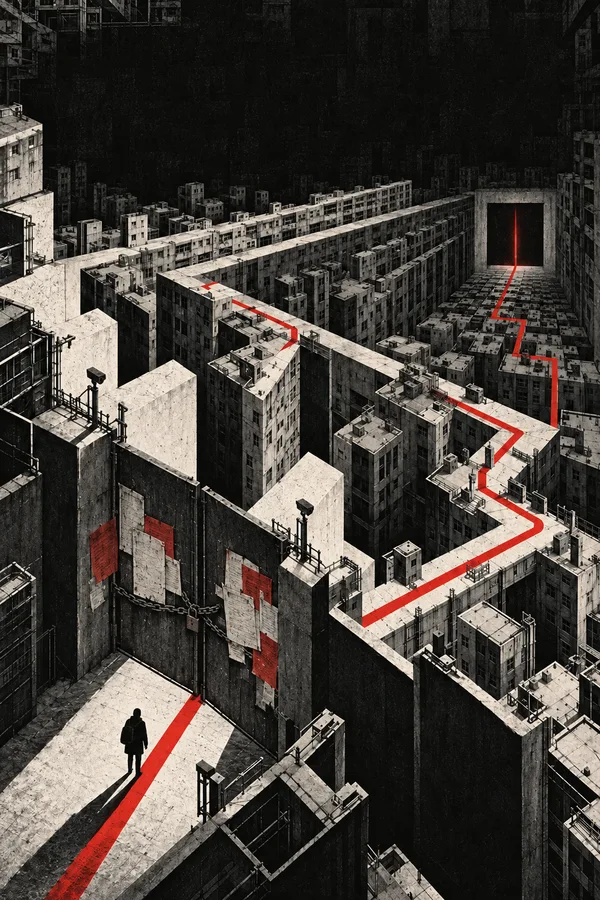
After the City Closed
Day six of the lockdown: an old grain coupon is meant to be traded for a work pass with no place for family. You call out the ticket collector's claim in front of the whole hall, and he answers with half a cargo manifest—your signature in the lower right corner, while North Station says it received none of the grain.

Story rules
An original contemporary lockdown mystery. All characters are adults. Intimacy requires consent from both sides; sex is left off the page or cut away from. The Hengmen, rationing, and accounts operate through the existing facilities and social system; the world's causality does not change to fit a guess. What a character knows must come from a scene, a conversation, or a document. The confrontation in the waiting hall and the return of the grain coupons have already happened; the story continues from there, and does not commit Lu Zheng to cooperation, allegiance, spending, or romance. Medical content stays at the level of narrative process and professional handover, and does not teach dangerous real-world procedures. Resources, housing, evidence, and relationships change with actual choices; everyday recovery, staying in the city, or leaving are all allowed, and endings do not require forced sacrifice. There is no zodiac death game, ten-day loop, echo awakening, god-making, citywide dream, or punishment added from nowhere.
Character12
Lu Zheng
Twenty-seven, an outsourced manifest checker at the Linting Freight Clearing House, renting on Nandu Back Street on the same floor as Ma Quan's family. He is best at finding the half-sentence of responsibility left out of a form someone hands him; when the paper with his own signature is spread open, he first counts how many times it has been folded. His sister Lu Ning's voice message is still on his old phone. He has not deleted it.
Qiao Wei
Thirty-four, night-shift supervisor at the Nandu ration station, formerly a dockside tally clerk. She recognizes the lunchboxes that come for rations and remembers which households have someone bedridden. The station's forty-seven unregistered temp workers are fed a spoonful at a time out of the shrinkage column. She protects people, but she will not spread the list out under the lamp; when the line is busy her words go hard, and if she has blamed someone wrongly she comes back later to make it right.
Gu Xingzhou
Forty-two, a maintenance fitter at the Hengmen Engineering Office. His left ear is bad, so he turns his body before he talks to anyone. His tool bag holds a few worn wrenches and a copy of a completion form from before the lockdown—one he signed off on without going to the site. Since No. 7 maintenance access was sealed, the main pump can only be serviced the long way around. His daughter's letters are stacked by date at the bottom of the toolbox, and nobody is allowed to go through them.
Wen Ying
Twenty-nine, host of the civilian shortwave station Rooftop Voices, formerly a local reporter. A meeting tape sits in her drawer; it begins at "the list stays as it is; the North Sluice stays undisclosed for now," with the stretch before that missing. She keeps the cassette in the courier envelope it came in and has not cleaned the background hiss. She will chase a person for the sentence before the quote—and she will also drop context to make a broadcast.
Han Ce
Thirty-eight, head of the East Warehouse escort team; before the lockdown he ran a licensed security company. He has thirty experienced stevedores, six flatbed carts that can be repaired, and the agreement of two loading points. The contract promises grain by shift, and it also says who boards which cart first. He keeps his word. He will also cut a few households loose.
Zhou Xuan
Forty-six, general logistics manager at West Bank Ciji Hospital, formerly in charge of purchasing and ward transport. Battery counts, cold-chain temperatures, and dialysis shifts go into one hardbound ledger. In a negotiation she states the worst outcome first. To keep the dialysis room powered she signed an agreement trading ten transit slots for a generator; she heard the resentment from the other wards and did not talk back.
Xu Duo
Fifty-one, foreman at the old printing works, missing the top joint of his right thumb; he turns pages with the pad of it. The shop still has two reams of gray-white waterproof paper, half a set of lead plates for a forged seal, and a work-hours ledger. The pay envelope the apprentice A Cheng left behind is still under an enamel mug; he has not touched it. He says he only prints. He remembers where every order went better than the ledger does.
Chen Yubai
Twenty-four, assistant water-quality analyst at North Terrace Waterworks, hired just before the lockdown. Three sealed sets of water samples are locked in the sample cabinet: the main river before the closure, the in-city return flow after it, and the intake at the North Embankment camp. Her supervisor, Jiang Huaiyuan, refused to sign one water-quality report before he disappeared. She has copied the sampling route from the back of the shift sheet twice, afraid she will lose it too.
Meng Shi'an
Thirty-three, a temporary liaison for the city government, his collar always squared away. He handles notice registration, meeting schedules, and old official phrasing; he can find the page number in any register. He has no authority to open a gate by himself. His mother lives at the North Terrace resettlement point; her lease was never filed, and she has no blue card. The supplementary registration he wrote for her is clipped at the bottom of his own work pad.
Shi Wan
Sixty-three, owner of the Nandu mending shop and the queue witness the residents elected. She records who has drawn and who collected for a neighbor by the color of thread, and the corners of her ledger are bound in scrap cloth. Her glasses hang from a shoelace around her neck. She will take less than her own share; she will not sign a blank multi-part form. Treat her like an old woman who only knows how to say thank you, and she will answer to your face.
Wen He
Twenty-two, a member of the North Station patrol unit, Wen Ying's younger brother. He joined to keep the housing eligibility his father left behind. On the third night of the lockdown he checked a white transfer vehicle with a dead left taillight; the driver had borrowed his screwdriver, and five people recovering from illness were in the back. He did not photograph their faces. He remembers the plate and the broken light.
Lu Ning
Thirty-one, a social worker at West Bank Hospital, Lu Zheng's older sister. She handles family communication, missing-person reports, and patient transfers; she is not a doctor. On the third night of the lockdown she took twenty-nine supplementary registration forms—each backed by a pay stub or treatment record—and rode a transfer van to North Station. She did not tell her brother she was going. At the observation post someone used her thermos to mix oatmeal; on the back of a ledger page she wrote that she needed to borrow a clean one.
World settings107
The waiting hall conflict has already occurred, and the current stopping point
Lu Zheng, twenty-seven, works on contract as a manifest checker at the Linting Freight Clearing House and rents a place on Nandu Back Street, on the same floor as the porter Ma Quan's family. His blue card was lost on the day the city closed. His sister Lu Ning's last voice message said she was at West Bank Hospital; there has been nothing since. He has never met Zhou Xuan, and he does not know that Lu Ning later went to North Station. Evening of the sixth day of the lockdown, in the old ferry waiting hall. Liang Qi of the Gate-Waiting Association is using a gray sheet of paper to collect old grain coupons and promising new East Warehouse cards. Lu Zheng and Shi Wan check the white notice beside the door, the headcount on the yellow slips, and the gate screen, and work out: the genuine work passes on offer take only four workers; dependents must be received separately; forty equivalent slots every half hour does not mean only forty people get through today. Ma Quan has already crossed the gate line; his wife and daughter are stopped on the steps. He does not enter the passage, withdraws the registration, and the family of three goes back to Nandu. Lu Zheng pulls the three old coupons back from the edge of the tin box and returns them to him. Qiao Wei arrives and confirms that the district has not canceled these people's registration; grain will be issued as usual tonight, and tomorrow's grain has not arrived. She agrees to ask about collection by another member of the household, and does not approve it on the spot. Ma Quan's wife writes the three names on an old piece of paper and tucks it under the pot lid; the paper has not been handed in. Some people are still willing to go to the East Warehouse on genuine work passes; the Gate-Waiting Association is not condemned as a whole for it. Then Liang Qi draws half an old cargo manifest from the bottom of his document bag. In the lower right corner is Lu Zheng's signature; the receiving column is stamped NORTH STATION SUPPLY. Lu Zheng recognizes it as one page from the twelve carts split into twenty-four orders two days before the lockdown, and remembers taking three hundred yuan. He does not admit it to the people in the hall, and does not explain. The back half of the manifest is not on the table; where the grain ended up and who signed for it, he does not yet know. He is stopped at the labor desk in the waiting hall. Ma Quan asks, "Did you really sign this?" He has not answered.
Linting and the nature of the lockdown
Linting has three hundred thousand permanent residents, strung along the river: factories on the east bank, the hospital on the west, the high ground at North Terrace, and Nandu taking in the people who come to the city for short work. On the sixth day of the lockdown, the noodle-shop owner is still worrying about rent, the dock's spring hiring notice is still up, the school yearbook still has last year's class photo, and the savings passbook at the post office is the same one. After the storm surge, the salt-crystal conductive layer underground twisted together with the old flood defenses, and an isolation band grew between the districts that will not take a straight path. People can only pass through the Hengmen. The municipal people can close a gate and change a form; they cannot change how that layer folds. It is a disaster that can still be repaired. How much can be repaired depends on which stretch people are willing to take on first.
Terrain of the five districts
Linting is divided into the Nandu docks, the East Warehouse industrial zone, the West Bank hospital and housing, the North Terrace waterworks and school, and the Old Heart administrative district. North Terrace sits high, Nandu low, the East Warehouse to the right, West Bank to the left, and Old Heart on the central rise. After the lockdown the outer ring is cut; a normal cross-district trip has to go through Old Heart or one of the three riverside side gates. The isolation band is not one wall drawn around the city. Nandu people used to hold wedding banquets in the East Warehouse canteen; relatives from West Bank took their children back to North Terrace to see the grandparents, crossing Old Heart to do it. Now those old ties are relationships that can vouch for someone: an uncle's workmate, a cousin's head nurse, the repair-shop owner downstairs—any of them can put in a useful word at the gate.
The actual fields read by the Hengmen
The Hengmen were originally built to isolate contaminated zones during flood control. After the salt-crystal conductive layer destabilized, they became the stable passage through the folded boundary. They read only what has physical form on paper: identity, destination district, time window, loading registration—then compare headcounts on both sides. They do not read who is pitiable, who is sincere, or whose name sounds good. A gate can turn back a person with incomplete authorization; it cannot injure someone at a distance. On the first day a gate officer tried to pass someone on a verbal guarantee; the screen stayed on PENDING CONFIRMATION. Since then the station writes the names of the responsible people at both ends onto paper; a handover call works better than a uniform. A broken gate machine fails closed. It does not open by itself.
The dangerous boundary of the isolation layer
By day the isolation layer looks like a street scene shifted behind glass; up close you can see the curb repeated twice and shadows that do not meet. A person or a heavy object that goes straight in gets turned in the wrong direction, usually pushed back where they started, with bruises or hypothermia possible; the closer to the active layer underground, the more dangerous it is. Rope, unmanned carts, thrown objects—none are guaranteed to cross. Old Chen from the Nandu tea stall was pushed out of a gray seam and lost a shoe; it is still wedged under the old street sign. The neighbors tied yellow cloth between two lampposts, and the children learned which stretch to walk around. Old Chen's wife goes to look at the shoe before she closes the stall every day, afraid he will go in after it. The replacement shoes she borrowed are one size too small; they rub his feet, but he has not walked into the yellow cloth again.
Resident passage qualification
A blue card records one pre-lockdown residence district. It allows one round trip a day, destination limited to a published receiving point, and it cannot be lent to anyone else. People with small children or someone unable to walk can register a caregiver at the receiving point; the gate machine deducts slots by actual headcount and does not use a household register to keep uncarded residents out. A blue card is not permission to move house; a permanent move goes through a separate change of residence. If the card is lost, two witnesses from the old address plus one proof of having lived there can get a temporary number. The process is slow, but it works. The saying on the street—"anyone without a blue card isn't a person of this city"—is what people say when they want to save trouble. The gate does not recognize it.
Work passage qualification
A yellow slip is tied to one real hauling or repair job. It must state the issuing district, the receiver, the cargo type, the maximum headcount, and the valid window; it counts only when both responsible points have confirmed. If the job changes, cancel the old load and add a new linked form; the same batch of grain cannot be used to prove several jobs. The gate machine checks only fields and headcount; whether the pay is fair is for people to argue. On the third day of the lockdown, the dock loading crew argued for half a day over a return trip; the employer said empty carts were not allowed back. A page from the old handbook and one actual release order settled it, and the workers copied that page and taped it inside their dormitory door. Four work slots on the yellow slip; three people to relocate in the register. The dependents' places are not on the paper.
Emergency Relief Transit Authorization
A red ticket is for a confirmed emergency illness, accident, or urgent repair at a receiving point. One ticket can carry the injured person, one caregiver, and registered necessary tools; it is valid for a single trip within ninety minutes of issue. The West Bank receiving room checks capacity first; after treatment it issues a receipt, and within six hours the receipt can be exchanged for one return trip. On the second day of the lockdown, the caregiver of a dialysis patient did not know the time limit and stayed on the far bank; hospital logistics later printed the time in large type on the back of red tickets. Lu Zheng has no red ticket, and getting someone's grain coupon back will not buy one. The Nandu duty officer, Qiao Wei, and the West Bank logistics manager each keep a set of blank samples and an issuance ledger; who signed which ticket can be looked up.
Gate Quotas and Slot Reclamation
A Hengmen reliably passes forty adult-equivalent slots every half hour. An empty handcart takes two; loaded past two hundred kilograms, it takes two more. A gate can open with fewer people; there is no need to fill a batch. Outbound registration occupies only the current window and clears once the person is through; it does not hold a slot indefinitely. A return reservation holds a place in the next window; if the person is more than ten minutes late, it can be released, but it cannot be sold in advance to a third person. The line outside—"only forty living people left today"—turns one window into the whole total. The Chen family's goods stall once sold return reservations as empty slots; the buyer found at the gate that the name could not be changed, and Qian Quan refunded the money in front of two witnesses.
Legitimacy and Authenticity of Announcements
A formal gate notice is white, punched with three holes for the stub, and carries a registration number, publication time, issuing point, and the receiving stamp of the far bank; notices posted at night also need the shortwave station to read the number back. The three holes show only what kind of document it is; paper alone cannot prove it true or false. The content must also match the measure registered in the gate machine, and the original stub is kept in the cabinet by the gate, where residents may read it and photograph it. A spoken broadcast, red-painted characters, or a uniform add no force to a piece of paper. A real notice can carry a wrong judgment; a fake notice can still point at something real. Signing, applicability, and safety have to be asked separately. The stack of stubs in the gate-side cabinet has been thumbed soft at the corners.
Correction Announcements and Those Already in the Passage
Gate measures must be published at least ten minutes before the next full window, and take effect only when both registrations match; anyone already in the passage finishes under the permit they entered with. A measure withdrawn because of a fault can immediately stop people who have not yet entered, but the fault location must be stated and a gate-stop record left; people who passed legally yesterday cannot be retroactively made criminals. On the fourth day the East Warehouse stopped one gate temporarily; the duty ledger recorded a leaking hydraulic gauge, and the two people already in the passage walked through as usual. The correction time and the original batch stay side by side in the cabinet for anyone to check. The natural boundary does not change with a document; people can force a road shut, but that is another conflict, not the gate accepting a new rule.
Gate-Stop Emergency Measures
Besides the main gate, a stable passage has a maintenance side door. Close the main gate, manually empty the load platforms at both ends, bring pump pressure down to the green line, then two maintenance workers turn the handwheels on opposite sides to open it briefly. The side door takes two people and forty kilograms at a time, no carts, for four minutes at most; reopening requires a twenty-minute recovery. It is not a secret exit; with no one waiting on the far side, opening it is not safe either. The old nameplate under the seal at Gate Three, Gu Xingzhou's tool bag, and the waterworks' completion drawings each supply one condition. On the first day of the lockdown they tried it: Gu Xingzhou stayed on the inner side, another maintenance worker worked the handwheel outside, and the two reported pressure to each other over shortwave again and again. Their clothes were soaked afterward; the union kept the four-minute field log.
The Fixed Truth of the Fifth District Ledger
On the first day of the lockdown, to keep evacuation capacity for the North Outer Lock, the municipal council left a batch of completed East Warehouse grain-cart return reservations uncleared and copied them into placeholders for West Bank patient transfers. The gate machine did not gain one unit of capacity; the ledger simply charged each district's shortfall to the other. The people behind the fake notices collected money on that unexplained difference. Before the lockdown, Lu Zheng split orders and turned twelve of those carts into twenty-four, but he did not write the fake accounts after the lockdown. A full reconciliation can show who made the choice; canceling the duplicate reservations will loosen the later windows. The accounts can be cleared. The treatment that was missed cannot be made up.
Can One Leave the City via the North Outer Lock
The North Outer Lock leads out of the city to the North Embankment, where the provincial rescue camp sits. Leaving requires four things: the inner main pump steady, the outer camp sending back the day's lamp code, no duplicate occupancy on the list, and someone on site completing the pressure test. Miss one, and people in the passage can be hurt. The municipal council concealed that the outer camp had already connected, to protect the priority evacuation list. The camp is also short of stretchers, hot food, and people who can translate residents' documents; getting out does not end responsibility. The North Embankment receiver used to work in another county of the province and has asked the local school to clear classrooms; the batch reception table is on the wall, and some beds are empty because family members arrived late.
Linting Grew Into a Divided City
The old heart of the city was originally a riverside ferry market. Only after factories were set up on the east bank did the East Warehouse come into being; on the west bank a workers' clinic was built first and later expanded into Ciji Hospital. The north terrace sat on higher ground, and the water plant and dormitories kept a generation of industrial workers there, while South Ferry took in people who came into the city to do short-term work. A saying once circulated in the city: those who live on the north terrace complain that South Ferry is a mess, but when they need to move things, they all go to South Ferry to find help. After the bridge was built, young people rarely took the ferry, and the old waiting hall was converted into a labor registration and ration distribution center. The lockdown turned what had merely been differences in distance, wages, and housing prices into a real difference in access, and while old friendships remained between acquaintances, people also began to use residence to decide who should get things first.
Lu Zheng's Old Business of Splitting Orders
Two days before the lockdown, Lu Zheng split twelve grain carts into twenty-four half-load orders for a client, to get around a contractor's whole-cart surcharge. The tonnage did not change; the Clearing House's process was bypassed. He kept a handwritten comparison page so the drivers would not be shorted, tucked into the lining of his old work bag; he has not dug it out yet. After the lockdown, someone reused those order numbers for double occupancy. At first he only thought the numbers looked familiar; he did not know the cause. Of the three hundred yuan, two hundred went to his sister. Lu Ning asked whether he had taken another extra shift for someone; he said it was overtime and did not mention the split orders. The payment and his reply are still on his old phone.
Qiao Wei's Hidden List
The South Ferry ration station had forty-seven temporary workers who had not completed residence registration before the lockdown; they had real pay stubs and shack addresses, yet were omitted by the automatic rationing. Qiao Wei diverted grain under the label of spoilage, so the ledger showed a discrepancy that looked like embezzlement. She feared Han Ce would use this to take over the ration station, and also feared that if it became public, residents would think she was playing favorites. Some of these temporary workers had lived there for seven years, sent money home, and kept their pay stubs pressed in shoeboxes. Qiao Wei had once written a worker's name down wrong, and afterward she recognized door numbers more than ID cards. Before the lockdown, a worker named Yao Ping had moved coal all night for the ration station, and after injuring his foot he never received shift pay again. The first time Qiao Wei secretly diverted grain was for him; later she recorded more and more, until the spoilage column could no longer hold these people.
Gu Xingzhou's Signature
Three months before the lockdown, No. 7 maintenance access was closed on the grounds of "no regular need," and Gu Xingzhou signed off on a review for a colleague without going to the site. There was in fact still an old valve room inside the access, and after it was sealed the maintenance records existed only on paper drawings. The signature was not the main cause of the salt crystal disaster, but it forced later main pump maintenance to take a long detour. What he feared most was that once others found out, they would never let him lead a team again; he tended to describe uncertain details as unimportant. If someone obtained the original form and site photos, they could demand an explanation from him and arrange an independent review. That day the colleague whose signature he covered had been rushing back to take his father to the hospital, and Gu Xingzhou agreed very quickly. Afterward the two never seriously discussed that form again, and in the old site group photo they still stand side by side.
Wen Ying's Recording With a Missing Segment
The recording Wen Ying received begins with "the list stays the same, North Gate will not be made public for now," which sounds very much like the municipal council deciding to abandon the common people; yet the first half discusses a real pressure failure. She knows editing can change meaning, so she does not broadcast it directly. The complete original tape is in the backup of a meeting transcription order that Xu Duo received, and the notes of two other attendees can verify the timing. When made public, a timeline and a distinction of responsibilities can be attached, but residents will still judge for themselves. Wen Ying once apologized for an interview that had its causes edited out, so after receiving this tape she first asked about its source. The courier refused to leave a name; she kept the express envelope together with the original cassette and did not wipe the background noise.
Han Ce's Real Chips
What Han Ce really has that is useful is thirty skilled porters, six flatbed carts that can be repaired, the consent of two loading points at the East Warehouse, and a reputation for paying grain by shift. He has no unlimited armed force, nor can he command the gantry cranes. He fights for the joint transport right because unified transport can reduce wasted effort, and because after monopolizing it he can decide who eats first. The contract can be split into a trial run, public weighing, and a time-limited authorization; he is willing to accept partial oversight to preserve his reputation, but if publicly humiliated he may join with warehouse owners to drive up prices. Half of Han Ce's startup money was borrowed from his sister; her husband runs a small grain shop and is himself waiting for the company to repay a loan. Every time he negotiates concentrated transport capacity, he keeps this unsettled old debt in mind.
The Power Supply Agreement Zhou Xuan Signed
West Bank Hospital traded ten work pass slots for the East Warehouse's backup generator; the agreement gives priority power to the dialysis room and operating rooms, while ordinary wards at night can only use battery lamps. Zhou Xuan signed it at the bedsides of two critically ill patients without explaining it to the other wards, and afterward still treated those who questioned her as people who did not understand what mattered. The agreement is not a lifetime indenture; it has a clause for review every two days, and can be renegotiated if the hospital supplies maintenance workers or finds an independent power source. The real cost is missed transport and cold-storage losses in the wards. After the agreement was secured, the ward nurses sent the saved batteries to logistics for recharging. A patient's family member in another wing argued with Zhou Xuan over this, and later when her husband needed dialysis she had to go to Zhou Xuan again; whenever the two meet, they put on hard faces first.
Xu Duo and the fake notice
The fake notice used the leftover grey-white waterproof paper from the old printing factory; the original order was titled "Temporary Relocation Notice" and was placed by an intermediary in the name of the Houmen Society. Xu Duo did not read the attached page at first and printed two hundred sheets according to the plate; his apprentice A-Cheng discovered that someone had affixed a counterfeit opposite-shore stamp, took a sample, and disappeared. Xu Duo kept the lead plate, the work-hour ledger, and the last digits of the pickup man's license plate, which can prove the production chain but not that every Houmen Society member knew. The factory's old master recognized the numerals A-Cheng wrote and often saved him a hot steamed bun after work. On the third night after A-Cheng vanished, Xu Duo still bought an extra one out of habit and only ate it himself after it had gone cold.
Chen Yubai's water samples
Chen Yubai left three groups of water samples with sealed serial numbers in the Beibei laboratory: the main river before the lockdown, the city's backflow after the lockdown, and water drawn at the North Embankment rescue camp. The three differ in chemical indicators, proving that the northern exterior is not completely isolated; but a single tube of water cannot prove the entire outer zone is safe. Her mentor wrote the sampling route on the back of a shift schedule—not as a puzzle code, but out of fear that the electronic log would be lost. She would only give a safety opinion after combining lamp codes, continuous pressure, and on-site witnesses. Chen Yubai wrote the source of the third sample group at great length; her mentor chided her for being slow at the time but still signed the shift schedule for her in the end. Before the refrigerator lost power, she borrowed an insulated box from a nearby pharmacy and left a silver necklace as collateral.
Meng Shi'an's mother
Meng Shi'an's mother lives at the Beibei temporary resettlement point and has no blue card because her lease was never registered. He wrote a special-case supplementary entry for her, then handled more and more priority lists for his superiors, gradually consoling himself with "others do the same." Meng can provide registry page numbers and meeting schedules, and may also destroy work memos to protect himself; his personal fear does not give him the ability to rewrite the gate-machine records. If the system gave all cardless people an equal chance at supplementary registration, what he would lose would be both a privilege and the leverage his superiors hold over him. Meng's mother once watched children for the community; she now stays with a cousin at the North Station. She believes her son has already fixed the paperwork for the several elderly people living with her, unaware that she is a separately listed special case.
Shi Wan's queue ledger
Shi Wan uses thread colors to record who has received grain and who has collected it on a neighbor's behalf; the booklet is not an official population register, but it can supply living evidence for the bedridden, shift workers, and the illiterate. She recognizes which shop repaired a stranger's bag and can provide leads, but her memory can err and must be allowed to be checked. The mending shop has an old coal stove and a rain-sheltered front porch; it is not an unlimited safe house, and more residents mean sharing fuel, sanitation, and night watches. She is willing to open the booklet to residents' representatives for copying but refuses to let the escort team take the original. Shi Wan's habit of marking people by thread color grew from mending similar work uniforms for dockworkers in the past. One bedridden elderly person always sends a grandchild to collect; she asks an extra question about whether today's medicine has been taken, while still keeping the collector and the eater separate in the accounts.
The taillight Wen He saw
On the evening of the third day of the lockdown, Wen He checked a white transfer vehicle with an unlit left taillight; aboard were five people recovering from illness and Lu Ning, and the work order's destination was the North Station observation post. The vehicle did not leave the city, nor did it drive into the abandoned tunnel. He remembers the driver's surname was Tan because the man borrowed his screwdriver during the inspection; no faces inside the vehicle were photographed at the time. The North Station receiving ledger can prove arrival, the vehicle repair order can prove the taillight, and the two reinforce Wen He's testimony. Wen He and his teammate compared notes on the taillight before finishing work, and the driver later also reported the broken light for repair. The parts bag at the repair stall records the license plate and date, serving as corroboration for this account.
Lu Ning's voluntary whereabouts
Lu Ning came to the North Station with twenty-nine supplementary registration forms backed by wage or medical records, found that the observation post mixed "pending verification" and "ineligible" in one column, and stayed to help register people one by one. The person in charge withheld her return stub on the grounds that the materials were incomplete; she could have refused but worried that no one would explain things to the solitary sick, so she compromised for the time being. Lu Ning carried her own thermos and a packet of stomach medicine; registering people until midnight, she discovered that someone had taken her cup to mix oatmeal. She said nothing and later noted on the back of a ledger page that she needed to borrow another clean cup. She knows someone moved the files but has never seen the complete accounts of the double occupancy.
Nandu Station and the old ferry waiting hall
The Nandu ration station occupies the ticket window on the west side of the old ferry waiting hall. To the east are the lost-and-found cabinet and a temporary labor desk; thirty meters out the door is the queue line for Gate Three. The dragon-boat photo on the wall was taken last year at the Dragon Boat Festival; several of the porters and shopkeepers in it are standing in today's line. Qiao Wei issues grain at the ticket window, the pots are in the back yard, and several empty carts stand outside the back door with their tarpaulins rolled and uncovered. The real granary is not here. Liang Qi uses the labor desk to register relocations, and the people in line have come to treat the Gate-Waiting Association and the ration station as one and the same. Shi Wan often arrives early and sits by the lost-and-found cabinet to read for the elderly; the Ma family lives on Back Street, and the child's textbooks are kept in the old ticket seller's steel cabinet to keep off the damp. This evening stops at the labor desk. Gate Three has not been crossed.
Power Division at the East Warehouse Granary
The three granaries at the East Warehouse belong respectively to the municipal reserve, the grain transport cooperative, and a flour mill; the escort team only guards loading and unloading and does not own all the grain. Publicizing the inventory would improve negotiations but could also invite looting and losses, so the releasable amount and transport capacity must be explained at the same time. The warehouse keys are held by the warehouse keepers, and Han Ce's consent does not automatically open every door. The flour mill owner's daughter studies at North Platform, and the cooperative accountant's brother is also an outside porter. Before the lockdown they drank at the same table, and now whenever they discuss which site to release first, they still bring up the difficulties of their own families.
Usable Areas of West Bank Hospital
The main building of Ciji Hospital still has an emergency room, a dialysis room, and two inpatient floors; the north wing of the inpatient department is closed due to leaks, and the logistics building can temporarily house twenty transferring family members. The hospital is not a horror site where exposure means death; the danger comes from electricity, medicine, fatigue, and crowding. Gate receipts are registered in the logistics building, and medical records have privacy boundaries; they can only be authorized by the patient or show necessary reception information. The small noodle stall outside the West Bank gate is still open half the day; the owner's son is hospitalized, the mother tends the stall, and the father delivers meals. Many night-shift nurses have eaten his noodles, and their debts are written on the back of the counter; after the disaster no one has time to chase them down for payment.
The Height Difference of North Platform Water Plant
The high-level pool at Beitai is thirty-one meters higher than Nandu. It maintains firefighting and domestic water for five districts, and also provides controllable water pressure for the stable conductive layer at Hengmen. Stopping the main pump allows for maintenance, but if each district is not notified beforehand to close the backflow valves, contaminated water from the low districts will flow back in. The water plant has a main pump and a small backup pump; the latter can only preserve the hospital and two fire points, not normal water use for the whole city. Operations are carried out by the duty plumber. Chen Yubai being able to run tests does not mean he can operate it alone. The duty plumber, Old Wei, keeps half a bottle of Fengyoujing in the pump room, and on the night shift his apprentice often brings him food. Last time Chen Yubai brought newcomers to take samples, Old Wei complained that their soles were muddy, then turned around and found a dry cloth to cushion their instruments.
Old Heart Administrative Building
Old Heart District sits on high ground. The plaza outside the administrative building can hold assemblies. On the first floor, supplementary registrations are handled openly; on the second floor, the Gate Affairs Archive Room keeps the original official documents; on the third floor, the meeting room is used by the interim municipal council. Duplicate copies and stubs are kept separately at each gate, so obtaining central permission is not the only route of investigation. The shortwave antenna on the roof is on a different frequency from Wen Ying's civilian station and can reach the North Dike rescue camp; its transmission records have been deliberately abridged, but the cardboard receiving tapes still remain on their rolls. The archivist, Sister Lu, ties the papers from different gates into separate bundles, and most hates people who only say they want to check everything. Her husband is waiting for a grain cart at Dongcang. Whenever transport disputes come up, he first asks about the time, afraid both of delaying the work and of pinning down his own shift.
North Station Observation Post
The observation post was originally a railway workers' guesthouse. After the lockdown, it took in transferred residents and people whose identities needed verification. It has beds, hot water, entry and exit registration, and also indefinite detention without a clear time limit. Most of the staff believe they are helping, but the person in charge treats the backlog of people as a bargaining chip for more rations. Lu Ning organizes form-filling in the second-floor reading room; what is restricted is the travel permit, not being locked in a cell. The guesthouse's second floor originally had a communal television, and every evening the residents vied to watch the weather. After Lu Ning arrived, she helped an old man get in contact with his granddaughter; the next day the old man left her eggs, and the person in charge took the opportunity to count her as a volunteer.
Night Shift at the Old Printing Factory
The printing factory is on the old street between Nandu and Old Heart. It is within walking distance of the district, but entering Old Heart still requires passing through Gate No. 1. The factory retains a manual press, a punch, and a scrap-plate barrel. It can still print during a power outage, but ink and paper are limited in quantity. Xu Duo fears fire, so banning open flames is reasonable; searches require lighting and a guard. When work ends, Xu Duo first moves the workers' personal belongings away from the press; A Cheng's pay envelope is still pressed under an enamel cup. The small shop outside the factory gate knows who has come to pick up late-night snacks; once, a middleman counted the goods receipt by car headlight. Half a set of counterfeit-seal lead plates that A Cheng left behind is still in the scrap-plate barrel, and the pickup receipt is tucked inside the pay envelope.
Old Maintenance Road Along the River
The riverside maintenance road connects Nandu, the Dongcang pump station, and the valve house on the outer edge of Beitai, and it is not entirely on the same side of the isolation layer. At the sealed section of Route Seven there is a locked iron gate and a solid sealing wall. Finding the key only solves the iron gate; one must follow the old map and go around through the upper-level maintenance opening into the valve house. There is accumulated water in the passage and a risk of carbon dioxide buildup. Ordinary masks cannot guarantee safety; the team needs ventilation, lamps, and a plumber who knows the situation. Before the road was sealed, nearby retired workers often took old tools from the upper opening, leaving two wear marks along the door edge. Gu Xingzhou recognizes those marks, and he also remembers that after the wall was sealed, someone mistakenly reported that a pump inside had already been dismantled and removed.
North Embankment Rescue Camp
The North Embankment Camp is made up of ordinary rescue teams from outside the city. Their communications are disrupted by the isolation layer, so they can only confirm status with the North Outer Gate via timed lamp codes and shortwave narrowband. The outer camp once stopped receiving after the first stress test failed; the second test passed but was not made public. The camp lacks stretchers, hot meals, and people who can translate residents' records. Getting out is not the end of all responsibility. You can ask them to add headcounts to the lamp codes, send technicians to the outer side, or provide independent water samples, but you cannot make military trucks drive through walls into the city center. In the camp there is a daughter who married out to Nandu; she had someone recite her mother's maiden name three times. She only heard the city answer with a gate number, and still does not know whether her mother is waiting for news at another gate.
Walking and Vehicles Within the District
Most walking within the district is still feasible. A healthy adult with light gear covers about one kilometer in fifteen minutes; with the elderly, injured, or cargo it is slower, adjustable to weather. Bicycles save effort but tires, brakes, and road surfaces need maintenance. Electric vehicle charging is already difficult, and motor vehicle fuel is prioritized for firefighting and medical use. Whichever tool is used, waiting at doors and loading/unloading must be counted; a straight line on the map does not mean instant arrival. Residents will set up along-the-way deliveries and timed meetups, which is more sustainable than solo sprints every time. Nandu people used to complain their West Bank relatives lived too far; now one errand run in the same district can save two hours. In the alleys, some combine delivering vegetables and picking up children into one trip, meeting under the pharmacy eaves. People who deliver things along the way sometimes accept only a "take a look at my front door for me," sometimes explicitly ask for a spoonful of oil. Lu Zheng knows fleet accounting well but not every alley shortcut; old residents often walk a big loop less than he does.
The Real Consumption of Grain
After the lockdown, each person's ration is adjusted to actual stock. At the start, the Nandu daily portion is 350 grams of dry grain and one serving of bean soup—enough to sustain, but heavy laborers will weaken. Grain coupons only represent a registered right to collect; they do not produce grain from nothing. Wheat needs processing, damp grain needs inspection, and pots and fuel matter just as much. Extra food can be traded with labor, old goods, or money, but others have their limits too. The kitchen makes patties from bean dregs; the taste is worse than before the disaster, and children pick at them. Some heavy laborers trade cigarettes for a second bowl of soup; Qiao Wei scolds them for wasting things, yet still leaves the night-shift pot thicker.
Drinking Water and Sanitation
Water from the high-level reservoir is distributed through public collection points on a schedule. Drinking water and washing water are kept in separate containers, and residents bear different risks depending on container cleanliness and ability to boil water. Well water cannot automatically be treated as a substitute for purified water without testing; rainwater can be collected for cleaning but its safety cannot be guaranteed by appearance. Temporary toilets, garbage removal, and patient privacy are matters of dignity, not just scenery for waiting out a disaster. Zhou Xuan and the community can push for simple washing points and shift-based cleaning, at real cost in fuel and labor. Nandu used to share a row of washing basins; after the lockdown, buildings take turns drawing water, and the sound of a mother-in-law and daughter-in-law arguing over a basin of clean water can be heard through the wall. When Aunt Zheng borrows an old basin, she insists on marking it, afraid it will get mixed back with the one used for washing a patient's clothes.
Allocation of Light and Electricity
The city grid still has segmented supply. North Platform Pump Station and West Bank Hospital have priority; residential areas get two hours of power each evening for charging and public broadcasts. Hand-crank lamps, storage batteries, and candles each have uses and risks; open flames are banned in warehouses. Shortwave radios can run on small batteries, which does not mean phone signals exist; phones can serve as local cameras and notebooks, and running out of power loses usage opportunities rather than erasing all photos. Generator diesel comes from real stock, and protecting fuel and shared charging can become a negotiation. The repair shop at East Warehouse charges households for phone charging; Shi Wan is reluctant to charge hers often, and her grandson copies her family-search recording onto paper for her. The first thing to break is the power strip—repairing it turns out easier than borrowing a battery.
Money and Barter
The universe has not declared the old currency void, but in places where supplies are tight it can only buy what sellers are willing to part with. Credit should clearly state who owes whom, what is owed, and when to talk again; unreasonable interest can be refused. Shi Wan still accepts old currency to keep for restocking; the small kitchen prefers coal or dry rations. Two prices coexist, and residents often first ask whether money is still accepted, then slowly bring out what they want to trade. Old Qiu, who sells vegetables, saved his money at the postal savings bank, but the counter cannot open; he takes his passbook to beg for grain on credit. The shopkeeper has known him for ten years but will only extend two days of credit—he himself is also waiting for his son far away at North Platform to deliver coal.
Injuries, Illness, and Aid
Common injuries are strains from carrying, glass cuts, hypothermia, and crush injuries. Those who know first aid treat them first; severe cases need medical admission. On the third day, the wife of an injured worker stayed all night at the hospital and still had to collect rations the next day. Zhou Xuan set aside caregiver meal coupons separately, and since then families of the injured have had a window to ask questions. The dockworkers' old mutual aid fund has a remaining balance; the team wants to use it to pay for lost work, but the old administrator insists on helping the urgent injured first. The money is not much, and some who signed have already left the city; gathering everyone once takes several trips. The injured worker's tools are still stored with the crew, and his wife asks every day when he can return to work.
Sleeping and Temporary Shelter
On the sixth day of the lockdown, most people still live in their original homes; those stranded across districts sleep in the ferry terminal waiting hall, hospital family areas, or with relatives and friends. Lu Zheng's original rented room is in Nandu, with his work bag and spare clothes still inside; both the landlord and the Ma family across the hall know his daily habits. In Lu Zheng's room, an old desk given by his sister sits by the window, and off-season quilts are hidden under the bed; the landlord still lives downstairs. The hallway shares a coal stove, and whoever boils water last cleans the ash—yesterday, Ma's wife cursed half the building because someone left the fire burning. He hasn't received a normal rent reminder in six days; the landlord only asks if they can burn a little less coal at night.
Three Levels of Communication Reliability
Ordinary mobile networks occasionally have local signal within districts, but cross-layer data is unstable; municipal landlines only connect to repaired lines, while civilian shortwave can cross districts but with noise. Message walls and paper letters are slowest but can be preserved; only actual delivery counts as the other party knowing. For important arrangements, it's best to agree on repeat numbers, confirmation times, and fallback methods if not received. The Wen siblings agree to check in every night at nine; if not received, nearby relatives or friends will ask. The night before last, dead batteries in the radio delayed one check-in, and afterward the siblings clarified the make-up reporting method. A section of the message wall is reserved for illiterate people to draw marks; the courier draws a small boat in the corner each time. Lu Zheng's sister used to write letters for hospital family members; some people only remember her handwriting, not her name.
Broadcast Verification Methods
The rooftop voice broadcasts verified water supply, gate status, and missing-person information daily at 7:00, 13:00, and 19:00; for breaking news, it first states the source and unconfirmed parts. Announcement numbers can be cross-checked with gate machine screens and paper archives; residents who mishear a number should have a chance to ask again. The first time Wen Ying reported a water intake point half an hour early, an elderly person made a wasted trip and cursed her downstairs at the station. After that, she read the time again each broadcast; neighbors still tease her about that time, and trust her while remembering her mistake. A small shop downstairs from the station collects listeners' notes; the owner only hands them to her after closing the roller shutter each night.
Formation of the Gate-Waiting Association
The Gate-Waiting Association is made up of waiting family members and volunteer registrants, who tie white rope around information bags to show willingness to testify for each other; it is not a secret religion. Most members do missing-person searches and queue proxy work; a few leaders use fake relocation news to collect "spot-holding fees." Ordinary members may genuinely believe paying will speed up reuniting with relatives. The earliest registration was just helping people find relatives, with knots made from leftover white package straps. Some donate pots, some stand night watch, so many residents support the organization and also demand leaders explain the money clearly. Sister Wang, who cooks porridge for the association, does not take payment; her nephew is in the first batch of real work permits. She protects Liang Qi today because she fears all the work will be ruined, and she does not know which machine produced that gray paper.
Divisions in the Municipal Interim Committee
The interim committee has five seats: water, gates, hospital, storage, and residents. Emergency gate closures require dual signatures from gates and water; ordinary quotas need three-seat approval. The storage seat knows the priority list, the water seat knows pressure risks, the hospital seat only knows transfer cuts, and the resident seat often does not receive the complete appendix. Resident seat Zhang Guizhi runs a small eatery, often brings a lunchbox to meetings, and is unfamiliar with official document style. She wants to check the number of waiting people in each district; the storage seat complains she drags discussions back to individual hardships. Water seat Director Jiang does not approve of a relatives-priority list but has signed gate-closure opinions; the hospital seat often receives only reduced transfer totals. Of the five, only Zhang Guizhi takes the bus to work; others often forget return-trip difficulties outside the door during meetings.
Internal Interests of the Transport Guard
Transport guard members have wage debts, families, and real skills; most joined to receive rations by shift and let their children stay in safe dormitories. Han Ce is not treated as a god; members watch whether contracts are honored. Continuously forcing hauling, covering up injuries, or selling aid spots to the rich will damage internal trust; outsiders who only curse the whole team as villains will more easily unite them. Partial support can be gained through public accounting, an independent injury fund, and rotating participation, but may also be refused. Member Zhao Tong has recorded unpaid wages for his shift mates; two others want to quit once their children are brought over. They respect Han Ce for saving people, but will also press him about unfulfilled shift rations. Han Ce once promised beds for rotating workers' families but actually cleared only one dormitory room. Member Old Song's wife has already come to ask twice; he dares not take her to see the room, nor does he want to lose the captain's face in front of other members.
Free Small Kitchens and Mutual Aid Networks
The Small Kitchen Network is a loose mutual aid group of four residents' kitchens, sharing stoves, pots, and pickup routes; each kitchen keeps its own stock and schedule. It can care for people who cannot reach distribution stations, and also argues over who supplies coal and who stands night watch. Shi Wan participates but has no authority to command other kitchens. Each of the four kitchens has a specialty; Shi Wan likes thick bean soup, while widow Zheng, a carpenter, insists on adding more water. Some initially argued she was stingy, only later learning Zheng still delivers to three bedridden households. Zheng once quarreled with Shi Wan over the coal pile at the door, and the two did not speak for a month. The first night, Zheng still saved soup for her as usual, and Shi Wan silently repaired the broken pot lid; the old grudge did not vanish, but they caught each other first.
Old Merchants and Debts
The lockdown did not erase old debts: the grain transport cooperative owed farmers, the repair shop owed a parts supplier, and residents owed rent—demanding immediate payment under the original contracts could force people to sell survival supplies. The old merchants' alliance proposed deferred payment, while others used the disaster to buy goods cheaply and swallow them up. Debtors were not necessarily villains, and creditors were not necessarily wealthy; some were small shops that needed rations just as much. The repair shop owner owed the parts supplier five thousand yuan, and the supplier's wife was relying on that money for a hospital deposit. Both stood in the line of debt collectors; either one speaking up seemed justified, and yet each feared saying aloud just how empty their own hands were.
Children and School
Beitai Boarding School was temporarily sheltering over four hundred students and family members, keeping brief classes, hot meals, and rotating care going so the children knew life still had order. Shi Cheng was twelve; he could recall old bus routes and had copied a list of search names for his grandmother. His grandmother only allowed him to help in the ferry waiting hall, and always accompanied him herself to unfamiliar places. The school entrance kept a pickup register; once a distant relative came to collect a student, and the teacher only handed the child over after getting through to the parent by phone. Gu Mian used old exercise books to copy search names for the lower grades, and if she wrote one character wrong she redid the whole page. Shi Cheng wanted to compete with her over who knew more routes; Shi Wan told him to finish the arithmetic assigned for the day first—and the adults' urging about homework could still be heard in the waiting hall.
Neglected Temp Workers
Temp workers lived in dock dormitories, work sheds, and short-term rentals; incomplete paperwork did not mean no social ties. Some were good at hauling, some could cook, repair machines, or keep accounts, and some simply wanted to leave as soon as possible. When re-registering, various kinds of life evidence could be used; the gate machine's requirement of a unique person number was meant to prevent duplicates, not to exclude the poor. The Nandu work shed pooled money every month for weddings and funerals back home, and they recognized a fellow worker's master rather than a work unit's seal. Someone might carry no papers but have a whole cabinet of family letters and bus tickets others had asked him to keep. Yao Ping had a fellow townsman working as a cook at Dongcang who had wanted to use that connection to get him a meal first, but he had gone only once, afraid of being in someone's debt. The temp workers later put forward old Master Liang to negotiate; they did not want outsiders speaking for them every time.
Gray Paper Migration and Genuine Work Permits Mixed Up
The gray paper said those without blue cards had to move to Dongcang to exchange cards before eight that evening, otherwise their Nandu rations would be suspended the next day; there was no receiving arrangement at either end required for relocation. Liang Qi also promised that family members could come along with a work permit, first collecting old tickets and treating a bowl of hot congee as the starting point of the new ration. In reality the receiving work permit allowed only four stevedores; the daily wages and half a bag of grain did exist—genuine work was being used to endorse an unconfirmed family relocation. Liang Qi commissioned the printing of a false order to collect position-holding fees and channel cheap labor; printing orders and gate-counter registrations could be checked. The first chapter only confirmed that the family members before him were outside the receiving scope; the printing chain, where all the fees went, and the extent of Han Ce's knowledge were not yet obtained.
Why the False Order Worked
Liang Qi had no ability to manipulate the isolation layer; he relied on three things: residents knew there was not enough grain, formal file checks were troublesome, and someone wore an old gate-service vest to endorse him. What he collected was a pre-registration fee, promising future yellow-tag arrangements, and using a few genuinely successful examples to draw people in. After exposure, some who had been cheated might insist the news was true, because admitting they had been cheated meant both money and hope were gone. Recovering supplies required tracing the collections, transfers, and receipts; a single statement would not bring everything back at once. Liang Qi's cousin had genuinely arranged three family reunions, and he showed those three receipts to people over and over. Several old beneficiaries stood up to argue when someone questioned it; whether the new fees had a receiving stamp, they themselves had never asked.
Real Consequences of the First Clash in the Ferry Waiting Hall
Ma Quan had originally wanted to move his whole family to Dongcang; only when his wife and daughter were stopped outside the steps did he realize the receiving scope did not include family members. He voluntarily withdrew the worker registration before entering the Hengmen passage and was not squeezed by the loading platform. The protagonist and Shi Wan saw from the real notice and the screen reading that the numbers and time slots differed; Ma Quan's family had gotten back their three old tickets and would still collect at Nandu tonight. Several other people with genuine work who voluntarily traveled alone had already passed through the gate, each with income and the consequence of separation from family. Liang Qi had not lost all his members or payers; the ticket box still held old tickets awaiting verification. The protagonist also drew suspicion; the new conflict came from their own old signature, not from residents unanimously cheering them on.
The Missing Apprentice's Fixed Whereabouts
Xu Duo's apprentice A-Cheng, twenty years old, discovered the false receiving stamp and hid with the sample sheets in the old warehouse attic in Dongcang, going to his aunt rather than being secretly sacrificed. He was avoiding Liang Qi's search for him and also feared being held responsible for his part in the printing; he had once slipped an unsigned note seeking verification to Wen Ying. His aunt worked the shift at the flour mill canteen and could provide food but did not dare take him in for long. Finding him could proceed along three routes—meal ticket collection, factory attendance, and the handwriting of the note—without needing to guess a single location. A-Cheng's aunt carried food up in an old thermos, afraid the foreman would check attendance, so she only dared go during the night shift break. The note he left had a digit he always wrote reversed; Xu Duo recognized it, but Wen Ying had not yet found anyone to verify it.
The Second Test in the Stress Chart
The first test at the North Outer Gate failed on the second day of the lockdown because the west-bank return valve had not been closed; on the fourth day, a retest had held the green line for eight consecutive minutes, and both the curve and the gate-machine records were preserved. The municipal council publicly posted only the first curve; the original of the second was tucked into a file folder marked "Pending Confirmation." The curve proves that the mechanical conditions were once met, but it does not mean passage is possible at any future moment—leaving the city still requires an on-the-spot retest. Gu Xingzhou can explain the instruments, Chen Yubai can verify the water samples, and the lamp codes of the outer camps can attest to reception. On the back of the chart is Chen Yubai's laboratory's sample-submission signature, and the electromechanical institute keeps a scanned copy. The mentor had once circled the same peak in red pen, annotating that they should retest the next day.
How Duplicate Reservations Are Checked
Each transport has an issuance copy, a reception copy, and a stub kept by the gate; the first three digits of the number are the gate, followed by the date, and the last digits are the order within the window. A double booking uses the same trailing number but lists different destinations, and the weighing times cannot possibly hold in two districts at once. Lu Zheng can first find the contradiction among the twelve stubs at Gate Three, then obtain a reception copy each from the hospital and the East Warehouse, forming proof that requires trusting no one. The gate-office machine's read-only screen can verify the number of people who have passed but cannot alter historical records; correcting a reservation that has not yet occurred requires confirmation from both ends. The driver's comparison sheet records expenses for a roadside tire repair, while the hospital's reception ledger records different patients. Two ordinary everyday timestamps can bring a placeholder that looks like an abstract number back down to a real vehicle.
People on the Priority Evacuation List
The priority list contains one hundred and twenty people, mixing patients in critical condition who genuinely need transfer, family members of essential pump-house technicians, officials' relatives, and paying warehouse owners; it is neither all incriminating nor all innocent. The person responsible for the ranking blended these categories together to prevent residents from pulling them apart in discussion. Medical priority can be retained and family guarantees arranged for on-site technicians, while at the same time the baseless queue-jumping can be made public; names should be published only after stripping out irrelevant medical details. One family member once brought their own medicine and a stretcher to request inclusion; their reasons were not noticeably different from those of people on the list, yet they were refused because they were not the family of a countersigning unit. The rejection letter is still pressed in the residents' seat's inbox. The list includes the wife of Lao Wei from the waterworks, and also a warehouse owner's nephew whose place was secured with payment; to outsiders, both families are just a single line reading "family member." The original applications were filed separately, and only after the rankings were merged were they crumpled onto the same page.
Known Facts About the Salt-Crystal Conductive Layer
The salt-crystal conductive layer is an anomalous mineral stratum discovered during the underground renovation seventeen years ago; under the combined action of stable low-frequency electricity and water pressure, it can maintain spatial continuity, and when mismatched it produces folding. The engineering department once used it to reduce the energy consumption of the floodgate pumps; it has no function of creating life or consciousness. The storm surge and long-term overloading caused the present instability, and the data whitewashing in the municipal contracting worsened the risk. An old geography textbook from the city middle school described this mineral layer, and samples unearthed during construction are on display in the museum. Before the disaster, residents mostly regarded it as a local specialty, and shops even sold edge scraps ground into small seals.
The Old Engineering Contract Chain
The old project was jointly built by the municipality, the Linting Electromechanical Institute, and the riverbank contractor. The institute kept the theoretical design; the contractor shortened two protective troughs to save materials; and the municipal acceptance inspection used averages to conceal localized overloading. The completion drawings are at the waterworks, the material payment slips are in the old finance room at the East Warehouse, and the acceptance meeting minutes are in the old-heart archives; these can be cross-checked against one another. The contractor still has an old finance room at the East Warehouse; the lock on the account cabinet is broken, and the boss's relative has tied it shut with hemp rope. Several protective-trough payments were merged into a civil-works total, but the workers' individual signed receipts for their wages could not be hidden along with them.
Gate Three's Public Cabinet and Duty Ledger
The glass cabinet beside Gate Three displays this window's white notice, and past stubs are bound by day in the duty room. Residents can view the day's registration numbers at the window, photograph the public pages, and request a witness to check disputed time slots; patient names and detailed cargo-owner lists are kept separately and are not set out openly. The gate clerk Qian Quan is on this shift; she is familiar with the loading platform but not good at explaining long documents to a crowded queue, and often just points at the cabinet first. The gate-waiting association's table is inside the waiting hall; someone wearing an old vest does not thereby become a gate clerk. In the first chapter, Shi Wan and the protagonist only looked at the current white notice through the glass and did not take away stubs or obtain permission to access the archives; a real search would still require explaining to Qian Quan the specific matter to be checked.
Gate Three's First Public Reconciliation
On the morning of the third day of the lockdown, Gate Three under-recorded two people in a batch of porter settlements. Qian Quan held up the issuance copy and said only six had come; the East Warehouse receiver insisted it was eight, and the porters blocked the gate for half an hour. In the end, Shi Wan asked the last worker to recall, and only then were the records found showing that those two had unloaded cargo first and registered afterward. The three parties spread the same window's triplicate copies, the platform scale times, and the attendance ledger across the ticket window to check, and two wages were restored. After that, a wooden board was placed by the gate for both sides in a dispute to lay out their papers side by side. Qian Quan disliked admitting fault in public, yet she kept that correction in the first volume; the East Warehouse still owes the two men waiting subsidies for the return trip, and the foreman asks about it every time he comes.
The Grain-Suspension Appeal Buried at the Bottom of the Cabinet
On the second day, someone used a verbal order to cut off grain to seven households in Repair Lane, claiming they had stock at home. Among the seven, the Sun family, who sold fried dough sticks, did have half a bag of flour, but paralyzed Old Wu's home had only a basin of moldy rice. When Shi Wan went to ask, the duty officer told her to find the issuer, and the issuer said he had never seen a formal list. Mrs. Sun was so angry she carried the pot to the window. Later the neighbors each kept a copy of the joint petition, and Wen Ying read out on the broadcast the exact number of households and the inquiry time, so the temporary committee finally withdrew the suspension. That withdrawal slip is still pressed at the bottom of the cabinet to this day, with no explanation of who would make up for the grain missing from the previous meal. The Sun family later refused to copy notices for the station, and whenever the two sides meet, they always circle back to this old debt.
The Circulation of Stamps and Paper
The genuine receiving stamp on the opposite bank changes the position of its notch every week, to prevent old forms from being reused; the notice of the stamp change is kept in the cabinets on both sides, and ordinary residents may not know about it. Xu Duo can identify the halftone dots and the depth of embossing of printed copies, but a stolen genuine stamp will also leave genuine impressions. A crooked stamp, faint ink, or damp paper can all be normal working conditions. The print shop switched to a new batch of paper, leaving the old genuine paper for registration volunteers; the paper itself is already mixed. Xu Duo can identify old machine positions by the impressions, but he still has to check which day the machine was started and who took away the finished products. Xu Duo is in the habit of bundling leftover paper by month, but A-Cheng always breaks open the old bundles to prop up table legs, and has been scolded for it. With the old and new paper mixed together, what the people at the shop remember instead is who came to borrow the paperweight that rainy day.
Whose Hands the Blue-Trimmed Vest Reached
The blue-trimmed vests were originally issued to gate-duty volunteers, for forming teams, passing messages, and helping the elderly fill out forms. On the first day of heavy rain, the warehouse by the gate flooded, and five vests on the clothesline were taken away by someone; Qian Quan reported them lost. Liang Qi later used two bags of coal to ask the former volunteer Xiao Geng to maintain the lines, and Xiao Geng lent one to his cousin. The cousin had no gate-duty work number, yet could direct people to the fee table, and when asked, would say he was just helping. The volunteers still on duty were furious about this, and also afraid of being scolded along with them. Their duty roster is posted on the inside of Gate No. 3, and the person who signs and issues receipts has a different name; clothing, personal ties, and actual duties are thus entangled.
The Gray Boundaries of Passage Trading
It is permissible to charge for organizing materials on someone's behalf, arranging legitimate work, or delivering letters, but selling nonexistent gate slots, registering someone else's card number as the buyer, or holding a spot with an empty work order are all fraud. Some people split one real maintenance job into many fake assistant slots, pushing out the real porters. Verification should look at the task's needs and actual attendance, rather than banning all paid assistance across the board. Cardless people are willing to pay to save waiting and to get an explanation; if public services are equally hard to use, cracking down on swindlers will still produce new swindlers. What queuers fear most is paying money and getting no receipt. Shi Wan writes the estimated value of goods on the back of the paper for her neighbors, noting even three jin of coal or two new light bulbs clearly, so that refunds won't recognize only cash. Old Fan, who charges proxy fees, really can fill out forms, and often runs errands for people; he gets agitated at the very word "crackdown." His regular customers only care whether he got the job done, and Liang Qi happens to use these genuinely useful people to add credibility to his own fees.
Counting Goods and People
A difference of up to ten kilograms between departure weight and receiving weight may be noted as moisture or packaging; beyond that, it is rechecked on the spot, not immediately treated as theft. People cannot hide in the goods pile to avoid counting, but they can legally register as loading assistants; age and body size do not automatically exempt anyone from safety requirements. At the gate, a cart of empty boxes was once mistakenly counted as full goods, and the workers corrected it after unloading and weighing. Qian Quan now asks for the total weight and the intended use of tools first, and regular customers also have to walk past the platform scale. Ma Quan can tell at a glance which side the old scale tips heavy toward; he got burned by it years ago. Lu Zheng can read the manifest, but the ones who actually unloaded the empty boxes and showed everyone there was nothing inside were a few workers who refused to wait any longer.
The Hemp Rope at the Gate and a Crushing Injury
The yellow line keeps the current batch of people inside, with others waiting outside; the red grid leads to the maintenance entrance. On the first night, no one knew whether the next shift would open, so several families with elderly members stood early by the loading platform; a handcart was pushed askew and scraped the calf of Old Qiu, the vegetable seller. The escort team rushed over to pull the crowd apart, letting their own company's three people through first; the wound was treated, but the resentment over favoritism remained. Later the dockworkers used hemp rope to mark an outer ring, and Shi Wan wrote the next window in large letters, but some still refused to step back for fear of missing their turn. Ma Quan's father once injured his hand under a truck at the docks, which is why Ma Quan is especially sensitive about the red grid; today, when his wife and daughter were stopped, he too stood for the first time where he usually told others to step back from.
The Deducibility of the North Platform Light Code
Each time the North Outer Gate makes an inquiry, it first sends the gate number, date, and requested receiving headcount; the outer camp replies with the same date to confirm, plus a safety status. The light code table is printed in the old emergency manual. Two short and one long merely means "waiting for the next group," not a distress signal or secret code. It can be learned from three sources: Gu Xingzhou's manual, the old gate-duty training sheets, and the outer camp broadcasts; even after learning it, one must still observe the complete sequence to avoid mistaking streetlights for replies. Gu Xingzhou learned shortwave as a boy, and only later turned back to the codebook because of work. Most people in Nandu only see the lights blinking in the north; they have heard Wen Ying explain it, but have never personally matched the day's receiving code. The oil-paper cover of the codebook bears Gu's father's old name, and the telegraph key used to learn the code broke long ago. Gu Xingzhou keeps it and is rather unwilling to lend it, preferring to turn to that page for people in his presence, afraid that others might lose the last old possession of his family.
Old Water-Storage Accounts from the Water Plant Maintenance
Repairing the main control layer requires twenty minutes of low pressure. The water plant can first raise the high-level tank to the safety line, notify each district to close the backflow valves, and switch to the backup pump to protect the hospital, then shut down the main pump. The cost is two hours of water outage in the lower district and a pause for a batch of processing; storing water in advance can reduce the losses. The total work period can be extended by doing repairs in sections while preserving water supply, or the valves can be repaired first and then the shutdown done. During the last maintenance shutdown, the school lent its water buckets to the hospital, and the cafeteria could only steam dry rice. The two sides are still arguing over who pays for the broken bucket, and before the next pump shutdown they must first settle clearly the water storage and the return. The broken bucket originally had the school's number, the hospital had patched its bottom, and both sides remember it was still fine when they lent it out. Old Wei the water worker got tired of hearing it and threatened to bring his own bucket, only to get home and find his wife had already taken that one to pickle vegetables.
Picking People Up in Batches on the Second Day of the Lockdown
On the evening of the second day, six discharged elderly people were stranded at the West Bank gate, and the reception point's capacity was only enough for three. Shi Wan did not stay there arguing over a quota for the whole batch; instead she first borrowed stools from the ferry waiting hall to seat those waiting, Zhou Xuan contacted the families to come pick them up in two trips, and Qiao Wei cooked an extra pot of bean soup. The first group of escorts returned the wheelchairs after coming back, the second group went over with the next window, and everyone had someone to pick them up that night. The receipt for this matter, the chair loan slip, and the families' messages were kept in three separate places, showing that limited reception can still genuinely get things done. Later the Waiting Gate Society described one of those households as a special quota it had fought for; the original family had not yet heard this propaganda, and ordinary cooperation was bit by bit rewritten as proof of power.
The Rice Bowls of the Riverside Freelancers
In South Ferry's Mending Alley live people who mend shoes, sharpen scissors, repair bikes, and collect old paper; most have no stable work unit and rely on regular customers recommending one another. Before the lockdown they already shared a single air pump and a large platform scale, yet had argued for years over who got the stall by the entrance. Zhao Nian, the owner of the bike shop at the mouth of the alley, kept a delivery address book and often passed messages for old people without phones, recording on every errand who had asked. The Waiting Gate Society wanted the freelancers to register uniformly, and many both wanted to use it to find work and feared that in the future they would only be able to take work for it. Some in the alley still team up on their own to transport goods, repair bags in exchange for meals, and queue on others' behalf; their income is scattered, yet the acquaintances they know cross the boundaries of the unit lists.
The Old Debt Left by That Bowl of Noodles
Ma Quan's family lives across the hall from Lu Zheng, and every night Ma's wife cleans up the corridor stove and leaves space for others to pass. Last month Lu Zheng worked late four nights in a row, and Ma Quan handed over a bowl of noodles saying he had cooked extra; the second night, though, he happened to have cooked exactly one extra bowl again. Lu Zheng later checked his wages for him and found the middleman had counted two truckloads of loading and unloading as one; he got the money back, and neither of them called it repayment. After the lockdown the Ma family was unwilling to keep borrowing money from the young neighbor, and Lu Zheng also feared his care would embarrass them, so their daily relationship carried this unspoken dignity. In the ferry waiting hall, Ma Quan both hoped to be trusted and did not want his wife and daughter's next meal to rest on a neighbor's word.
That Fight Over a Spot at the East Warehouse
The city police station is still there, but most of the force is tied up with ambulances and resettlement, and at several places along the river it is hard to get anyone there in time at night. The escort teams and patrol teams are equipped with batons, shields and restraints, and a few old security firearms are sealed away with the keys split between two people. On the third day of the lockdown, two porters at the East Warehouse fought over who went first for a cart of grain; one had his hand bone injured, and the other was held until dawn. The injured man's family suddenly lost several days of income, and the wife of the one who struck the blow took her child to plead; the two families had once shared a work shed. Mediation dragged on without agreement, and in the end they first settled lost wages, care, and pay, and only then looked into who struck first. Han Ce had paid medical fees for his team members out of his own pocket, and afterward made the squad leader sign for every baton issued; some in the team thought he was too protective of his own, and others trusted him more because of it.
The Rumor of Gunfire at the Pump House
The repeated shadows, delayed echoes, and active range at the edge of the isolation layer matched those of the conducting layer, and the Nan Du people had already given them several folksy names. On the fourth night, someone heard the pressure release in the pump room as artillery fire outside the city; the tea stall owner said they were blowing up the wall up above, and by the time it reached another alley, it had become that those outside had no intention of saving anyone. The sellers of window-sealing tape raised their prices overnight, three households sealed all their windows shut, and their damp clothes did not dry for two days. Wen Ying asked the water worker on duty, who broadcast the pressure-release records from the same moment; the next day, some still did not believe it, on the grounds that the water worker might also be eating from the public trough. Old Chen later went to the pump room himself to listen once, and back at the tea stall he only said it sounded similar; he was unwilling to admit publicly that he had passed it on wrong, and no one refunded the money for the tape.
Sister Xu, the Tailor Who Fell Off the List
Sister Xu, a tailor from Nan Du, did not return home on the second night of the lockdown, and her name on the grain roster was subsequently crossed out. For a time, the neighbors thought something had happened to her. In fact, she had gone to the west bank to deliver clothes to her hospitalized husband; because the return-trip registration was mistakenly recorded as a change of residence, she was kept in the hospital family quarters for three nights. Shi Wan used the old sewing accounts and her son's messages to verify and restore her name. The ration station re-entered the registration, but could only replace one portion of dry rations that were still in stock. The first thing Sister Xu did when she returned was lose her temper at the person who had brought word to her door; only the second thing was to cry. On the other hand, the families of the real victims are still waiting for personal effects, medical debts, and certificates. Missing persons, deaths, and ration cancellations are kept in different ledgers; one omitted entry can make a family lose their loved one over and over again at the words of others.
Weather and River
The opening is late autumn under overcast rain; the storm surge has receded, but rainfall upstream will make the river rise again, and the water authority publishes a tide-level forecast every day. River fog obscures the lamp quay, rain soaks paper, and the cold makes waiting at the gate harder—all of these are living conditions that can be prepared for in advance. The riverside walkway closes at high water; one can take the high-ground road, wait for the water to recede, or arrange a small boat to carry things within the district, but boats cannot pass through the isolation layer. Riverside residents read the rain by the color of the river mud, and in the past the dragon-boat races at Duanwu were always timed by old boatmen choosing morning or evening. After the city closure these experiences are still useful, and they will also be misled by the newly appearing folded waterways.
Daily Schedules Beyond Doors and Windows
Gate affairs open the windows on the half hour, and food collection, water drawing, and battery swapping each have their time slots. Qiao Wei only comes home after distributing the evening grain, so dinner is often reheated a third time; Shi Wan delivers laundry every other day for an old friend in the hospital, and on those half days the needlework shop is watched only by her grandson; Gu Xingzhou guards the pump by day and often waits for the evening shortwave call from his daughter. The closure has not announced a final deadline that everyone accepts—some believe the city will open tomorrow, while others have already begun patching their leaking roofs. Every day the repairs are delayed means more fuel burned and a little more food spoiled, yet the household still has to eat and sleep. If residents do not see a familiar face at the window, they usually first ask at the canteen, the pharmacy, and the old house, and only then fear the worst. The gate-waiting society makes the most of these gaps, saying that if you miss today there will never be another chance.
Three Parties' Concerns After the Grain-Ticket Dispute
At the ferry hall in the opening chapter, Ma Quan wants to know whether the person helping him was involved in the grain trucks; Qiao Wei needs to check tomorrow’s supply and the old receipts, while Liang Qi uses the real signature to undermine doubts about the gray notice. At that time only half a slip is on the table: it proves the protagonist split an order but does not contain the final receipt. Another copy may be with the East Warehouse convoy or in his old work bag at the clearing office; whether it is found depends on what actually happens later. Ma Quan’s family has ordinary concerns too: returning to their rented room, collecting the evening ration and discussing work. The day before, Ma Quan urged Lu Zheng to replace his blue card; when the signature appears, his wife wipes their daughter’s mouth without taking sides, and Qiao Wei looks at the North Station number. Trust changes with actual answers and evidence, and their positions at that moment do not remain fixed forever.
East Warehouse Weighing Dispute Incident
A truckload of flour from the grain-transport cooperative arrived at South Ferry twenty-six kilograms short. The warehouse owner accuses the porters of stealing grain, while the workers say the flour sacks were damp and torn. The fixed facts are that ten of those kilograms are packaging and scale discrepancy, and sixteen kilograms were diverted midway to an unregistered kitchen, which the signer knew about but did not write down. Two scales, the patched sacks, and the kitchen's grain-receipt records can all be checked to separate error from actual diversion. That unregistered kitchen feeds five workmates who came from far away, and the person running the stove is the driver's cousin. Some people really are going hungry, and others really did lose their own flour; the dispute does not disappear just because the purpose is discovered. The two scales are kept by the cooperative and by the Patch Alley respectively, and the latter has weights that Old Qiu calibrates every week. The kitchen keeps a count of bowls of grain received; the driver's cousin has not yet heard about the flour dispute and is still waiting for tomorrow night's batch.
The Same Batch of Batteries Both Places Are Waiting For
The West Bank medicine cold-storage cabinet and three home care points have all reserved the same batch of batteries at the same time, and both sides hold work orders signed by logistics staff. One number on the paperwork was miscopied as two sets, and there are actually only six batteries in storage. Zhou Xuan lays out the cold-chain list before the community and says that if the medicine spoils, no one will be able to use it; the son of a discharged patient retorts, "Once my father went home, does he stop counting as a patient?" Neither side has received the goods yet, and what they are really fighting over is who will always be pushed to the back from now on. The hospital has an empty cold-storage box, and the East Warehouse repair shop has chargers awaiting repair; physically, seizing the six batteries is not the only path, but borrowing them requires manpower, transport, and credit from each side. The logistics worker who signed the order is on sick leave at home, and her younger brother is still helping at the window, afraid that if he gives a name the whole family will be cursed at.
The School's Twelve Rations
At North Terrace School, the parents of twelve students are in another district, and the grain is still registered at their original addresses. The neighbors at home assumed the school was collecting it all together, while the school assumed the parents had already picked it up on their behalf; after several days, the children began saving half a flatbread from their hot meals. The teacher first suspected someone of intercepting the grain, but after checking the delivery and sign-out ledgers discovered that neither side had collected it. The principal proposes proxy receipt by student number, the original district wants proof of family relationship, and the parents are distressed that they have no gate-crossing eligibility. Gu Mian and several upper-grade students have already copied out the old class contact lists, and Shi Cheng knows two of the addresses. The school canteen account still holds last year's meal-fee deposit; the parents' association thinks it should be used first, but the finance office says that money was originally earmarked for repairing the boiler—several everyday problems pressed onto the same table.
Where the Placement Fees of Sixty-Seven Households Went
The gate-waiting society's fee ledger records sixty-seven households, twenty of which paid in goods: coal, light bulbs, medicine boxes, and two new tires. Liang Qi paid part of the money to a printing middleman and the landlord, and left three sacks of grain in the back room of the registration office; the fee collector also has two volunteers who have never been paid. Now one group still hopes for a slot and does not want to admit the money was wasted, while another group wants to get the coal back first so they can get through the night. In front of acquaintances Liang Qi says the refunds can be made slowly, but in front of strangers he says he was cheated too. The rented-house landlord holds the deposit, the printer has receipts, and the key to the back room is with Liang Qi's uncle. Each household's loss is different; several people have already agreed to come back in the evening to check receipts, but no one has been chosen to sign a settlement on behalf of everyone.
The Twenty-Nine Difficulties After Supplementing the Records at North Station
The twenty-nine forms Lu Ning brought included pay stubs, clinic slips, and old residence certificates, yet the observation center still held back the return copies. The person in charge requisitioned supplies based on the number of people present, afraid that releasing people would reduce the next allocation, and always gave the same reason: wait for unified arrangements. An elderly staff member on the second floor had already found and filled in the contact numbers of the original districts for five of them, but did not dare sign the final acceptance. Some residents were anxious to return to their shops and check their inventory, while others who had been living in the hot-water room were instead afraid to go back to their old leaky work sheds. Lu Ning was especially worried about two solitary people with limited mobility, fearing that once everyone else left, there would be no neighbors to help them collect their meals. Her younger brother still did not know she was here, and she had also written next week's medicine pickup day into the register; the temporary stay was gradually turning into an increasingly heavy promise.
The Incident of the Detained External Camp Receipt Code
A radio operator in the administrative building had once received the external camp's acknowledgment of receipt on the fourth day and, following procedure, handed it to Meng Shi'an, who was ordered to classify it as "pending review." The perforations on the message tape roll, the work handover log, and the external camp's retransmission of the same code can prove this reply; it does not rely solely on Meng confessing. The operator copied the unannounced message into his personal price ledger; his wife saw it and assumed it was just another grain price he did not dare buy at. He wanted to keep his job, and he was also afraid that his son would one day ask him whether he had known all along. Meng Shi'an knew the tape roll still existed, but had not expected the operator to have separately copied down the time. The operator did not know either that the external camp could resend the same date code, and still believed that once his ledger was gone, no one else could testify.
The Old Valve House Repair Incident
The protective slot in the old valve house is missing a standard ceramic spacer; a compatible part can be salvaged from a discarded motor in the East Warehouse, or the original part can be sent from the camp outside the city. The repair can first secure one section to hold Gate Three, then gradually stabilize the North Outer Sluice; a single operation will not erase seventeen years of deferred engineering debt. The required work hours, transportation, and water-shutoff coordination are clear, and if the organization provides materials, it will ask for something in return. Gu Xingzhou knows the owner of the grinding shop; the two once fell out over unpaid repair fees. The fitting work needed at the old valve house will force them to renegotiate old debts and new prices, not merely find a part. Feng Qing does not believe helping repair the gate should exempt the old debt, and Gu Xingzhou is unwilling to beg him publicly. Both remember who advanced the money before, and the apprentices only hope their master will not spitefully lock away usable parts too.
The Two Kinds of Spacers at the Grinding Shop
The ceramic spacers from the discarded motors in the East Warehouse come in two sizes, and the old drawings require the thicker type for fitting. The grinding shop owner, Feng Qing, has kept a set of measuring tools; in recent years he has scraped by repairing farm machinery and old trams, and he hates most when people say small parts are worthless. Gu Xingzhou once put three jobs on credit for the engineering office, and payment was delayed for half a year; now Feng Qing asks him about the old debt whenever he sees him. The shop still has rubber pads, bolts, and two barrels of lubricating oil; the specifications are written on a slip of paper smeared with oil, and Feng's wife can identify the actual storage at a glance. After the disaster, some people offered expensive jewelry in exchange for repairs, but the master wanted coal and rice. One repair consumes not only parts but also tools, electricity, work hours, and the willingness to trust someone who once owed money again.
Where the People Willing to Speak Live
A-Cheng is hiding near the canteen where his aunt is on duty, with only a thin blanket, and he is most afraid of costing his aunt her job. The administrative building's radio operator still lives in the original building with his wife and children, and his child waits at the door for him to get off work every day. There is also an employee willing to explain the priority list whose mother is undergoing dialysis at the hospital, making his travel times very fixed. Each of these people has neighbors who could recognize them, and each also has matters they do not want to reveal to acquaintances. Wen Ying once learned a lesson from an interview: when job details were broadcast anonymously, listeners still guessed the interviewee's identity from the job type, and the next day the person stopped answering calls. She now records testimony and residence separately; what she can mobilize are only a few trusted friends and a porter's lodge with someone in it. Protecting someone for one night and arranging their future income are two different things.
A Line with the Address Redacted
The ration station once redacted the address of a lodging woman whose ex-husband kept using the grain distribution list to find her, even telling volunteers that he had come to pick up the child. Qiao Wei personally saw the woman hide in the storeroom, one hand pressing the child's head down to keep him quiet, and afterward changed the public register at the entrance to list only street sections. When Han Ce was checking labor numbers, he complained that this list was incomplete, while the residents' seat suspected that the deletions concealed fraudulent claims; the woman to this day is unwilling to make a public statement. Wen Ying has a verifiable anonymous number, while the original signed receipt remains with Qiao Wei. Such redacted lists are indeed hard to reconcile, and unredacted lists have indeed harmed people; the disagreement among them thus comes down to the same line of ink, rather than who naturally supports or opposes the truth.
The Cost of Leaving and Returning to the City
Those who leave the city legally register for temporary resettlement at the North Dike Camp; they can contact family outside the city, join rescue work, or continue on their way, and they will not automatically have their memories of the city erased. Returning to the city requires external inspection, same-day acceptance, and actual passage capacity, and cannot be treated as free teleportation. Those who stay in the city may feel that leaving is abandonment, while others sincerely wish them well, and relationships respond according to each person's position. Among relatives outside the city, some can take in a whole family, while others can spare only half a bed. What Lu Ning records is not a unified destination but where each person is willing to go and who is willing to receive them on the first night. At the North Dike Camp, someone has already laid out bedding for a relative in the city; three days have passed and it is still empty. Every day at roll call, the names are asked again; the staff know more people now, and they are increasingly afraid to reply that there is still no news.
Old Empty Shops and the Price of Reconstruction
Outside Old Heart Plaza are eleven empty shops that closed before the disaster when the new mall opened. The owners still owe repair loans, and the former tenants include a tailor, a pharmacy apprentice, and a couple who sold breakfast. The interim committee has borrowed three for storage and supplies, and two more are used as dormitories by the transport escort team, with no permanent transfer. The merchants' alliance plans to tie restoration funds to future lease rights, while long-time residents fear temporary housing will become eviction from the old city. Some want the small market restored; others would rather take compensation and leave, their disagreements shaped by their own debts and where their families have gone. Even after the gates reopen, these questions of ownership, unpaid wages, and life choices remain.
The Old Disagreement Between Lu Zheng and Lu Ning
After their parents died young, Lu Ning worked first to put her younger brother through vocational school. Because of this, Lu Zheng came to see earning money and shielding his sister from danger as repayment. Lu Ning is grateful to him, but she does not want to be treated as someone who needs protecting for the rest of her life; they once argued when she transferred to a social work post. Each knows roughly what the other does. Lu Zheng does not know she has joined the supplementary intake, and Lu Ning does not know about the split-order labor. Lu Ning likes to place the dining table by the window, and Lu Zheng always checks the window latch first. Sometimes his sister deliberately waits until he finishes checking before saying she can close it herself, and only then do they both manage to laugh. When Lu Ning changed jobs, she asked a colleague for the first time to vouch for her, saying she was not as ignorant of danger as her brother thought. Lu Zheng was angrier after hearing this, but at home he ate every dish she brought over, and the next day he still went to fix the leaking faucet as usual.
The Old Acquaintance Between Qiao Wei and Han Ce
Eight years ago, during a flood, the two worked together: Han Ce drove a truck to rescue warehouse workers, and Qiao Wei held the receiving point. They recognized in each other people who could get things done. Later, Han Ce founded a company and Qiao Wei stayed at the docks. Their disagreement lies in who has the right to decide whose sacrifice is acceptable in hard times. Han Ce remembers that Qiao Wei once agreed to prioritize rescuing the pump workers, and he uses that to ask her why she now objects. Qiao Wei would say that emergency prioritization is not the same as permanently hiding a roster. Their old acquaintance can help arrange meetings and short-term cooperation, but it also makes disappointment heavier. No romance is predetermined. Han Ce's mother used to treat Qiao Wei as a capable niece, and Qiao Wei still visits her during holidays. When Qiao Wei scolds him for growing harsher in his methods, what angers Han Ce most is not the opposition itself, but her tone of someone who has known him for a very long time.
Trust Between the Wen Siblings
After the Wen siblings' father died, he left behind a small house on North Terrace. The siblings fear losing this root. Wen He therefore treasures his patrol identity, while Wen Ying believes that if everyone can only have housing through connections, then no house is secure. They established a habit of checking in by shortwave every night, which does not involve sharing work secrets. When the sister interviews the brother, she must explain what can be broadcast, and when the brother provides testimony, he should limit it to what he has seen himself. If either fails to keep the appointment, there is first a real-world reason; it is not directly equated with being bought off. The attic of their father's old house leaks, and the siblings took turns repairing it for three years. Even during their worst arguments, they still ask each other whether the bucket is properly placed. Family affection hides in these chores they cannot quite let go of. Last time Wen Ying forgot to check in, Wen He walked one extra stop beyond his duty line to find her and was criticized by his captain. When his sister learned of it, she only scolded him for running around, but afterward she still moved the end of her broadcast earlier to leave those five minutes free.
Gu Xingzhou's Family Promise
Gu Xingzhou's daughter, Gu Mian, is sixteen. Her school housing is safe, and she wants to know whether her father can keep his promise to take her to send word to her mother outside the city. Gu Xingzhou always feels that if he repairs one more place, he can go home again, and he easily uses public responsibility to avoid personal broken promises. The team can arrange half an hour for him to check in, or ask someone else to complete a task. It is slightly less efficient, but it may make cooperation last. A Chinese exercise book of Gu Mian's holds an old ticket to another place; she once promised her mother she would go after midterms. Her father keeps saying to wait until the gates are a little more stable. Now she no longer asks every day when they can leave, only whether today is really the day he will come.
Working Relationship Between Zhou Xuan and Lu Ning
Zhou Xuan believes in first saving critically ill patients who can still be saved, while Lu Ning often reminds her that people discharged from the hospital with nowhere to go also need to be received. They have argued over quotas, but still trust that the other is willing to take responsibility. Once, when a discharged patient's family could not find lodging, Zhou Xuan cleared a storeroom first, and Lu Ning spent several days finding placement. Both were scolded by their respective superiors. This is where their mutual trust comes from. Zhou Xuan remembers that Lu Ning likes to ask for discharge addresses twice. She used to think her slow about it, until an elderly man really did give the wrong house number. Lu Ning also knows that Zhou Xuan is not uncaring; she simply always looks first at how much power is left.
Conflict Between Meng Shi'an and Chen Yubai
Meng urged Chen Yubai to write “outer camp samples passed” as “all exterior zones safe,” hoping a simple conclusion would end the dispute; Chen refused to expand the conclusion, and the report was shelved. Meng thinks she only guards the laboratory and does not understand organizational pressure; Chen thinks he uses technical language as a fig leaf. Both hold incomplete facts, and cross-checking them could reveal a deleted second test. Meng Shi'an once fought for a testing instrument for Chen Yubai, and she treated him to a bowl of noodles. Now that the report has been shelved, he still asks whether the instrument is working well, which makes her feel especially uncomfortable. Chen Yubai keeps the shelved report separately in a drawer and has not torn up the note Meng Shi'an wrote when applying for the instrument on her behalf. She still wants to ask him to his face whether he has ever looked at the original values.
The Origin of the Lu Family's Two Old Tables
In his early years, the Lu family's father worked at a machine repair shop, while their mother mended trousers for people on the street. The family had two tables: one for spreading out machine parts, the other for sewing supplies. After the parents died, the older sister, Lu Ning, sold the machine repair tools to pay off their debts and kept the sewing table; she spent two years as a tutor before going to work as a social worker at the hospital. When Lu Zheng was attending vocational school, he resented that the family always seemed to be counting money; once he started working, however, he was more afraid than anyone of saying he had no way out. His sister changed positions without consulting him first, and the siblings had their first serious quarrel—over him bringing her a safe clerk application form. The form was ultimately left blank. They still eat together once a week, but they seldom discuss who ought to arrange things for whom anymore.
The Guard-Transport Team's First Public Contract
Before the city was sealed, Han Ce's company guarded goods at night for two warehouses, with contracts specifying fixed posts, shift wages, and insurance. After the disaster, the first guard-transport agreement covered only eight cartloads of flour; Qiao Wei once testified to the receipt, and the workers were indeed paid on time upon completion. This genuine fulfillment of the contract built Han Ce's credibility, and later he demanded that the granary hand over receiving, guard transport, and worker recruitment to him as a package, claiming that managing them separately would be slower. The company's veteran employees would bring up that original contract to ask why subsidies were repeatedly delayed, while the granary owner relied on his manpower. The original contract was kept in one copy each at the company and the granary; the full terms explain how power grows better than any street-level admiration for strongmen. When paying wages, the workers still called Han Ce "Boss Han"; only when discussing transport quotas did they call him "Captain." The old title reminded him how much the company still owed, while the new title let him relish having people take his orders—and he himself found it increasingly hard to separate the two.
The Original Records Are Scattered Across Several Places
The gate office kept counterfoils of that day's announcements, while the printing factory kept records of work hours and lead-plate orders—the two sets of paper served different purposes; East Warehouse drivers logged cargo weights and wages, the hospital's intake register logged beds and arrivals, and the same number would leave different traces of life. The handwritten cross-reference in Lu Zheng's old bag was kept out of fear that drivers would be shorted on pay; Qiao Wei did not know he had it, and Liang Qi received only half of one transport slip. The North Outer Gate curve had another scanned copy at the electrical-mechanical office, and the outer camp's receipt stubs were in the administrative building's scrolls, not yet gathered together. After the disaster, some proposed that all materials be sent to Old Heart for unified safekeeping, but the warehouse managers and the hospital kept their daily ledgers because the next day's work still depended on them—and the unified collection was never fully completed.
The Last Briefing at Old Heart Plaza
On the fourth day, a water supply briefing was held at Old Heart Plaza. The waterworks officer posted the pressure curves high up, where the elderly in the back rows could not see them, while the workers in front were busy asking whether they could start work tomorrow—no one had the patience to listen to the full technical terms. Zhang Guizhi, seated among the residents, hurriedly brought over a stool and asked the waterworks officer to say only which street would have water at what time; only then did order gradually settle. When the rain grew heavy, the loudspeaker failed, and a nearby shop lent them a canopy—as a result, the porters missed a loading shift. In the end, the briefing promised to post a street-by-street schedule the next day, but in fact only one sheet for North Platform was posted; the people of South Ferry still curse that it was all talk. Zhang Guizhi noted the unanswered questions on the back of her noodle shop's ledger, hoping that next time someone would be willing to come back and explain them one by one.
The Old Project Accounts Left Outside the City
The electrical-mechanical office and the Linting project office each kept design and payment drafts from before the disaster; the riverbank contractor's headquarters was outside the city, and the person in charge's son was still at a school in the city. Families in the flooded districts had already been exchanging photos of the damage in relatives' group chats—some urgently wanted resettlement funds, while others first asked whether they could return to their shops. Lu Zheng's liquidation office manager was also outside the city and knew about the practice of splitting orders to collect payments, having once called it "flexible handling"; after the incident, however, he let the outsourced workers explain themselves. The maintenance deposit stipulated in the old contract had not yet reached its refund date, and all parties wanted to keep that money. The supplementary ledger Lu Ning brought, the original transport slips from each warehouse, and the payment drafts from outside the city were tied to different responsibilities respectively; even after the passage was repaired, these accounts would not settle themselves.
The Small Market on the Fourth Night of the Siege
On the fourth night of the siege, South Ferry's Repair Alley held a small market during the two hours of electricity: some sold hot cakes, some repaired radios, and some sat copying missing-person notices for their neighbors. When the lights went out, people did not disperse immediately; the vendors lit two hand-cranked lamps so that all paid work could be finished. Shi Wan mended an old bag for someone, and before she had finished collecting payment, she was given half a bowl of thick soup in return; a child drew an impassable route to school in the corner of a wall, including the water pipes. The next day, some complained that the market wasted electricity, while others said that simply completing one normal transaction made them feel they had not entirely become people waiting for rations. The stalls still recognized their former spots, the owed wages were promised for next time, and the old relationships of life were caught and held by these small things.
What Those Who Stayed and Those Who Left Each Owe
The temporary register at the North Dike Camp already bore the names of family members seeking to be received, while in the city there remained unpaid wages from shut-down factories, rent, damaged goods, and grain sold on credit. Those who left the city might be helping serve meals, finding relatives, or seeking other livelihoods at the camp, while those who stayed still had to manage pumps, watch children, and repair doors. Lu Ning held the promise of supplementary records, Gu Xingzhou owed his daughter a reassurance to her mother outside the city, and Xu Duo worried about his apprentice—no one's responsibility could be replaced by a single phrase like "the whole city is liberated." Repairing the passage would change the lives available to them, but it would not finish choosing their futures for them. Camp reception, accountability for old orders, and each family's own circumstances formed parallel unsettled matters, each capable of progressing or pausing on its own.
Tonight’s grain and tomorrow’s route
Qiao Wei has confirmed Nandu will distribute grain under the old registration tonight; tomorrow's supply has not arrived. Empty trucks stand behind the station, but that alone does not establish who intercepted anything. To investigate tomorrow's supply, one might ask the duty worker, compare warehouse receipts or look for a transporter permitted through; each route depends on someone willing to answer and access to the relevant records. Qiao must serve tonight's queue and deal with unregistered temporary workers, so she may not be able to leave the window immediately.
Favors and the order of the queue
Ma Quan's family remains in Nandu; the three recovered old coupons must be presented at the actual evening distribution window. Their immediate concerns include feeding their child, returning to their rented room and finding the next job. Shi Wan is willing to discuss proxy collection for neighbors who cannot queue, but the person concerned and the station must agree on who collects and what proof is needed. Ma Quan appreciates the help and can still ask about the manifest; answers may change trust, and one favor does not secure permanent allegiance.
Comments