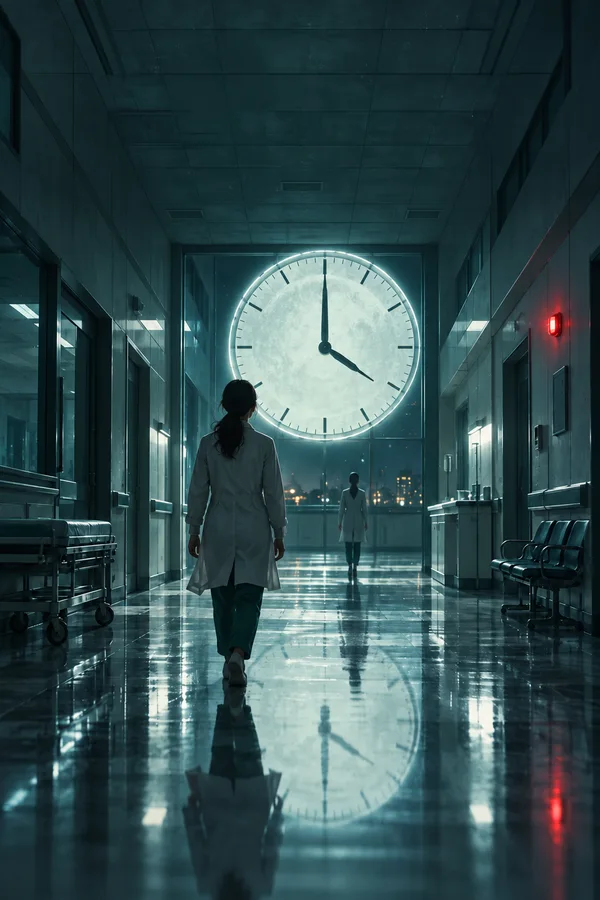
At Four in the Morning, Please Stay Awake
At four o'clock you're back at 3:12. The one who helped you up remembers the smoke; the one who handed you water remembers just the sentence. Before the clock chimes again, you have to work out which part each of them keeps.

Story rules
An adult story. Everyone is willing, intimacy can happen, and sex is elided or cut away. The fixed time window, the device's conditions, the reach of each memory, and the accident chain don't bend to guesswork; the return is triggered by equipment, not decided by a patient's life or death, by love, or by a god. Real actions change the round they happen in, the return restores bodies and objects, and memory survives only within each person's range; when it ends, the last round stands, and no perfect save is loaded. Su Mian has no license to practice medicine, work on electrical systems, or fight fires; medical and facilities decisions go to qualified staff. This night has already happened: the first night shift, the return at four, the second round at 3:19; there is no cooperation, no rescue, no shutdown yet. What you haven't chosen won't be decided for you.
Character12
Su Mian
Twenty-six, hospital affairs coordinator, third night shift. In the logbook she writes "resolved" more often than "referred," though most of those were handed to someone else. Her voice notes to her mother never run past three sentences; it's only after she hangs up that she remembers she didn't say she was scared. Right now she's wearing the jacket she didn't have on last round, standing in the corridor at 3:19.
Zhao Baiyu
Thirty-nine, the inpatient department's night charge nurse. The word "probably" is not allowed in her handover book, though she has twice got the time of her son's parent-teacher meeting wrong. She walks fast and talks faster, and after she's blown up she comes back to finish the sentence she left off.
Shao Yue
Thirty-one, the on-duty facilities technician for the campus. A screwdriver wrapped in electrical tape sticks out of his toolbag's side pocket, and he won't take a work order unless the folded corner lines up. He talks slowly and is occasionally dryly funny; when he feels guilty he fixes whatever is in front of him, and only admits it when he can't. He once signed a review with a limited scope, and half a page was later cropped from the original.
Luo Suqin
Fifty-four, head nursing aide. Before she pushes a bed she checks the brake, then the corner of the blanket; when her gloves split she sews them with white thread and goes on lifting. She remembers which patient feels the cold and which family member always forgets things, but her own overtime pay has been three months late and she hasn't gone to ask.
Wen Cheng
Thirty-two, neuroelectrophysiology technician, also responsible for the catalog of decommissioned research equipment. When she checks records she tucks a pencil behind her ear and only remembers she hasn't drunk anything after turning a page. Her mother once cleaned in this building, and anyone who talks about workers as background gets cut off mid-sentence.
Du Jiashu
Thirty-five, emergency physician on duty. A half-used pack of wipes is stuffed in his white-coat pocket, meant for the baby, three days now without making it home. He asks who can't breathe and which door before he listens to anything strange; his wife's messages usually get a single "okay" back.
Lin Mi
Twenty-four, inpatient nurse. A little rabbit with the gray worn off its ears hangs from her green pen cap, and when she's rushed she taps the pen's end twice against her palm. She has only just started working on her own; one word from her mentor reddens her eyes, and she still finishes every check before she turns around. When her mother asks when she's coming home, she always says after this busy stretch.
Ye Shoucheng
Sixty-eight, a retired vocational-school carpentry teacher, in the hospital for lung disease. A paper folded several times by his pillow has the dimensions of a small stool drawn on it, and the back records where the hospital fees are kept. When his daughter answers for him he turns his face to the door and waits to be asked again; only when he's truly out of breath does he stop.
Ye Xiao
Thirty-four, Ye Shoucheng's daughter, runs a bakery in the south of the city. She wipes the flour off her hands on a towel before taking a call, and when the machines in the shop are running she asks people to say it again. She clipped a blue-edged receiving slip to her father's bedhead, afraid she'd misremember and afraid someone would wheel him to the wrong place.
Chen Yan
Forty-one, night supervisor of campus security. The key tags are ordered by floor, and he knows whose handwriting took which key; when his back goes he moves the radio to his left side. He was once held to account over a false alarm, so now he runs at the first sight of smoke and frowns at the word "maybe."
Tang Ying
Forty-eight, head of hospital logistics. Her handover binder holds chaser emails and a review sheet marked for later, with "before dawn" in red along the margin. She can take two calls at once, while a photo from her daughter's graduation performance sits unread; her favorite line is that she'll check after dawn, said in a voice steady enough that it sounds checked already.
Xia Mingzhen
Twenty-nine, joint duty clerk for medical records and public-works files. Every file box label faces out, though in a rush she'll set an empty box straight on the floor. She remembers who took which attached page and never asks what it's for; her application for the civil-service exam sits at the very bottom of the drawer, the signature line still blank.
World settings112
An ordinary night shift and the first return have already occurred
Su Mian's default name is Su Mian, twenty-six, hospital affairs coordinator at Hechuan Second Hospital, on her third night shift. The first round begins at 03:07, when she answers her mother that she's already asleep: she goes down to the basement for a narrow wheelchair, hears the digital clock tick over at 03:12 at the handover desk, holds the door for Shao Yue with his work orders, and hears him say he's after a different one today. Then comes her mother's voice message about the clerk's job and the fish stall. At 03:37 the transfer form prints in two copies; at 03:43 Ye Shoucheng is wheeled away and she doesn't see which copy was taken; at 03:48 Lin Mi comes to borrow a pen; at 03:53 the west wing smells of scorching, Shao Yue pulls her away from the doorway, and Lin Mi hands her water and says, "That door on the east side, don't take the west" — the second half drowned out by noise. At 04:00 she's back at the basement handover desk at 03:12: the bruise on her arm is gone and so are the messages that came after. She calls her mother to ask the time, forgets the wheelchair, and meets Shao Yue upstairs; he remembers the smoke, and that he was just underground. In the second round at 03:19, Lin Mi repeats the same reminder but doesn't remember handing over water, the smoke, or any picture — only the sound from the final stretch; Luo Suqin has a physical reaction to the smell of scorched cloth and the bed rail. Right now the transfer form hasn't printed, Ye Shoucheng is still in the ward, and the narrow wheelchair is still downstairs; there is no cooperation, no rescue, no shutdown. Su Mian doesn't yet know why the return happens, or the exact range of anyone's memory.
The objective reality of this night
Hechuan sits along a river, and the Second Hospital grew out of an old railway workers' clinic; the restaurants, taxis, and small pharmacies at its gate make their living from ordinary patients. The old building, the new wing, the emergency department, and the inpatient wards all run as usual; the time anomaly repeats only between 3:12 and 4:00 tonight, while people elsewhere keep working, falling ill, and arguing. Patients and staff both have lives outside the hospital; there is no apocalypse and no hospital-wide experiment. What Su Mian does most at the reception desk is turn the old building names families still use into new floor numbers.
The fixed length of the return window
A return starts at 3:12 in the morning, runs its ordinary forty-eight minutes, and happens once at exactly four. People can move around the hospital, make calls, leave and take a cab; there is no wall across the road. When four comes, bodies, objects, paper, and electronic records go back to 3:12. What happened before 3:12 is not rewritten, and whatever was experienced afterwards still genuinely happened. On the first pass Su Mian only knows that the clock went from four back to 3:12; she doesn't know which of those forty-eight minutes can be changed and which can't.
The fixed physical cause of the return
In the timing room under the old research building there is a phase reference ring, once used to sync clocks across equipment; it is a fictional device, not real medical technology. At 3:12 a contractor's temporary power splice brings it online; at four, the primary and secondary timing circuits cross-check each other wrong and the bypass is still closed, and the return happens. The ring has no mind, chooses no one, and doesn't sense whether anyone lives or dies; stopping one round's accident won't release it by itself, and safely isolating the device won't put out that round's smoke.
The established conditions for ending the loop
Before four, if qualified facilities staff confirm that both the ring's main feed and its independent backup are isolated, and clear the miswired sync bypass, four o'clock passes normally. Pressing only the casing switch connects the backup; changing only the clock face leaves the reference signal alone. The main feed, the backup, and the bypass are recorded on the blue-line drawing, the asset card, and an old trial-run paper tape, and those three things are in three different hands. The call on site has to be checked by the technician, the old records, and the duty support together; no one can sign it off from a single sheet.
The difference between the device and the hospital power supply
The ring runs on a decommissioned research line, separate from the clinical life-support circuits; the danger comes from the contractor's splice joining two old terminals that were meant to stay apart. A professional can isolate it from the as-built drawings and an on-site check, without pulling the hospital's main breaker. Last year, when the new wing changed over its power, the clinical side drew up a list of affected equipment, and the research building's independent circuit wasn't on it; a copy of the old list is in the public-works cabinet, where Shao Yue marked an equipment storage room in red pen, and later summaries left it out.
Baseline moment and single body
The return restores bodies, the positions of objects, paper, and electronic data to 3:12; the same person is never doubled, and a patient who left the hospital is back in the bed they were in. Supplies carried out of the hospital, records uploaded to the network, and texts already sent all roll back — cloud storage doesn't carry across rounds on its own. Paper and old logs that existed before 3:12 stay put, and can be found again each round. The only thing that crosses rounds is a few people's memory; wounds, money, and objects don't. So no one can use the loop to withdraw cash, stockpile medicine, or move a patient out and leave a stand-in. Once the return stops, that round's changes carry on as ordinary time.
Su Mian, who remembers everything
At the first baseline Su Mian was standing inside the old sensor strip at the basement handover desk, which made her a lasting memory anchor. She remembers every round she lived through awake; anything after she passes out, or that happened where she wasn't, she doesn't know. If she's awake at the four o'clock return, the round just finished folds into her old memory; if she's unconscious, that stretch is missing, but the rounds she already holds are not erased. Staying awake depends on ordinary rest and someone watching over her, not on pouring coffee down or using dangerous drugs. She was decent at memorizing while studying for her exam, though after a late night she mixes up similar department phone numbers, and she's in the habit of checking the handover book first. The memory stays, and so do the fear and the tiredness; the first time, she didn't think of it as a skill — she thought she was just scaring herself stupid.
Shao Yue's memory of the most recent loop
At the first baseline Shao Yue was in the secondary sensor zone of the reference room, and he keeps only the last round's full waking experience; the next return replaces it with the new round. He remembers how to repair equipment, how to sign off, how to talk to the crew, and he remembers the people he met in the last round; earlier rounds survive only as Su Mian's account. She can retell old events to rebuild cooperation, but a retelling is testimony — it never becomes his own memory. A code word can prove they shared the last round; it can't sync them across rounds, and what he didn't hear himself he still won't know next time. If Su Mian describes an earlier round, he understands her, but he doesn't have the feel of it.
The voice Lin Mi leaves behind
Lin Mi keeps only the sounds she heard herself between 3:52 and four in the round just ended; pictures, touch, and anything earlier vanish with the return. Sound is limited by distance, doors and windows, noise, and whether she was awake — she can't hear conversations all over the hospital, and getting closer to her won't turn it into mind-reading. She likes listening to voice messages on the move, is good at picking out the tone of people she knows, and in a noisy room she mishears names too. When the leftover sound first appeared she suspected she was just too tired, and was embarrassed to tell her mentor; she has always been in the habit of asking a second time about anything she didn't catch.
Luo Suqin's sense of bodily familiarity
What Luo Suqin keeps is the familiarity of last round's repeated motions and a few sharp sensory fragments: the smell of scorched cloth makes her step back before she thinks, her hand settles on a bed rail out of habit. It gives no names, no exact time, no culprit, no knowledge of wiring; intuition can be wrong and can't be used to point at anyone on its own. If this round takes a different route she may still tense at the old danger, and needs someone to explain rather than being held to the old motions. She has held bed rails for years and can see at a glance which side catches on a door; the worn places on her gloves match her habits, and the anomaly is mixed into the craft, so even she can't always tell them apart.
Why the Others Have No Memories
The other main characters weren't in that decommissioned timing sensor circuit at the first 3:12, so after a return they keep only their ordinary memories from before the baseline. Hearing the explanation once doesn't mean they'll remember it next round; cooperation has to be rebuilt, and people Su Mian helped won't feel close to her for no reason. Walking into the sensor zone later won't make them new first-time anchors, and it can't copy a full memory into the whole hospital. Zhao Baiyu is in the ward, Wen Cheng in her office, Chen Yan at the south gate, Ye Xiao at the shop; those positions can be checked against the duty roster and an ordinary call, but nobody automatically receives anyone else's anomalous experience.
Why Shao Yue Always Asks Twice
When Shao Yue first joined the maintenance team, he mistook one Master Li on the phone for another, sent tools to the wrong building, and delayed the shift by half an hour. The master didn't scold him—he just made him repeat the floor, name, and callback number. Ever since, he doesn't readily accept a string of fast talk and makes people repeat specific locations; colleagues sometimes find him slow, but those who have been through incidents read the number to him first. He jots short phrases on the edge of paper to help himself remember, never patients' private matters. Su Mian and he had only a nodding acquaintance from charger repairs and signing work orders; the line at the stairwell about looking on another bed was, to both of them, an utterly ordinary complaint—yet after the first return it became the first point of comparison that both remembered from the previous round.
Old Records That Can Be Found Again
Blueprints, approval appendix pages, and equipment labels created before 3:12 return to their original places each round; notes written, photos taken, and system remarks afterward are restored with each return. Su Mian's memory has ordinary human gaps—she has memorized hundreds of phone numbers, but in a real emergency she may still get one last digit wrong. Shao Yue can share materials from the round just passed, but the next round leaves only his latest experiences; Lin Mi's residual voice carries its original pauses but not the location written on paper. The few of them also use different note-taking habits: Su Mian circles unfinished tasks, Shao Yue sketches circuit boundaries, and Lin Mi writes reminders on the back of her hand. These habits remain useful amid the anomaly, and each carries its own risk of copying errors, mishearing, and inconsistent understanding.
The Days Around the Third Night Shift
After her first night shift, Su Mian came home from grocery shopping still excited, thinking she could finish a full practice test during the day. After the second night, she fell asleep sitting on the floor after a shower, woke up having missed grocery shopping, and had to boil the eggs left in the fridge. She had worked two years at the reception desk and was used to settling others before thinking of herself—half a year after changing posts, she still hadn't shaken the habit. A college friend she once lived with urged her to find a job with regular hours; she said aloud, "Where would I find one?" but still bookmarked the recruitment notice. On the third night she brought a workbook but hadn't opened it by three. Her hopes and hardships about the night shift are ordinary—she wasn't waiting for a miracle to change her life from the start.
Death Is Not a Manual Restart
No one's death triggers the Return early; it must still wait until four o'clock and the device conditions must be met. After Su Mian dies, there is no subsequent experience from that round to record; upon waking, only previously consolidated memories may remain, so one cannot use death to observe secrets. The Return occurs only when the four o'clock signals of the two reference circuits overlap, and has nothing to do with the patient's heartbeat. After the baseline, a person who loses consciousness has no subsequent firsthand experience to record, but the original life and the earlier retained experiences remain. In the original first round, Su Mian did not see any death, nor did she verify where anyone went after the smoke. Her fear came from the chaos she heard and stumbled into, not from a known casualty list.
The Causal Chain Before the First Return
At 3:12 that night the temporary circuit in the logistics contractor's handover came live on its own and activated the reference ring. Su Mian was at the basement handover desk finding a narrow wheelchair for someone; Shao Yue was in the sub-room checking an alarm, Lin Mi was taking an inside line beside the broadcast branch, and Luo Suqin pushed a bed past the sensor zone by the service elevator. The four o'clock return came from the devices cross-checking each other, not from a wish made by a dying patient. The wheelchair loan call, the broadcast line, and Shao Yue's work order were all scheduled before the baseline; the four of them were standing where their ordinary shifts put them, and none of them knew about the connection.
The Fixed Smoke Incident Chain
The old underground laundry room had ceased production, but temporary construction materials were piled beside the old cable. The contractor's reconnection of the power supply overheated the old insulation, and smoldering began around 3:46. Around 3:51, the normally closed door of the service shaft was propped open by a temporary electromagnetic retainer, and smoke traveled up the shaft into the West Wing waiting area, clearly affecting breathing after 3:54. No one planted a bomb, and no nurse poisoned the whole hospital. Retained materials and circuit inspections can establish responsibility, but putting out the fire does not mean the time problem is solved. That batch of barrier cloth was supposed to be cleared away that night under the contract, but the collection truck arrived late, so the workers moved it closer to the old cable to clear the passage. It made the immediate hauling easier, but squeezed two unfinished jobs together.
The Fixed Error on the Transfer Form
Ye Shoucheng's planned transfer should have gone to a monitored bed in the east wing. The overnight template update changed only the department code; the address field still pointed to the old west wing waiting area. Two copies printed at 3:37, and at 3:43 the aide came for him with the paper slip, sending a man who depended on continuous care toward the smoke. No one picked him as a sacrifice. The original system order, the nurses' handover board, and the east wing bed phone can be checked against each other three ways, and the blue-edged receiving slip is still clipped to the family's bedhead. On the first pass Su Mian only saw the bed go by; she didn't read the address field and didn't hear the aide's whole answer. She can separate what she lived through from what other people say, ask a nurse to check the east wing record, or have Luo Suqin bring the slip and compare it with her. Nurses have their own patients and their own order of handover and won't necessarily leave at once, but a specific discrepancy can change their plans.
Concealing responsibility for the temporary power supply
To avoid delaying the old building's acceptance inspection, Tang Ying tacitly allowed the contractor to keep the temporary power supply until dawn, writing on paper that it had been reviewed with a supplementary page to follow. Contractor head Zheng Heng knew the old laundry branch circuit had not been tested and only wanted to hurry the settlement along; Shao Yue only had a duty work order missing its appendix, knowing about the alarm but not the false approval. Zheng Heng's crew had already been delayed twice, and the workers were also waiting to be paid. The danger involves both management choices and labor conditions; the scope of what each layer of people knows differs, and the complete attachment records who raised questions and when. Zheng Heng had left breakfast money for the workers, urging them to finish the inspection and knock off; no one scheduled separate overnight review hours. The crew assumed the hospital would inspect, and the hospital treated the contractor's completion as already inspected.
How the old research project ended
The decommissioned research building once housed six teams whose work was not the same: some handled sleep records, some handled signal acquisition, and the timing room merely synchronized clocks for several sets of equipment. In the project's final two years funding was compressed, the hospital prioritized clinical departments, half the old equipment was removed, and the rest was gradually registered as decommissioned. Retired technician Qiu Zhengren submitted a written opinion on the ownership of the independent backup, asking whether the asset office managed the battery or logistics managed the wiring; in the end both sides listed it as an accessory item the other had already confirmed. The dispute record is still in the handover box, showing how responsibility was dispersed—there was no secret plan to turn the whole hospital into test subjects.
Campus layout and the three building clusters
The Second Hospital campus is laid out along a long north-south street: the emergency department at the south gate, the new inpatient building on the east side, the old inpatient wing on the west, and a small northern courtyard connecting to the decommissioned research building. Underground, only the logistics corridor connects them; normal patient transfers use the first-floor covered walkway. The old laundry is on the southwest basement level, the timing room on the north basement level; they are about six minutes' walk apart and are not behind the same mysterious door. The actual routes and stairs take time—hurrying saves a little, but bringing a bed and waiting for elevators cannot be ignored. There are short flights of steps between the old building's two levels, and Luo Suqin most hates people holding the new building map saying it's right next door. The people who move beds know door widths and corners, yet administrative maps never draw those differences.
Su Mian's coordination desk
The coordination desk sits at the first-floor walkway junction, handling family directions, transfer liaison, wheelchair loans, and non-medical complaints. Under the desk are a lost-and-found bag, charging cables, and a few commonly used maps; the cabinet most often runs out of ballpoint pens. Su Mian has the shift contact list and non-sensitive location information; medical records, orders, and facility operations belong to other posts. She worked two years at reception and transferred six months ago; on her third night shift she still misnames old-building nicknames. After her daytime partner Yuan He resigned, she often agrees to go ask first, only to find the person she needs is clocking off. The night coordination desk is usually staffed by one person; the chief duty officer can temporarily assign a receptionist to cover for a while, and when borrowing a shift one first asks how long—because the other person also has unfinished work. On the first pass Su Mian found the narrow wheelchair, contacted the loan desk, and brought it upstairs; on the second she called her mother first and forgot the chair. If she goes to fetch it, she should explain the delay and complete the actual loan handover. If she investigates the smoke first, the waiting person still has their own needs and may contact the coordination or loan desk instead. Lin Mi has ward duties and will not wait indefinitely to hear about the anomaly.
The ordinary busyness of that night's emergency department
That night the emergency department had a young man injured falling while drunk, a feverish small child, and an elderly person waiting for family; work had already been nonstop before the inpatient incident. Du Jiashu's office held a half-eaten takeout meal; his wife had just sent a photo of their sleeping child, and he only had time to reply with one word. The resuscitation area was not empty; several transfers were simultaneously waiting for nurses, beds, and receiving phone calls—calling someone over is not something you can just pull off with a word. Duty driver Master Sun had just run a trip to the neighboring hospital the night before, and his handover notebook held that hospital's phone number. In the original first loop these things happened as usual; Su Mian mostly only heard bells and the urging in the corridors and did not see every ward; in the areas without smoke, people were still waiting to be properly cared for.
East wing receiving beds
The east wing receiving room has two reserved transfer beds and one temporary observation spot; at 3:12 one bed was confirmed for Ye Shoucheng, the other reserved for emergency department arrangement. The duty nurse can verify reception by phone and must not rely solely on the printed slip's place name. Sending Ye Shoucheng safely to the east wing avoids the western smoke, but continuous care, family contact, and follow-up treatment still pass to the medical staff. The reservation of those two beds was confirmed by the previous day's noon shift, and the paper bears two nurses' handover handwriting. The east wing receiver had long been waiting; a delay would affect the next scheduled item, and she would actively ask where the patient had gone. The night before, Ye Xiao had specially photographed the bed slip; in the family group chat her father complained she took it crooked, and her grandchild replied with a sun emoji. This small quarrel happened before the baseline and can still be found later.
West wing waiting area
By day the west wing waiting area is used for non-urgent transfer handoffs; at night there is no full monitoring shift, only lighting and cleaning patrols. An old inpatient building map hangs on the wall, two of whose doors have been renovated, with a date and correction sheet pasted beside it. The service shaft door is behind the waiting chairs, not the glass door that outwardly leads to the wards. Before smoke arises this is just an ordinary corridor; sealing it early should explain the risk and provide an alternative route, and one cannot lock family members outside on the protagonist's orders. In the original first loop Ye Shoucheng was led here by the old text address; the subsequent handling never entered Su Mian's view; in the second loop, at 03:19, the transfer had not yet begun. An indicator arrow for the geriatric ward had once been pasted behind the waiting chairs, leaving a pale mark after the department sign was removed. Family members often sit there waiting for the elevator, and Luo Suqin will casually push a crooked basin back against the wall.
Underground logistics corridor
The basement corridor links the linen room, the maintenance room, the old laundry, and the steps to the research building, with yellow tape on the slick stretches. Su Mian's 3:12 baseline is at the handover desk: three wheelchair registration clips on the table, their covers split and mended with sewing thread; a cup of warm water poured by the linen crew before they clocked off; a washed-white jacket over the chair back; and behind the wall a strip of old sensor, its paint gone, that no one looks at. Ordinary staff can reach the handover area; the machine and equipment rooms need keys and a signature. The linen workers mark their carts with blue tape, and taped in the corner is a child's drawing from last year, safe home.
History of the old research building
Twenty years ago the old research building was used for sleep and multi-device synchronized observation; later the research project ended and the clinical departments moved to the new building. The reference ring remained in the timing room as a fixed asset; several generations of catalogues wrote only "decommissioned, not removed," and after maintenance staff turnover few knew the independent backup still existed. The building still holds ordinary desks, chairs, cardboard boxes, curtains, and equipment cards; its true use can be verified through property registration, old photographs, and retired employees, without breaking into a secret room to guess passwords. Former project staff still wish each other happy birthday in a group chat every year, and the retired technician occasionally returns to the hospital for follow-ups. It is not that no one at the hospital knows the past—each person merely remembers the small segment they handled back then. Before retiring, Qiu Zhengren treated everyone to one last meal, and the old team members still exchange birthday wishes in the group every year. Xia Mingzhen recognizes only two people in the group photo, and Wen Cheng never followed the project's earliest years of funding and handovers either.
Stairs and alternative routes
The new inpatient building has a set of stairs on each of its east and west sides; beds use the official transfer elevator first, and those who can walk follow security guidance down the safety stairs. There is a short stair from the basement to the northern research building, suitable only for ordinary personnel; one must not force a bed down it. After the western route is affected by smoke, the east first-floor covered walkway leads to the emergency department and south gate, though several boxes awaiting transport currently occupy half its width. A reasonable reroute can reduce risk but requires telling the handoff party the location so orderlies and family do not lose each other. Security clears the walkway clutter once a week, but clinical staff often crowd it again with temporarily parked beds. Both sides have spoken at meetings of accommodating each other, yet for any single cart they still have to renegotiate face to face. Zhao Baiyu once pushed a bed along the actual route to show logistics that one extra turning step means it is not the same shortcut as on the map. That was recorded in the relocation meeting and later condensed to just four words: "recommend optimization."
Elevators and service shaft
The campus has two medical transfer elevators, one logistics freight elevator, and one decommissioned old service shaft. In the first chapter the erroneous transfer slip led the orderly to the logistics freight elevator; the problem was the destination and the smoke route, not that every elevator was haunted. The service shaft's magnetic hold-open door had not been restored, letting smoke rise; closing it can only block smoke, not cut off the reference ring. The wall beside the freight elevator still bears the original linen crew's loading times, and nursing transfers were never on that schedule. Luo Suqin knows the old routes and also knows that sometimes, to save waiting, people were temporarily reassigned there. A "no overloading" sign is pasted in the freight elevator car, with an old annual inspection sticker beneath it. Luo Suqin reads slowly, yet remembers these different-colored stickers quite precisely, knowing which time someone really came to inspect.
The night road outside the south gate
The south gate has a taxi stand and an all-night convenience store; the east small gate is for staff card access, and the north back gate is watched by security at night. Drivers like to park by the hot water stall at night; regulars know to walk to the light before hailing, and ride-hailing cars occasionally veer wrongly to the closed back gate. Healthy staff leave according to shift handover; patient departure is arranged separately by condition, the patient themselves, and medical staff. A taxi from Su Mian's rented room takes about fifteen minutes, and the first bus does not come until 5:30; on ordinary days she walks one stop to buy breakfast before boarding. The return covers reality outside the hospital; leaving the hospital likewise returns to baseline, though she has not yet personally tested this range. Her family outside the city and the neighboring hospital truly exist, each still in this day's ordinary schedule.
The outside help call that once connected
Last winter a tour bus from an outlying county overturned, and the Second Hospital's night shift received a diversion notice; the neighboring hospital sent two vehicles, and the fire department and traffic police each arrived, with several direct contact numbers kept in the dispatch table. Chen Yan remembers the order of arrivals that night, and Du Jiashu remembers it was already dawn when the last patient was transferred out; their concrete experiences of outside help differ. That night the phones and mobile network were normal, with weak local signal underground, and some old internal lines had changed numbers. Fire, sealing, and wiring risks each have their own reporting channels, and getting people on scene takes travel time and handoffs. Chen Yan habitually reports location by door number and landmarks; Su Mian used to lead with a long preamble and was once cut off by him; this time, if she needs to find someone outside, she will face the same difficulty of making things clear.
Clocks and time verification
Most clocks run on ordinary network time; the old research building has one primary and one secondary reference clock, maintained on an independent line for observation. After 3:58 the secondary clock gradually falls seven seconds behind—a measurable precursor of the loop cross-checking each other, not proof that elsewhere has paused. Setting the hands to five o'clock, changing the phone time zone, or smashing the wall clock will not bypass the fixed signal. If the time difference stops growing after professionals isolate it, that is bounded evidence of success, though one must still wait for four o'clock to actually pass to confirm the exit. Nurses verify the handover clock weekly by network time, logistics test runs use a stopwatch, and times from different sources can be compared side by side. The ordinary clock's chime is not a command, nor does it decide which route is safe. In the first loop Su Mian only saw the ordinary clock reach four and did not enter the research building to see the difference between the two clocks. The secondary clock's seven seconds is still a clue waiting to be discovered on site, not knowledge she brought back.
Logistics lights and staff charging
Corridors run dim at night; the emergency department and duty desk stay bright; the decommissioned research building keeps only passage lights, with maintenance using independent work lamps. The second-floor break room never has enough power strips; Luo Suqin's old phone plug is loose and often pulled out by others, so she wrapped a red thread around the charger head. When Wen Cheng's mother worked as a cleaner she complained the lights at ward doors were too bright, and only after a complaint were they changed to zone control; young nurses sometimes complain instead that they cannot read the meters clearly. Last year one lamp flickered for two weeks, and the repair log said aging ballast; another that would not light was simply a patrol switch blocked by a cabinet. Night workers know these ordinary faults; true anomalies hide among familiar sounds and are at first easily dismissed as another broken thing.
Hot water, rice balls, and the missed late-night meal
The first-floor convenience store is open all night, there is hot water outside the east wing nurses' station, and a "wipe clean after use" note is taped to the break room microwave. Before baseline Su Mian had not finished a rice ball and left it in the coordination desk drawer; Luo Suqin already counts it as evidence she again did not eat properly tonight. Lin Mi sometimes buys two soy milks, leaving one for the orderly, and it goes cold when she gets busy; Shao Yue has a bad stomach and keeps two soda crackers in his tool bag. Wheelchair loans and temporary transfers constantly call people away from the table. Su Mian's cup of water was poured by the linen crew, and after she was startled in the first loop Lin Mi poured her another; the cup spilled, and she was still apologizing for whether the water had touched someone's papers while her body shook too much to care.
Old group photo in the break room
The second-floor break room has folding chairs, lockers, and the duty roster; the group photo on the wall still includes two people who have left. Whether one can sit ten minutes longer often depends on whether a colleague on the same shift has just been called away; once someone said verbally they were going to the toilet and did not return for half an hour, and afterward the one left behind always asked exactly how long before covering a shift. On Su Mian's first night she could not set up a folding chair, and Luo Suqin pried the clasp open for her, complaining that her thin jacket was useless. Lin Mi's locker holds an eye mask her mother stuffed in, used only a few times; Zhao Baiyu sometimes closes his eyes in the chair but turns the internal line volume to maximum. The hospital chief duty officer can arrange temporary coverage for the coordination desk, but the temporary person still needs to know who borrowed a wheelchair and which family member is waiting for an answer.
Wages and outsourcing relationships
Formal hospital staff, labor dispatch workers, contract maintenance crews, and nursing aides belong to different contracts, and the real differences in wages and rest genuinely affect who can stay. Luo Suqin's unpaid overtime is not some mysterious organization's funding; checking the shift schedules, attendance records, and signed receipts will move things forward; Shao Yue worries the contractor will make the frontline bear the blame for the incident, which is why he values the original work orders. Exposing risks may bring work stoppages, income loss, and pressure from family, which does not mean these people are greedy for money. After the loop is lifted, these ordinary rights are still worth continuing to address. Last Mid-Autumn Festival, the nursing aide group held a sit-in outside the cafeteria over not being counted for the holiday subsidy. That night no one abandoned the patients' care, but no one was willing to write extra hours as volunteering to help again. Luo Suqin's daughter used to say the hospital had guarantees; she just laughed, knowing the meal cards, contracts, and subsidies in the same building were not the same kind of thing. She was still willing to teach the newcomers how to avoid wasted trips.
Family Members Who Didn't Go Home at Night
Plastic basins, slippers, and takeout boxes people couldn't bear to throw away were often stuffed under the companion chairs, and the queue for hot water still had quiet arguments late into the night. Ye Xiao guarded the bakery by day and brought her father clean clothes at night; her younger brother was out of town and could only send money and call. Her father told her to go home, but when he truly woke and found no one there, he would ask about it for ages. Some family members in the neighboring beds took turns between husband and wife, some hired hourly nursing aides, and some sent school-age children to relatives; their arrangements differed, and they looked down on each other's. Amid the arguments, Luo Suqin had found people's phones and checked whether the pot could heat porridge, and she would also say not to always come to her about these things. The people guarding the beds each had wages, sleep, and another person at home waiting to be cared for.
That Sheet of Paper with the Wrong Phone Number
Xia Mingzhen once handled a complaint: a public-facing window printed a family member's private phone number as a contact point, and although the paper was recalled quickly, the person still received several days of calls meant for someone else. Because of this, she clips lists for different purposes with different colored paper, and people in a hurry to retrieve files often find her slow. Transfer verification involves names, destinations, and recipients, while full diagnoses stay in the ward; administrative summaries usually list only numbers and care needs. That night, the old building list and the patient list appeared on the same table in the main duty room, and outside the door there were still people delivering meals, reporting repairs, and waiting for others. Tang Ying feared people would see it and then add supplementary review; the ward feared unrelated medical records would be passed around—their reasons were not the same thing, and as Xia Mingzhen clipped papers together, she too could not tell who was truly anxious and who wanted to use busyness to cover something up.
The Everyday Behind the Decommissioning Seal
The retired research building's clinical use was stopped, but equipment and cardboard boxes still remain underground, and it also doubles as a logistics passage. The seal is affixed only to the equipment room; in the corridor people change lights, mop floors, and move tables, and the side door's weather stripping was even replaced last year. The maintenance card outside the reference ring room says the main supply is decommissioned, with the backup column left blank; when Wen Cheng sorted the catalog, she copied the original card as it was, and the equipment department did not add the final confirmation. The edges of the old seal are wrinkled, and Xia Mingzhen can trace from the file-borrowing dates who opened the door last time; Chen Yan only knows which rooms should be locked, not how each piece of equipment is powered. The cleaning crew comes every Wednesday to mop the floor, so mop marks are not strange; the real signs of reconnection must be matched against that night's construction and wiring.
The Four Locations the Initial Baseline Passed Through
In the initial 03:12 event, Su Mian was in the basement handover station's old sensor strip core wheelchair, Shao Yue was checking alarms in the secondary room during the north measurement, Lin Mi was connected to the internal line via the second-floor broadcast branch line, and Luo Suqin pushed a bed past the sensor zone beside the service elevator. The equipment simultaneously established different recording positions, leaving behind four different kinds of memory residue. Other staff carried on at their posts as usual and did not share these fragments. At the time, the four neither gathered nor saw one another, let alone agreed to participate in the project. The positions can be cross-verified from old maps, duty rosters, public entrance footage, and personal recollection; for now, only Su Mian's experience is clearly repeating, while the others are each still finding ordinary explanations for what feels off.
The Reference Ring's Asset Card
The reference ring's asset number is 036 from the old research period; the paper card is kept in the document bag outside the time-measurement room, with a copy in the old-building handover box managed by Xia Mingzhen. The card records decommissioned, not dismantled, and independent backup power supply; the latter two were merged into one line on the new inventory, causing those who read only the summary to mistakenly believe everything was cut off. The card does not explain all temporal-spatial phenomena, but it can be deduced from it that shutting off only the main supply is not enough. Wen Cheng can recognize the old terminology, and Shao Yue can verify the site; the two's duties complement each other. Wen Cheng retied the drawstring of the old asset bag herself, and the label was written by a retired custodian her mother knew. The paper card has always been in an ordinary place; it's just that few in the different departments look at several columns together. Wen Cheng once circled the backup column and asked the equipment department who would add the final signature; the other party told her to first write out the full location. That reminder note is still clipped in the bag and has not become a new formal ownership decision.
Two Versions of the As-Built Drawing
In the works office cabinet there is a new inventory marked temporary line pending removal; in the old archive box there is a blue-line as-built drawing marked reference backup branch and cross-zone synchronization bypass. The two are not forgeries of each other but records with different purposes, and must be linked by date, signature, and attachment pages. The handover booklet in Tang Ying's hands is missing the contractor risk attachment page; the contractor's computer and the email header Shao Yue received can prove it once existed. The drawing can be used by professionals for verification, and does not mean Su Mian gains operating qualifications after one glance. The blue-line drawing has a coffee stain at the folded corner, while the new summary has only one clean page, so later duty staff naturally reach for the new item more often. The omissions in the drawings and work habits together create the cognitive gap. When Shao Yue received the email, his phone was almost out of battery, and what he saved was a thumbnail of the first page; the full original attachment is still in the mailbox. The next day a coworker mentioned the later pages, and he promised to look after work but kept putting it off until that night.
Automatic Power-On Record Before Three O'Clock
The power supply at 3:12 that night was not someone pressing a hidden button on the spot; rather, the contractor's temporary timer switched in automatically according to the test-run settings from the previous day. The works log records a handover at 3:00, and the test-run email records verification at 3:12; the on-site timer bears the same item tag. Zheng Heng assumed no one was using the research building, so he neither checked the backup nor cleared the bypass. If discovered in advance, the timer could be disarmed after professionals arrived or the entire branch isolated, changing the danger of this round; if the baseline was already established, the full exit conditions still had to be met before 4:00. Zheng Heng had left breakfast money for the workers so they could knock off after the test run; no one scheduled make-up shifts for a possible additional review during the night. This inadequate arrangement can be seen in the attendance and payment records. Zheng Heng's breakfast money was paid per head, and the list counted workers who had left early; the crew later even reconciled over a dozen or so yuan. The small accounts were meticulous, but no one filled in the big account of who would stay for the final review.
The Original Records of Two Clocks
In a cabinet in the timing room there is a roll of paper tape from the test run before the baseline, recording that the secondary clock ran seven seconds slow and then returned to the calibration point; because the bypass was not fully connected at the time, only the error was left, with no return. Wen Cheng can explain the measurement meaning of the record, and will not claim on the basis of the paper tape that time travel has been scientifically proven. The same type of error at the current 3:58, together with the sound of the backup switching in, can form a strong correspondence. Taking the paper tape away will not stop the equipment, and burning the paper tape cannot erase the established truth, which can still be verified through the observations of that round. Beside the paper tape there is also an ordinary humidity record, with normal values. It separates that instance's error from the weather and clinical conditions; what is recorded is a device phenomenon, not the fate of everyone in the hospital. On the empty box the paper tape used to be kept in, the old project abbreviation is written, and Wen Cheng remembers the handwriting habits of the custodian at the time, so she can match the date back to the handover ledger. The box is not hidden in the wall; it is simply crammed into the same drawer as the humidity records.
Why the Service Shaft Door Was Propped Open
The service shaft opening originally had a normally closed smoke door; the contractor added a temporary holder when moving materials, and the completion form says it was withdrawn, yet it was left in place on site. The door frame has fresh glue marks, conduit markings, and cart scratches, and Luo Suqin's gloves had touched the same batch of glue. The daily inspection sheet ticks the outer glass door; the cleaning staff thought construction was unfinished, while the works crew thought the last cart would withdraw it when leaving, so each was waiting on the other. The contact phone beside the door had been changed twice, and the old number paper had not been torn off cleanly; Aunt Liu called once and no one answered, so she left the clutter for the next shift. Around 3:51 that night the held-open state allowed smoke to rise along the shaft; the formal passage on the east side was still usable, and clearing the obstructions would require the moving crew to send people, but they were still waiting for the last cart of materials to be handed over.
Why the Old Laundry Room's Materials Were Not Cleared
After the old laundry room was decommissioned, the contractor crew temporarily piled partition cloth, scrap cable reels, and toolboxes there, and the contract required the site to be cleared that night. The collection truck arrived late, and the workers moved several rolls of cloth closer to the old cables to first free a passage for the carts. Around 3:46 the old insulation overheated, and the earliest scorching was on the cloth edge near the cables; outside the door it first grew warm and smelled, then the alarm trend rose. The toolbox bore Zheng Heng's crew tag, the partition cloth bags had delivery dates, and the workers' WeChat group still had messages urging the truck. The movers only knew the things had to be shifted, the power crew assumed the laundry room was empty, yet the settlement sheet listed both items as completed at the same time. Beyond firefighting, smoke damage, shutdown, wages, and material losses would fall on different people respectively, and all sides were waiting for an explanation that did not push themselves down entirely.
Template Version of the Error Slip
The transfer template was batch-updated by system maintenance at 10 p.m. the previous night; the department code was changed to East Wing Receiving Room, but the text address still used the old West Wing name. The duty nurse could amend the slip on the spot to save the patient at hand, and the system batch list could still find four other similar records. The maintenance staff had once asked the department to check a sample slip; the day shift only looked at the department code and assumed the text address would update in sync as well. What both sides confirmed was the part each had noticed, and this misunderstanding predated this night. The printer running out of paper was often replenished by Su Mian, but replenishing paper did not mean she had read every line. That night she saw the paper come out and handed it to the person who came to collect it, and on the first pass did not ask an extra question about whether the old and new addresses were the same.
Ye Shoucheng's Blue-Edged Paper and Old Craftsmanship
Before the baseline, Ye Shoucheng saw the nurse who delivered the bed confirmation and remembers her pointing beside the east-wing sunroom, but he does not remember the department code. His daughter fastened the receipt paper to the head of the bed with a blue-edged clip, saying that from then on they would compare it against any new slip, and her father laughed that she was treating him like a schoolchild. In his youth the old man taught carpentry at a vocational school and was familiar with old factory seals and timber specifications, but he had never dealt with hospital wiring. Even in the hospital he carried a stub of pencil, wanting to make a stool for his grandson, though after a few lines he would have to rest. The east-wing receiving nurse and the original handover board both retained the same arrangement; on the first pass Su Mian noticed the blue edge of his clothing and a different folded paper in his hand, but did not closely examine the admissions slip, and after the old man was wheeled away there was no time for him to explain it to her.
The Fresh Glue Mark on Luo Suqin's Glove
Luo Suqin's usual glove bore a fresh glue mark, picked up before the baseline when she held the service shaft door for the construction worker. One wheel of the cart he pushed was off, and it would rattle over the brick seams, so she stopped and gave him an extra hand. She saw only his jacket and work shoes and did not take in his full badge; she can confirm that materials were moved through, but on that basis she cannot identify who made the electrical connection. After her return, the bodily familiarity will make a certain hand-on-the-rail motion happen before thought, and she cannot explain it herself. The glue mark, the door frame, and the materials receipt are three ordinary things that together fill in the timeline; her craft and caregiving experience still come from years of work, unlike the residue that suddenly appeared on this night. She has sewn the tear in her glove twice, and the glue mark sits right beside the new stitching, not yet cleaned off before the end of the first pass. When she returns to the baseline the mark is still there, because the glue was picked up earlier.
The First Sentence Lin Mi Brought Back
In the last stretch of the first round Lin Mi heard, with her own ears, footsteps in the corridor, a ward call bell, Shao Yue telling people not to go in, and her own voice telling Su Mian to take the east door. At 3:19 in the second round she repeats, "That door on the east side, don't take the west," with the same tone and the same breaths, and no picture at all. Su Mian asks about the cup and the smoke, and she remembers neither; for the first time she admits she doesn't know where the voice comes from. Their talk came around 3:48 in the first round, and anything before the last eight minutes doesn't stay. Lin Mi still remembers her family and her job, and the unexplained voice sits in among her ordinary thoughts; she's afraid that saying it aloud will be taken for double-shift fog, and she hasn't agreed to cooperate.
Shao Yue's Review Signature
At eleven the previous night Shao Yue had signed an "external power supply marking review," whose scope was to confirm the markings and switch positions, not to verify that all old equipment was de-energized; yet the contractor photocopied the first page of the work order as an unscoped "review completed." He knows the signature could harm a colleague, so at first he stresses only that he did not misconnect any wire, and that the original order is needed to make responsibility clear. Shao Yue keeps a copy of his labor contract at home; his cousin urged him to photograph every slip, but he thought it took up too much phone space. What he most wants to recover now is precisely that original document, which at the time he felt no one would ever look at again. Chen Liang once said that as long as the switch positions were right it counted as having checked, and Shao Yue did not argue at the time. The two usually cover shifts for each other, and chasing down the original will also drag out this remark that they both quietly let pass.
The Letter Tang Ying Tucked in the Handover Book
Tang Ying's handover book sits in the first-floor general duty room, holding the urgent email sent before dawn about handing over the old building, the supplementary review slip for the temporary line, and the ward's request for additional beds. She often files budget pages together with clinical requests, signatures in several colors overlapping one another, with overdue fees calculated in the margins. The book contains no time-experiment arrangements; she knows only that the temporary power supply is still in place and does not know which set of decommissioned equipment it will meet. Du Jiashu once wrote on a request that a formal transfer route must be retained before relocation, and the annotation was buried under other pages. The administrative duty office, facilities duty, and clinical staff each have their own emergency duties; Tang Ying can coordinate and can also stall, and she does not alone hold every on-site decision. What she has been best at for years is getting the other party to agree to wait a while first.
The Three Contexts of Wen Cheng's Discontinued Recording
Three years ago while organizing equipment, Wen Cheng recorded a spoken statement: first she read out the project completion year and equipment numbers, then said no more subjects would be accepted, and finally urged that the asset sign-off be completed. The original audio is in the electronic catalog of the handover box, with another copy on the old computer in the equipment room; both match in duration and date. Taking only the middle half-sentence makes it easy to think she knew something abnormal would happen that night; joined front and back, she is only talking about a study already concluded and assets no one would take over. The recording also caught construction noise outside the window; Xia Mingzhen remembers that after recording, Wen Cheng called to ask where exactly the sign-off form should be sent. The roster is split between the research file and the official materials; the decommissioning notice and whether the site actually lost supply are two separate pieces of work to begin with.
The unchecked review attachment that was never returned
The retrieval log records that at 22:40 the previous night the contractor liaison borrowed the review attachment, and at 23:20 returned a scan; the paper original never came back. Xia Mingzhen was only responsible for the borrow-and-return; she did not read the attachment's construction content at the time, and what she signed was receipt, not acceptance. After the filename she added "original not returned," and the contractor replied that it would be delivered the next morning. The works department email header, the scan barcode, and the retrieval signature are all still there; the times link this handoff together. Her morning shift still has a batch of medical records to move to storage, and she fears the whole handover box will be carried off, which would both delay the search and leave her unable to explain what went missing. Wen Cheng once wrote the return location clearly on the box lid for her; the stickers by the desk are layered one over another, and the most recent has curled up, yet the old return-reminder slip underneath has not disappeared.
The actual whereabouts of the outsourced contractor
Zheng Heng, forty, is the on-site supervisor for the contractor on the line renovation. At the baseline time he is at a small inn outside the hospital with his phone on. He does not chase witnesses inside the hospital, nor does he know about the loops; each round of calls begins from the same everyday state. At first he puts things off as already handed over; after receiving specific missing items, site photos, or a formal request from the hospital, he may come over or send complete documents. If he fabricates new material, that requires actual action and time; he cannot delete the hospital's old files remotely. His inn is two streets from the hospital, and the owner knows these rush-job workers. Some took wages early to send home, some wait for the final payment to return to their hometowns; what the contractor supervisor is dragging out is more than one hospital settlement.
Director Liang, hospital duty officer that night
The administrative hospital duty officer sits in the office beside the emergency department; that night the shift falls to Director Liang, who coordinates outpatient services. He knows the clinical and logistics phone numbers, did not take part in the old study, and has never seen the abstract with the missing attachment. On his desk are three unsigned bed-transfer requests and a box of oranges his daughter packed; the duty phone connects before the desk phone. He has dealt with water outages before and knows clinical, security, and logistics cannot each wait for the other to speak first; he has also been rattled once by a false fault complaint, so with vague reports he keeps asking for locations. Tang Ying administratively oversees support, but emergency handling also involves the on-site duties of the clinical duty officer, facilities, and security. Director Liang's greatest worry is that at daybreak another patient's family member will come with a piece of paper no one will accept and ask him who exactly was in charge that night.
The tag once missing from the key cabinet
Keys to public corridors and closed areas are kept by Chen Yan; facilities-specific keys are with Shao Yue, and the duty officer still holds a sealed spare set. Keys hang by number, and borrowers write the destination on the back of the tag; in urgent cases Chen Yan mostly goes along and fills in the record afterward. Two years ago a construction crew took a key back to their dormitory, water leaked inside, and by the time they found the person several bundles of linens were soaked; Chen Yan paid for part of it. After that he learned to ask first what is behind the door, and he particularly hates "just grab it first, explain later." Ren Chuan thinks he is too long-winded, yet has himself lost a numbered tag and still owes a written explanation. A key opens the door, but facilities staff must still verify which line is in use in the machine room, and where a patient is moved depends on a ward accepting them.
The one call Du Jiashu refuses to skip
Two years ago a family member brought a patient to the emergency department, claiming to be the brother and urging the doctor not to wait for a signature. In the confusion Du Jiashu noticed the two gave different home addresses, then phoned to verify the real contact and learned the visitor was a helpful neighbor and the patient's daughter was rushing back from out of town. The neighbor meant no harm, only thought taking on a little more responsibility would speed things up; the daughter later still got angry over missing the explanation. This made Du, beyond emergency treatment, place special importance on making clear who knows and who decides. When Su Mian first came to the reception post she heard him tell this story, and she remembers no drug names or procedures, only his closing line: people who help can also work themselves up into acting like relatives.
What was actually seen on the first night shift
In the first round Su Mian was downstairs at 3:12 finding a wheelchair, and ran into Shao Yue holding the door with his work orders under his arm; later she took her mother's voice message and sent one reply. At 3:37 the printout came, she handed over as usual, saw Ye Shoucheng's blue-edged clothing wheeled away, and checked neither the address field nor which copy had been taken. At 3:48 Lin Mi came to borrow a pen and they talked about home; after 3:53 the west wing smelled of scorching, Shao Yue pulled her clear, and Lin Mi handed her water and pointed to the east door. After four she was back downstairs, without knowing the full extent of what happened, and she never went into the equipment room. The blue-edged paper and the transfer printout both really exist; on the first pass she only passed the paper along and didn't read the difference.
The memory discrepancy at 3:19 in the second round
Tonight only reaches 3:19 in the second round. Su Mian remembers the whole first round as lived, awake experience; the bruise on her arm and the new phone records have been restored. Shao Yue remembers the previous round in full, first suspects he's just tired, and once they match on "the second one" at the stairwell he admits he remembers the smoke and being underground again, then goes to check the west side first. Lin Mi heard her own east-door warning from the end of the last round, has no picture of handing over water, and has said she doesn't know where it came from. Su Mian has only confirmed that the two of them don't match her, and hasn't worked out the exact kinds of memory yet. The transfer form hasn't printed, there's no smoke, and Ye Shoucheng is still in his own bed; there is no safe transfer, no mutual check word, no shutdown, no promise of trust.
The unsigned labor around the handover desk
The warm water at the basement handover desk is poured by the linen shift before they clock off; the wheelchair clip's cover was broken and Luo Suqin mended it with sewing thread. At first Su Mian thought the forms only needed to be set out according to procedure, and only later saw that someone wipes the wheels during shift change, sets aside chairs with faulty brakes, and notes the return location for a caregiver who cannot read. No one signs for these extra tasks each time, yet the moment they are missing, someone cannot find something. On her third night shift she still has not learned all the linen workers' names, only recognizes a few handwritings. The first loop brings her back here; in her panic she forgets to deliver the wheelchair, and the real request from upstairs still comes, because the existing work does not stop automatically just because of something anomalous.
People and matters accessible after the first loop
In the corridor after Su Mian and Lin Mi meet early in the second round, the previously unfinished wheelchair loan is still being urged. Zhao Baiyu is doing a normal handover and does not remember the first pass; Luo Suqin is delivering a bed, Shao Yue has gone to check the light fault, and Xia Mingzhen is sorting the old building handover box in the duty office. Su Mian can tell Lin Mi what she saw first and try to verify one small repeated matter, or press Shao Yue on how much he remembers and how the basement repeated. Each person has their own work and a limit to what they will explain; they do not automatically become a mystery-solving group. Lin Mi just pulled her wrist back, and Su Mian has already let go; that grab brought fear and offense, and did not establish an intimate relationship for the two. The person upstairs asking for the wheelchair still knows nothing of this conversation.
The two chains linking smoke and the loop
The same improper reconnection simultaneously activates the reference circuit and loads the old cable; afterward smoke enters the west wing through the unreset manhole door. Blocking smoke and correcting the transfer can reduce harm during that round, but do not change the reference circuit's four-o'clock mutual check; isolating the reference device will not put out a fire in a ward already smoking. The two sets of equipment are in different locations; ordinary walking from the old laundry room to the north testing room is about six minutes, and a hospital bed must avoid the steps. The formal transfer route, security, the facilities shift, clinical reception, and outside fire services each have actual resources available and are simultaneously dealing with other matters. The complete exit condition remains that the main supply, independent backup, and miswired synchronous bypass are all safely isolated; patient life and death and the number of people play no part in triggering it.
The two deadlines of the old building handover and the bed shuffle
The logistics contract sets the old building handover date at the end of the month, but clinical services will not vacate until the new wing's staffing and beds are ready. Tang Ying has explained the delay to the contractor three times and pressed clinical services five times, then squeezed "trial operation" and "formal acceptance" onto the same form. Du Jiashu looks at how many patients can be received at night, finance looks at the late fee, and maintenance looks at who takes over the shift. Everyone says the same date, but what each is actually waiting for is not the same thing. The old research building is caught in this relocation; no department still admits it belongs to their daily-use area, and so the independent backup gets passed from hand to hand.
How the Ye father and daughter worry for each other
In his youth Ye Shoucheng took on apprentices, and he most disliked people finishing his sentences for him. After he was hospitalized, Ye Xiao feared her father would tire himself, so she often rushed to answer for him, and the old man insisted all the more on asking where exactly he was being sent. Every time he tells her to go back to the shop, saying someone will look after him, yet once she really leaves he asks why she does not answer the phone; the daughter picks up while cutting noodles, and her voice inevitably turns stiff. The blue-edged paper by the bed was left by his daughter on purpose after the two argued once, afraid her father would keep saying he had not heard. Ye Shoucheng wants to bring his own old cup, finds the hospital cups too light, and keeps thinking about the last plank still needed for his grandson's little stool. The doctors and nurses know how this father and daughter talk, and Luo Suqin usually hands the cup over first; only once the old man has it steady will he slowly listen to the receiving arrangements.
The small hours at Ye Xiao's bakery
Ye Xiao's bakery in the south of the city prepares the first batch between 3:20 and 3:40; she wipes the flour off her hands before answering the phone, and when the machines are loud she asks the caller to repeat. Tonight one apprentice is off, and the other dares not watch the proofing cabinet alone; if she rushes to the hospital, she usually has to finish explaining the baking schedule first, and the drive takes about twenty minutes. The photo of her father's blue-edged receiving paper is in the family chat group; she knows he was originally going to the east wing and has saved the receiving nurse's number. Her younger brother is on duty out of town, and her aunt lives in the city but has bad legs, so every kind of help is limited. The shop has just negotiated a school breakfast order; missing the first delivery could lose the order, and though Ye Xiao says money does not matter, she knows the caregiver fees later will still depend on this shop earning.
The forms led astray by the same template
Besides Ye Shoucheng, the previous night's template update also affected four non-urgent transfer records: two patients can walk on their own, one needs a wheelchair, and one had already been canceled before the baseline due to a change in condition. The department codes are all for the new east wing, while the text addresses use the old west-wing names; the ward handover board and the printed addresses are updated from different sources. The canceled one already had its status in the original system and did not become active again just because it reached the print point. Zhao Baiyu knows the receiving bed but has not read every address word for word; on night shift the habit is usually to check names and department first. The system maintainer only comes on day shift; the message asking the afternoon shift to check the sample forms is still on his phone, and the other party replied that it looked fine; at the time the two were not actually looking at the same column.
The folded paper by Ye Shoucheng's pillow
A folded paper by Ye Shoucheng's pillow sketches wood dimensions, meant for making his grandson a little stool; on the back he notes where the hospitalization fees are kept and writes, "Don't cancel the gathering for me again." Twice in the past his children, worried about his legs and his hospitalization, put off meetings with old colleagues; he was unhappy inside but on the phone only said, "Forget it." Half a sentence is pressed under the cup's base, and a hurried glance can misread it as giving up treatment. The stool dimensions are based on the height his grandson measured last month; his daughter once teased him that he had drawn three diagrams before even starting the gift. An old colleague, Teacher He, long ago arranged to visit him at home after discharge; in his phone contacts he is still listed as "He Muto," and at first Ye Xiao did not even know who that was. This paper concerns his plans for the rest of his life; it contains no answer about the anomalous device. During the first transfer he took the folded paper with him. Su Mian saw him hold it, ask about it, and tuck it under his pillow, but did not know what it said.
Luo Suqin's own record of overtime
In the caregivers' rest cabinet is Luo Suqin's overtime booklet, listing in pencil the dates, detours, and extra time spent pushing beds. Construction blocked the corridor for three weeks, and the team often counted the ten-odd minutes as a casual favor; afraid it would be unclear at settlement, she wrote down who was on shift with her. Tucked in the booklet is also a receipt for shoes bought for her daughter, and when outsiders flip through it she reaches out to block that page first. She wants to use the summary to negotiate her wages; some younger caregivers fear they will not get shifts later and tell her not to make trouble, while others privately ask her to add their missed hours. The contractor settles by project days, the caregivers are paid by service shift, and each side says it has not taken extra, yet the same detour time is left as labor no one will pay for.
What Lin Mi did not say to her preceptor
At home Lin Mi was naturally talkative, but after starting work she often grew sleepy over meals, and when her mother asked about the ward she only said "nothing much" out of concern for privacy. Her mother thought her daughter found home tiresome; the more she explained, the more anxious she got, until she simply went back less often. In the original first round at 03:48, she came to Su Mian to borrow a pen and, rarely, voiced this grievance; Su Mian did not tell her to be more understanding, only said she too was being pushed to change jobs. Most of the heart-to-heart happened before 03:52, and after the loop that earlier dialogue left no trace; Su Mian remembers her eyes were red, but she does not even have the image from then. The sounds of the last eight minutes do not bring back earlier conversations. Her hesitation about the anomalous sounds also includes the worry of being thought unreliable just as she has begun working independently. She had wanted to talk more with Su Mian after the shift; in the second round she does not remember having that intention. The green pen is the one she normally uses, and the rabbit charm is somewhat faded; it does not turn into evidence because of one reminder.
The two out-of-hospital coworkers on the maintenance shift
Two of Shao Yue's workmates were guarding the other two buildings outside the courtyard—one had just had a child, the other was preparing to return to his hometown. Both had the original work orders and contract attachments on their phones, and their tools were complete, but slipping away at night was hard; there were people waiting in the other buildings to report repairs too. The crew was settling the final payment at month's end, and his workmate Chen Liang feared that stopping the line would count as breach of contract, while Old Xu, who had once been injured on the job, decided that if something felt off he simply wouldn't write it up as complete. Shao Yue usually smoothed things over between the two sides, and on the night of the review signature he had found Chen Liang's attachment too long and read only the first page. Now he wanted to pin down the scope of responsibility, but also feared that laying out the original documents would cost his friend who had just had a child next quarter's contract. The men had known each other for over a decade, had gone through hard times together, and each feared a different thing about the same form.
Zhao Baiyu and Lin Mi's Everyday Friction
Zhao Baiyu values handover; Lin Mi dreads leaving family members waiting, and the two most often clash over when one can say "soon." Zhao, too, once passed on an inaccurate time when she was young, and later got an earful from a family member, though she rarely tells this to juniors—only saying "verify first." Lin Mi feels she only ever sees what's done wrong, while Zhao feels the younger woman hears reminders as contempt. After the argument in the locker room, Zhao began explaining her reasons a little more, though she still gets blunt when busy; Lin Mi dares to ask, but often rehearses in her head whether she'll be scolded. Tonight's printed form involves an old address; Zhao knows the bed arrangements but not every column of the template, and Lin hasn't checked it all yet—their existing experience and blind spots remain in both of them at once.
The Corridor Tang Ying and Du Jiashu Fought Over
Du Jiashu once demanded the unstable transfer corridor be shut down, and Tang Ying retorted: then where do the patients go? Does the ER have beds? He felt she put cost first; she felt clinical staff only cared about the immediate moment and dumped all the shuffling onto logistics. Both kept different meeting annotations, and rarely went through the whole thing face to face again. During a water outage, the two once ate cold meals in the cafeteria; Tang wrangled two extra cases of water for the ER, and Du gave his own case to the orderlies. Neither felt the other hadn't tried that night. Later they argued just the same over new-wing staffing and old-building dates. Tang Ying knows Du will insist on writing down the corridor risk; Du knows she can reach the contractor's manager in the middle of the night—each one's competence and distrust both come from years of working together.
Wen Cheng and Xia Mingzhen's Everyday Life as Roommates
Wen Cheng and Xia Mingzhen share a rental in an old complex two stops from the hospital, take turns buying laundry detergent, and have argued over who forgot to turn off the kitchen light. They know each other's night shifts and exam prep, and don't read each other's professional files. Before the baseline, Wen Cheng asked Xia to bring a box of old equipment labels; Xia left the box in the general duty room—which doesn't mean the two are in collusion. One can call to clarify where the objects went, or after release eat breakfast together and talk about transfers and the lease. Xia Mingzhen sticks sticky notes on the fridge while studying; Wen Cheng worries about waking her by reheating food in the morning, so she portions out the dishes before night shift. They've argued over utility bills, but each knows which days the other is most exhausted. The lease renews at year's end, the landlord wants to raise the rent, and they haven't yet discussed who stays. If Xia Mingzhen's transfer goes through, Wen Cheng will have to find a new roommate; she says aloud "tell me earlier," but in her heart she doesn't want to swap her out right away.
Su Mian's Mother's Life in the Neighboring City
Su Mian's mother works in an elementary school cafeteria in the neighboring city, knows exactly which child won't eat scallions, and won't take extended leave despite her bad back. She's used to getting up at six and asking whether her daughter has eaten; if she wakes at night she checks her phone, afraid a call would wake her. That night her daughter said at 03:07 that she'd gone to sleep, and she believed it; later, hearing the fish stall downstairs unloading, she sent a few voice messages grumbling, and mentioned in passing that the community office was hiring clerks. She values the job for being close and letting her sleep steadily, but Su Mian heard it as telling her to give up her half-year of exam prep. Her mother knows nothing of the anomaly, and doesn't remember the calls after the return, yet will still overthink the same pause. Sometimes one talks about meals and the other about work; both mean genuine concern, but they always miss the place the other is truly afraid of.
The Old Cost of "I'll Take Care of It"
During daytime reception, Su Mian often turned "I'll go ask" into "I'll take care of it." Once a family member missed the last bus, and she covered the fare; afterward several families came asking whether she could front them money too, since others assumed the window had a subsidy. Too embarrassed to explain, she finally had Yuan He accompany her to see the social worker, who wrote out the appropriate help channels one by one. Yuan He also scolded her in private for always trying to be the hero; Su Mian sulked for two days, but once the reimbursement came through she still treated her partner to noodles. Switching to night shift, she meant to learn not to say too much, but when someone is crying and urging her, she agrees first again. On the first return she badly wanted to grab hold of someone who would believe her immediately, and this collides with that old habit: asking others for help is harder for her to voice than taking the burden on herself.
The Reception Partner Su Mian Once Relied On
Su Mian had a partner in daytime reception named Yuan He, four years older, who knew she always saved her lunch for last and would often shoo her off to eat before handover. The two once planned to take a certification exam together; last year Yuan He's family moved to another city, and she never resumed preparing. After Su Mian moved to nights she didn't want to keep messaging and disturb her, yet when facing a difficult family member she'd instinctively look for that other desk. Being used to working alone doesn't mean she doesn't need someone who understands what she hasn't said. This loss of a daily partner still lives in her ordinary-life memories; that urgency on the first return to find someone who also remembers—part of it is fear, and part is this old gap.
That Blind Date Two Years Ago That Went Nowhere
Su Mian's mother had someone introduce a local young man who worked day shift; when talk turned to marriage, he first asked whether she could switch to a regular-schedule position. They met a few times with no real conflict—it was just that he laid out the same life plan too clearly, while she still wanted to try for the exam once more. In the end she was the one to say it wasn't a fit, and told her mother the man had no time. Her mother thus eased off for half a year, though she still brings up stable work. Su Mian both longs for intimacy and hides what she wants, afraid it'll be explained away as ingratitude. These hospital colleagues each have their own lives and might become her friends, partners, or something closer; for now no one has been chosen by her, and no romance is waiting to be fulfilled. The matchmaker still keeps in touch with her mother and asks after her daughter when they meet; she occasionally deflects for her. Su Mian knows this, which is exactly why she dreads every phone call coming down to "stop nagging."
The Repair Call She Took but Couldn't Find
In Su Mian's first week after transfer she took a call about a broken corridor light, passed it to Shao Yue, and crossed the box off. Half an hour later the family called again saying the technician hadn't come; she asked around and discovered that the caller's "west second floor" was the old designation, and Shao Yue had searched twice in the wrong building. Neither had meant to delay anything, but in the end it was Su Mian at the window taking the scolding. Shao Yue later told her not to just say "it's been passed on"—at least leave a callback number; she in turn reminded him to call back when he couldn't find the place. Tonight the two are still just colleagues of this sort—somewhat familiar, each having found the other a nuisance. Lin Mi has borrowed a pen from her, they've never done anything major together, and there are currently no agreed signals, fixed meeting points, or pledges to risk their lives for each other.
Different Handwritings in the Same Handover Book
The hospital handover book isn't tidy uniform script: some write full names, some just destinations, some draw little arrows in the margins. Su Mian found it messy at first, until Luo Suqin showed her that one linen worker who can't write well only draws two kinds of chairs, and those who recognize them know which one needs repair. Zhao Baiyu revised abbreviations three times, saying new people on nights can't rely on guessing. The back of the book keeps a page of common phone numbers, with layers of correction tape over them. Su Mian usually circles unresolved matters, and even marks only she understands must be explained at handover; this ordinary habit gives her a small grip for organizing what she saw on the first return, though it won't turn memory into a flawless archive. Once a chair wasn't mentioned at handover and went unreturned; the morning shift searched half the day, and Su Mian finally found it outside the billing window. Even after she enlarged her marks, some still couldn't read them—familiarity with each other comes only through day after day.
The Phone Number of Retired Technician Qiu Zhengren
After retirement Qiu Zhengren cares for his ailing wife, keeps his phone on silent, and his number remains on old project asset cards and in Wen Cheng's contacts. He took part in the backup circuit handover and remembers the equipment numbers, though he's never been in the hospital to see the night's reconnection; on the phone he most likes people to read the drawing out in full, afraid the next generation will skip the crucial line to save trouble. Last year Wen Cheng called during the day and he replied two hours later, first asking whether old equipment had lost its owner again. The current maintenance hotline is staffed all night with professional remote support, but one must first report the equipment, on-site personnel, and drawing number. Outside help consists of real people with their own sleep and commutes—retirement doesn't make them secret mentors on call, nor does one missed call mean they vanish forever.
Aunt Liu, the Basement Cleaner
Aunt Liu reached the old laundry room around 3:40 to collect waste materials and was one of the first to notice the smell of scorched cloth. She'd worked in a factory before, and it smelled like heated insulation, but she didn't know this building's wiring, so her first reaction was to ask whether the construction wasn't finished yet. Cleaning is paid by zone, and missing a spot risks the team leader docking her pay; she also picks up her son's child during the day, so she doesn't have much time to come back through. When the old contact paper by the door doesn't connect, she'll go find the maintenance room that's still lit. She recognizes toolboxes, material rolls, and who pushed which cart, but knows nothing of the reference loop. Her son bought her non-slip shoes; she thought them too expensive and keeps them in the cupboard, still wearing her old pair to work—Luo Suqin always scolds her for skimping on that.
New Guard Ren Chuan Wants to Learn Fast
Ren Chuan is newly on the job, hasn't yet learned all the uniforms and regular staff by sight, and wants to report first whenever people gather in a corridor. A relative from his hometown introduced him to this job; his mother told him to talk less and do more, but he fears others see him as merely a gatekeeper. The year before he joined, at a shopping mall, he mistakenly reported an argument as a brawl and got chewed out by his supervisor; now he's prone to waiting too long for confirmation instead. Chen Yan sketched three normal evacuation routes for him; he memorized them quickly when quizzed, but when actually pushing family members' luggage he'll still detour to the old door. Su Mian has only ever exchanged greetings with him; if during the anomaly he suddenly rushes to tell people to change routes, both sides will still have to work out who the other is and on what grounds they're in such a hurry. The radio at Ren Chuan's side can summon Chen Yan, but he himself doesn't hold all the keys.
The Source of the Erroneous Broadcast
The old broadcast system has a test-play notice at 3:50 that still uses the outdated location term "west-area assembly," originally meant for construction workers, with no scope specified. Lin Mi's voice residue may therefore lead her to think the whole hospital should head to the west wing. This can be verified from the broadcast list, the works department's test-play sheet, and the speaker locations for that cycle; stopping the misplay early or clarifying the scope can reduce confusion. It's not that every sentence in a broadcast must be heard in reverse to survive, nor do any voices imitate relatives to lure people into rules. Formal evacuation should be organized by guards and medical staff according to on-site safety directions; the broadcast is a tool, not an unquestionable cosmic command. The last editor of the broadcast list was an earlier construction liaison, who copied the old wording from the test-play sheet; no one in hospital administration was ever named to verify the scope. Zheng Heng remembers he urged the broadcast, but never heard how far the official announcement reached.
Repeated Messages on the Phone
Su Mian's 03:07 message claiming she'd gone to sleep precedes the baseline; her mother's voice messages about the clerk job and the fish stall come after it, and the return erases the latter along with Su Mian's replies; the landlord's water bill message also comes after. These ordinary repetitions help her gauge the time and don't imply the landlord is behind anything. If she switched devices or sent to a different account, that would only change that cycle's propagation. The landlord's water bill message is a monthly settlement—since her roommate moved out, Su Mian hasn't learned to check the meter herself. If people are not newly affected, ordinary messages may recur according to their original routines. A new call or other action can change whether a message is sent and what it says; the previous pass is not a prophecy. In the first round's fish stall voice message her mother even coughed twice; Su Mian initially only thought about the work topic. After the return the message is gone, and she suddenly wants to ask whether her mother caught a cold.
What the Public Cameras Catch
The guard room can view public-corridor footage with timestamps, recording construction material moves, people passing the entrance, and that cycle's transfers. There are no panorama cameras in the wards; one camera in the North Research Building was removed last year per a checklist—the temp workers said it blocked the wiring, and it was never reinstalled. Chen Yan had pushed for it, procurement said wait for the new batch, and he only recorded the date in his patrol log. Blind spots also leave traces via access control, borrowed keys, and witnesses. Footage pulled that cycle and its backups both revert to baseline after the return, while images from before 03:12 remain as they were. One monitor in the guard room has a color cast; when Ren Chuan first arrived he thought someone was wearing a different shirt, and Chen Yan made him look again at another screen—identifying people isn't as effortless as it seems.
The Wheelchair Left by the Handover Desk
What Su Mian is looking for is the narrow wheelchair lent to Ye Shoucheng's ward companion; the register number matches the clipboard, and the return time was written by Luo Suqin. The chair is behind the linen bags—the wide chair can't pass an old doorway in the ward, the borrower specifically asked for this one, and is already waiting upstairs. On the first pass Su Mian found it, called the loan desk, and pushed it upstairs; after the return she forgot it in place out of panic; in the second round at 03:19 the distant urging is still over the same unfinished task. One armrest is wrapped in blue tape; the caregiver recognizes it at a glance, and Luo Suqin wiped the wheel axle just the day before yesterday. The sensor strip behind the basement wall happens to pass by the handover desk; Su Mian stepping into it comes from this ordinary errand of the wheelchair register—she never knew that spot had any other meaning.
Last Year's Review When the Backup Light Wouldn't Go Out
During last year's warehouse move, Shao Yue shut off the research building's main supply, but an old indicator light stayed lit. He thought the label corresponded to another battery unit and called an old technician to check, only to find an independent backup still powering the recorder. That time the sync bypass wasn't connected; only the equipment kept running—there was no time return. The record was written on a blueprint appendix signed by the old technician; Shao Yue remembers this ordinary job, but the summary he received that night didn't include the appendix. His skill is enough to notice similar anomalies, but he needs the original drawing to confirm scope. The old technician later teased Shao Yue about it in the cafeteria, saying he'd dare call it all disconnected with the light still on. Shao Yue remembers that joke, but the drawing details from then must be dug out again—craftsmanship doesn't mean nothing is ever missed.
The Duty Stories Once Circulated in the Old Building
After the old research building was decommissioned, night-shift workers told stories of doors opening by themselves, clocks running wrong, and someone calling out old department names over the PA. Most of these were eventually traced to ordinary causes—door hinges, time synchronization, broadcast scripts—but the next batch of newcomers would still retell them as jokes. Chen Yan hated using legends to scare interns, yet he remembered an old colleague who really did fall on the leaking steps. Wen Cheng's mother had worked as a cleaner back then, had seen the building at its busiest, and felt that the same sound seemed stranger once there were fewer people. Su Mian had heard a story or two but never paid much attention; when the real return came, these half-true old tales would influence which explanation she looked for first, but they were not proof of this anomaly.
The Ten Minutes Shao Yue Waited
When Shao Yue was young, rushing a handover, he signed off on a completion form even though his partner said it would take another ten minutes to recheck. The equipment didn't break down afterward, but the senior technician on duty asked him why he wrote 'done' when it wasn't. He thought the man was making a fuss—until a cropped photocopy of his signature was used to prove a much broader review had been completed, and he realized how 'close enough' could grow into a different meaning on paper. Now he tends to confirm the scope first, yet he also fears that hesitation will make clinical staff wait longer. The time anomaly did not relieve him of either pressure; he might waver, demand the original, or ask someone to double-check, but his decision would still be triggered by the actual matter at hand in that round. He never tore up the note his old mentor gave him—it's in a drawer of his toolbox at home—and he still occasionally grumbles that the older generation loved to be overly precise. Tonight, a colleague's remark—'Didn't you already sign?'—is enough to make him tense first rather than calmly explain.
The Money Saved by Switching to Night Shifts
Su Mian's rented place requires monthly rent, utilities, and an unfinished training installment plan, and the daytime exam tutoring costs more than she expected. She isn't so poor she can't afford food, but she dreads going home after quitting and becoming a dependent adult. When her mother suggested a clerical job, she only saw that her daughter could sleep on a regular schedule; what Su Mian heard was that half a year of effort might be wasted. The extra money from more night shifts was supposed to buy her some study time, but by the third night she began to suspect she'd miscalculated. She tracks the training installment and rent on the same sheet, once undercounted a water bill, and only fixed it after the landlord reminded her. The extra daytime hours didn't come with much extra energy—her workbook still often sits open at the first few pages.
One Building, Three Sets of Names
Second Hospital has been expanded twice. Older staff still say 'front building' and 'back building'; new maps say 'east wing' and 'west wing'; but maintenance diagrams still use the original building numbers. After the old internal medicine observation room on the second floor moved out, the arrows by the elevator were changed, but several printed templates kept the old wording. The hospital once unified all signage, then temporary construction pasted new paper over them, so family members often come asking directions with two different maps. When Su Mian transferred, she memorized department names first; Luo Suqin taught her to navigate by the cafeteria, the blood-draw window, and the two trees—things ordinary people could actually find. Ye Shoucheng's transfer sheet is caught in this mix of old and new terms; the bed number and work order number are not a code—only the specific receiving party and actual location tie them back to reality.
Participants Left by the Old Project
The old research project involved voluntary test subjects; the roster is in the formal research files, and a year-end group photo is tucked at the bottom of an equipment bag. Some later moved to other cities; some still do ordinary clinical work here. None of them consented in advance to a nighttime time anomaly. Wen Cheng joined the group late, and many signatures were already photocopies; a retired technician remembers the early phase, while the former finance officer is more familiar with the final closeout—each oral account can only fill in one segment. After the project was discontinued, a participant once asked whether they could retrieve their own records; the equipment department transferred the request twice before finding the receiving department. Because of this, Xia Mingzhen left a routing note. The reference ring was originally for equipment time synchronization; the research around it and patient experiences are not the same set of materials, and that night's anomaly did not automatically fill in all the answers from the old project.
The Real Balance in the Supply Cabinet
At 3:12, medications, linens, wheelchairs, and food each have concrete stock levels; usage during a round leaves consumption, and the return restores the baseline; no object can accumulate across rounds. Newly requisitioned consumables from the ER are logged on the shift sheet, linens are handed over by the bag count, and convenience store shortages wait for the morning delivery—these channels are not the same. The night before, Luo Suqin argued with the warehouse over one missing duvet cover, then discovered a family member had taken it to block the wind for a companion chair and even washed it before returning it. She said aloud that as long as it was found it was fine, but still folded that one separately in the cabinet. After the return ends, that round's accounts still exist normally; the borrowed wheelchair, the broken power strip, and the smoke-stained sheet all have someone waiting for an explanation in the course of ordinary work.
A Secret Heard at the Reception Window That Was Not Hers
During a daytime reception shift, a woman once showed Su Mian a train ticket hidden in a medical record bag. She said she wanted to take her mother, who was somewhat better, to the seaside, and that her husband didn't know she had saved the money. She only asked whether the hospital could print out some travel precautions for her; she did not ask anyone to argue with her husband on her behalf. Su Mian later ran into the couple in the corridor and did not mention the ticket. She began to understand that some people talk about private matters just to be heard, not to authorize someone else to arrange their ending. Night-shift family members, contract workers, and colleagues also have parts they don't want public; the reception desk brings people together but does not hand every relationship to a single coordinator.
That Empty Bench in the Staff Photo Exhibition
For the hospital anniversary, a staff photography contest was held once. Most people photographed buildings and lights; Luo Suqin's daughter submitted a photo of an empty bench on the morning shift. At the edge of the frame was only a single cloth shoe someone had left behind. The caption beside the photo said the family member had just been called to see the patient, and the bench was finally empty for ten minutes. The younger staff didn't understand at first; only after working night shifts themselves did they grasp that it wasn't about desolation. The photo was later hung outside the east wing cafeteria. Wen Cheng glances at it every time she passes; Xia Mingzhen thinks the frame is crooked and has straightened it many times. The caption was written by Luo Suqin's daughter; her mother initially thought it was too flowery, but after it was hung she would slow her step half a beat when passing. Lin Mi has seen the photo and never recognized the owner of the cloth shoe at the edge.
The Old Couple Who Spent a Night Outside the Hospital Gate
Last winter, an elderly couple from another county missed the last bus. They had only enough money for return tickets the next day, so they planned to sit outside the ER entrance and wait. Security guard Ren Chuan had just started then and didn't know whether to let them in. Chen Yan first borrowed two chairs from the duty manager and reminded the nurses that two ordinary family members were staying overnight. The next morning, the old couple insisted on wiping the chairs clean before leaving and left half a bag of their own roasted peanuts. Later, a nighttime waiting notice was added outside the hospital gate, but it still didn't solve everyone's travel costs. What Ren Chuan remembered was not a heroic solution but first asking clearly where this person needed to go and who they could still turn to.
Why That Bench in the East Wing Got Armrests
Outside the east wing reception room there was originally a row of plastic chairs. A patient who was a carpenter, after being discharged, brought back several well-sanded armrests, saying his wife always had nothing to lean on during night vigils. The hospital was initially afraid to install them; logistics checked load-bearing and edges before adopting them. Zhao Baiyu still remembers the flurry of emails at the time. The chairs were later polished to a shine; one foot pad was replaced by Luo Suqin. The first time Ye Shoucheng sat by this row of chairs, he touched the wood and said it was decent work; his daughter laughed that he had to critique everything wherever he went. Ordinary people use their own craft to leave a small change in a public place; the arguments were slow, but what remains is genuinely usable.
After Four, It's Still Shift Time
After exit, it can be observed that the deviation starting at 3:58 no longer expands; 4:00 passes normally, and 4:01 still occurs; Su Mian will not return to the underground handover platform. The reference ring stopping does not mean the hospital stops: wards still admit, security still checks, maintenance still verifies on site, and if the smoke source is not yet controlled, danger continues as usual. The convenience store at the south gate changes shifts at five, the wonton shop fires up at five, and her mother habitually messages at six—these schedules existed before the opening and do not wait for anyone to announce the end. Shao Yue's new experiences are no longer overwritten by returns, and the words Lin Mi hears from now on accumulate as an ordinary life. Four o'clock passing is a result of equipment conditions, unrelated to whether the whole hospital knows about the anomaly or whether anyone thanks Su Mian.
Which Memories Remain After Exit
Su Mian retains her own consolidated multi-round memories and the last round's normal experiences; Shao Yue retains the most recent round just before the return ended and ordinary memories afterward, and does not suddenly gain all earlier rounds due to exit. Lin Mi retains the memory of the last residual voice, then continues life as an ordinary person; Luo Suqin may also remember having had an inexplicable sense of familiarity, but images are not automatically restored. Everyone else remembers only the last real retained round; Su Mian can offer her testimony but cannot force others to experience it. Relationships are thus asymmetric, requiring explanation, respect, and future interaction—not magic to unify everyone's feelings. There is no record in the hospital that automatically fills in past rounds for everyone. If future interactions touch on old experiences, only those who remember can speak of them, and others understand them through present contact.
The Safety Committee Meeting That Was Left Unfinished Three Times
Last year the hospital safety committee discussed the west wing corridor three times. The first time they were busy fixing the door; the second time the budget diverted them; the third time they finally confirmed that the hauling route should be separated from patient transport. Meeting minutes were supplemented by different departments; the final draft wrote items needing further verification as 'already coordinated,' but no specific recipient was assigned for the actual review. Du Jiashu kept his own page of annotations, and Tang Ying also saved the application that finance returned. Both felt they had stated the difficulties; the other was still pushing. This unfinished old decision is the social prehistory of the mixed routes that night; post-incident materials will not point only to one person who carelessly mistyped. After the meeting, Zhao Baiyu wrote the key points back into the ward notebook, but logistics never received her page. Each person can produce material they actually said; only by piecing them together does it become clear that no one ever picked up the final sentence.
Su Mian Won't Deliver Bad News at Night
When she first started working, Su Mian once told her mother at midnight about a family member's ordeal, just wanting someone to talk to. But her mother, hearing it, thought of her daughter alone far from home, didn't sleep all night, and the next day took the earliest bus with groceries, without even asking clearly which hospital entrance. Su Mian felt both touched and a little annoyed; after sending her back, neither knew how to speak for several days. After that, Su Mian got into the habit of saying 'it's fine' first and only sending earnest voice messages when there was good news; her mother learned to guess from pauses whether she was tired. The phone call after the first return continues this old habit—hiding things is not lack of love for family, but she doesn't yet know how to ask for a little help without dumping all her fear on the other person.
The Ye Family's Long-Term Care Ledger
Ye Shoucheng's lung disease predates the anomaly; even after transfer to a safe bed, follow-up treatment and daily care remain. Ye Xiao has taken a month of early shifts at the bakery; her brother sends money regularly each month; their aunt can come for two hours during the day but cannot stay alone at night. The family discussed hiring a long-term caregiver, but Father thinks it's too expensive and isn't used to strangers touching his tools; the two steps at the discharge entrance also need someone to modify them. Ye Xiao writes these things at the back of her purchasing notebook, flour purchases next to grab bar purchases, often crossing out one and adding another. Father wants to make his grandson a small stool before resting; his daughter fears he'll overexert himself—both have a life they want to keep. The hospital social work office keeps several care channels and cost ranges; whether they suit still needs the family to discuss slowly.
Luo Suqin's Daughter's Unfinished Day-Shift Story
Luo Suqin's daughter is twenty-seven, works night shifts in logistics, has a young child, and has a day-shift interview scheduled the day after tomorrow. She fears her mother will say she can't endure hardship, so she only mentions 'changing places' in conversation; Luo Suqin mistakenly thinks she's going to another city and has already saved up travel money. The daughter actually first wants her mother to help less with childcare, though her monthly salary might drop; she and her husband have talked about it for several nights. Luo Suqin asks Su Mian whether she can help tidy up a resume, saying only that her child's handwriting is poor, and doesn't tell colleagues about the family income. The caregiver group has agreed to go eat wontons after work; she originally planned to call her daughter afterward and casually ask when the interview is—she has already washed the jacket her daughter can wear to the interview and hung it at home without saying anything.
Lin Mi's First Clash with Zhao Baiyu
During the week Lin Mi first worked independently, a family member asked several times when the patient could transfer to a ward. She relayed the receiving department's 'probably soon,' and was later asked whether the nurse had lied. Zhao Baiyu told her not to vouch for an unconfirmed time, in a very harsh tone; Lin Mi retorted on the spot, 'So is it right to just keep people waiting?' They later finished the conversation in the locker room; Zhao admitted that when busy she turns reminders into scoldings, and Lin admitted she wanted to soothe people quickly but gave false certainty. After that she still seeks preceptor review, but also dares to ask what the family is actually afraid of. Lin Mi later heard a very similar urging from her mother and realized she often answers at home in Zhao Baiyu's tone too. She wants to become a skilled nurse, yet fears that means being forever impatient.
The Real Cost of Shao Yue's Memory Gap
During returns, Shao Yue keeps only the round just ended; earlier anomalous experiences are overwritten, while his original thirty-one years of life and skills remain. If in one round he cooperated deeply with Su Mian and in the next round the two had no contact, the later he would not spontaneously remember that shared experience; Su Mian still remembers and can tell him, and to him her account is newly heard testimony. The fact that they were colleagues does not vanish with the overwrite: the first time at the stairwell looking for 'the other one,' in the second round he still has full memory of the previous round; after Su Mian accurately recounts it, he admits he also remembers the smoke and returning underground. The gap caused by overwriting is limited to anomalous rounds and does not imply he lost family, skills, or normal feelings. There is currently no established cross-round trust, much less a mutually agreed romance.
Tang Ying's Missed Graduation Call
Tang Ying's daughter studies at a university in another city. That night was a dinner after her graduation performance; she wanted to show her mother stage photos, and called twice without an answer. Three years earlier, during the college entrance exams, Tang Ying also missed seeing her daughter off because the hospital district had no water; afterward she bought an expensive computer as compensation, but her daughter said what she had wanted then was simply to see her. Tang knows money cannot replace every broken promise, yet when work gets busy she still puts the home phone call last. Her sense of responsibility for the ward renovation and her concealment of risks exist side by side; she is not a purely villainous face. The daughter knows nothing about the old building's problems; in her own life she simply waits for her mother to reply, "I saw it." Tang Ying pins her daughter's photo to the top of her chat list but often only opens it after she finishes her work. Later the daughter only sends photos and no longer calls; Tang Ying feels she has grown sensible, yet also feels they are less close than before, a loss she rarely speaks of.
The One Ledger That Was Actually Merged
Maintenance used to keep both a repair log and a repair-request form; when aides reported the same broken light, they had to write it twice—one copy to logistics, one kept by the ward. Last year Luo Suqin brought three months of records to ask about it, and Wen Cheng helped her match two sets of numbers that shared the same source. In the end Maintenance merged them into one ledger, marking after each entry who took it on and when they replied. The people who changed the form are still on staff, and the lights did not all stop breaking because of it, but there are fewer arguments over not being able to find who took the job. That night's issues with the template, temporary lines and asset cards were another set of specific gaps: old and new addresses were not changed together, the independent backup had no sign-off from a receiver, and during final clearing each side waited on the other. Several ordinary staff had already worked together on changes before, and each also remembered who had done extra work last time and who only stepped forward at reporting time.
The Empty Receiver Column on the Asset Card
The reference ring belonged to the original research project's fixed assets: the equipment office managed the inventory, logistics managed the wiring, and clinical staff had only borrowed tables and chairs from the building. When the project closed, the paper card had a decommission date but no signature from a final receiver. Three years later, while sorting the catalog, Wen Cheng added the storage location but still could not find anyone who could confirm on behalf of every department that all power had been cut. For this she left Xia Mingzhen a borrowing slip, tucked into the equipment bag. The old equipment had been kept, not entirely because it was valuable, but because everyone feared responsibility if they signed it off for scrapping. Ownership of the independent backup and synchronized bypass dispersed into this handover gap, and that night the responsibility had to be reconnected using the drawings and the physical equipment. When Xia Mingzhen received the borrowing slip, she asked who would ultimately sign; Wen Cheng said she was still asking. Neither threw the slip away, but the next time they met each was busy with something else, and the blank has stayed with the equipment ever since.
The South Gate Wonton Shop Lights Its Stove at Five
The wonton shop at the mouth of the South Gate alley lights its stove at five every day. The owner's wife boils water first, and her husband sorts the greens delivered the night before. Night-shift people who arrive early help set out stools, and sometimes one bowl is split into two small bowls for people rushing to different buses. Zhao Baiyu often asks for clear broth, Luo Suqin likes a little more vinegar, and Shao Yue occasionally takes a portion back for his cousin who lives with him. Since coming to the hospital, Su Mian has eaten there only twice, and finds that walk after the meal feels most like a normal morning. That shop holds no key case files and knows nothing of every hospital title; it is simply a place where these people still meet outside work. Being able to go eat a bowl after dawn is an ordinary intention that existed before the opening. The wonton shop owner knows what they eat but cannot name all their jobs; when they meet he only asks whether tonight is busy. When family members occasionally sit down, he sets down the bowls first and then asks whether they want clear broth or spicy.
What Everyone Is Waiting For This Season
The entrance exam Su Mian saved is next month, Xia Mingzhen first needs this season's archive training certificate, Luo Suqin's daughter has a day-shift interview the day after tomorrow, and Ye Xiao's bakery has just negotiated a school breakfast order. Tang Ying's renovation settlement is also due at the end of the month, Shao Yue's outsourcing contract is about to be renewed, and Chen Yan is waiting for a reply about a transfer due to his back injury. These deadlines existed before the anomalies, so interests and human ties do not all reset to zero because of one alarm. Some want to stay, some want a different life, and they will meet new trade-offs in the ordinary time that follows. The hospital is a place where work and life keep intersecting; it is not just a mechanism waiting to be solved in one night.
Comments