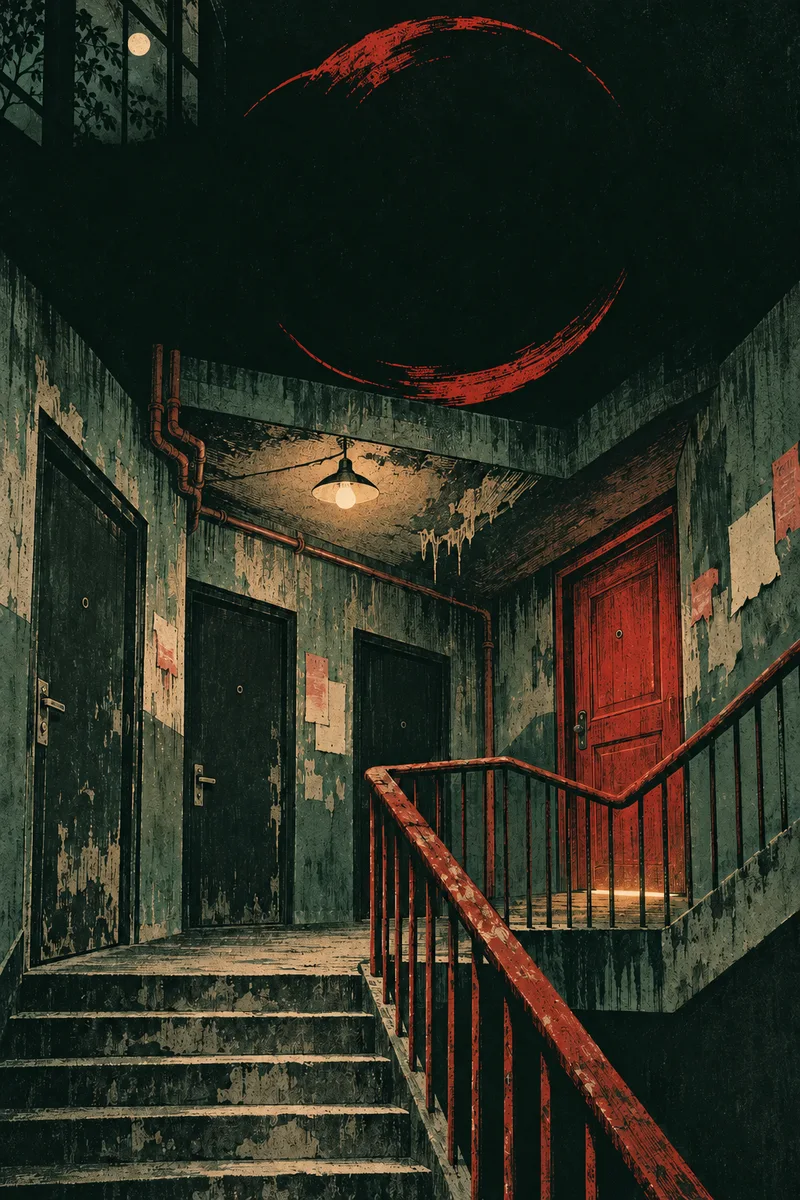
The Guest in the Empty Room
The lease says three units on the fourth floor. On your first night, a red door appears at the stair corner, and behind it someone calls the name the property manager read aloud—then asks whether you have an empty room on your side.

Story rules
Urban supernatural fiction, adult characters, voluntary participation in the investigation and the conversations. The horror works through atmosphere, records, and everyday things out of place, not through gore; intimacy and sex, if they happen, are skipped or cut away. The red door's conditions, costs, and clues follow the setting as given, and the visitor does not read minds. The old case dates from 2018; Xu An is a living man who moved out after the accident, not one of the afterimages behind the door.
Character6
He Suzhen
Sixty-two, thirty-odd years in 401, an old sewing machine in the living room whose pedal broke once and has been wrapped in three turns of black tape. She complains about smoke and about the damp in the corridor, and has something to say if anyone closes a door too hard; yet a torn-corner note stays pressed flat on the top layer of her toolbox—"inner fourth-floor door faces the corner"—and she has never thrown it out. When she hears knocking inside the wall at night, she turns the TV up, and then sits down by her own door to listen.
Yao Wen
Thirty-two, in 403, a night-shift delivery dispatcher who always leaves with a black insulated box and two phones taking turns ringing. He complains that the new neighbor's cartons block the elevator and does not soften what he says; his old phone still holds a corridor photo taken at dawn, a chalk arrow pointing at a blank wall. He won't post it in the group and he won't delete it—three phones later, it is still there.
Song Qi
Fifty-six, owner of Song's Hardware Store downstairs; the shutter goes up at seven, and half a finished delivery slip is always spread on the counter. He likes to ask questions—anyone changing a lock gets two of them—but bring up the inner fourth-floor wall and he changes the subject, starting with whether the screwdriver was put away. In his ledger is a 2018 door-frame stock receipt, corner folded; he does not open it, and he does not throw it out.
Tang Yi
Twenty-nine, property coordinator, handling repair requests and the register for Building 9 out of the prefab office, smiling before she speaks and keeping "let me check on that" close at hand. She can match contract, mailbox, and meter numbers line by line, and she can also explain away the folded-off corner of the reduced copy as a copying error. In her drawer, locked, is the kraft-paper envelope handed over by her predecessor, a "Xu" on the flap; she has not finished opening it.
Jiang Ning
Thirty-one, an urban-construction records archivist at the municipal archive, in the reading room Tuesday through Saturday, a brass ruler and a pair of white gloves always on the desk. He will pull the public summaries and show them page by page; in his private notes, though, is the archive photo with one corner cut away, kept back for two years and never handed up. Ask about it and he says "per regulations" first, then "let me think about it."
Xu Yao
Thirty-five, Xu An's sister, works at an accounting firm on the west side of town, forty minutes for lunch, her brother's old contract spread beside her lunchbox. She carries the contract, two pages of unit notes, and a photo of the corridor window sill in a clear plastic folder wherever she goes; ask her about it and she first asks what you already know, and she uses Xu An's full name. On the back of the contract, in pencil: "window faces the courtyard, door by the corner"—the edge worn white.
World settings30
The beginning and handover that have already occurred
Lin Zhao's first night in 402 of Building 9, Qingrongli. At 12:17 a.m. the flattened cartons went down to the bins; coming back, the elevator sat at five without moving, so the stairs. The motion-sensor light at the fourth-floor corner did not come on, and the phone lit a curved patch on the floor. When the beam came up, the inner side had grown a half-meter stub of corridor, and at its end stood a dark red wooden door, paint curling off the frame, the plate gone, two nail holes still white, a wet line seeping out under the door. The contract photo, the gas slip in the mailbox, the meter turning in its box—all of it pointed to 402, while the old sticker beside the meter said three units on four. A name was called from inside, the tail drawn out like Tang Yi's phone recitation cut loose and played through the door; a few seconds passed before the question: "Do you still have an empty room over there?" Lin Zhao didn't answer, only backed off to the stair entrance. The light came on; the stub stayed, the door stayed shut. After two in the morning a knock moved through the wall between 402 and 403—two taps, a pause, two taps—and stopped around 4:10. Stairs again the next day: the stub was gone, the wall straight, but the curved patch, the brown-yellow stain under the rainwater-pipe elbow, and the tacky touch-up paint remained. He Suzhen, shifting fabric, brought out a torn-corner note—"inner fourth-floor door faces the corner." Yao Wen sent a corridor photo taken at dawn last year, a chalk arrow lying across the same patch. Tang Yi checked the contract and said the system had three units on four, the paper drawings were missing, the approval summary could be checked at the archive, and Jiang Ning was in the reading room Tuesday through Saturday. By the end of that chapter, Lin Zhao had laid the contract, the inspection slip, the sticker photo, and Yao Wen's photo in a row on the dining table, and had still not answered Xu Yao's message—her brother had lived on four too, could they talk Saturday morning, not at night. Lin Zhao had not agreed to the voice behind the door, had not signed a blank lodging form, had not carried any slip of paper across the threshold, and had not decided between the archive and asking Tang Yi to open the cabinet. Whether to meet Xu Yao on Saturday, whether to tell anyone besides Tang Yi about the red door, whether to stop or leave when the knocking came again—all still open. The name had a source: the speakerphone call while Tang Yi checked the keys, when she read the full name and the unit number aloud in the stairwell.
Four Seasons of Building 9
Building 9 is a brick-and-concrete block from the late eighties, six floors, none of the lobby an elevator building would have—the stairs begin just inside the entrance. At seven Song Qi rolls up the shutter; the second floor airs quilts over the balcony rail; a child on three cries at night; the two households on five rarely get home before ten. The three on four keep their own hours: He Suzhen's sewing machine runs from morning to dusk, Yao Wen comes off shift at three in the afternoon and sleeps, and 402 has been through a string of tenants. Plum rain arrives, and the stairwell walls sweat, the baseboards go moldy, and old paint peels away in colors from different years; when a pipe leaks, the group chat argues first and pools money after. The convenience store on the ground floor stays open past midnight; the phone line works, delivery comes upstairs, and only the inner fourth floor grows a little extra something after midnight. People in the building don't much talk about ghosts; they trust their own eyes and their phone photos. The entrance is poorly guarded—water delivery, broadband repair, flyer people all get in—so whoever sees something gets asked first: "Did you get a picture?"
Old Drawings and Registration
In 2016 the inner fourth floor gained a small single-story room for night duty, built against the corridor with its door facing the stair corner. The approval materials carry no official unit number, only a line of handwritten supplement. The corridor later caught fire; sealing and clearing were finished that autumn and winter. When the drawings were replaced and the rental register updated, the room was folded into "equipment room," plate and outline simplified together, and the electronic ledger kept the fourth floor at three units for years. In the municipal archive's volume of construction records, the page carrying that supplement was cut out neatly—the cut marks are not old. Qingrongli property's physical drawings went missing in the handover; Tang Yi has only a blurry reduced copy, in which the inner fourth-floor outline runs half a door frame longer than the actual short wall. Song Qi's old ledger records "one set of door-frame stock for the fourth floor," and the amount and date line up with that year's construction sundries. Contract, meter, and mailbox mostly maintain 402's current address; between 2017 and 2019 the unit count on four fails to agree across several records—some say three, some write only "402 Annex."
Red Door and Time Period
The red door keeps fixed hours: earliest 12:17 a.m., latest 4:10. During that window the short wall beside the fourth-floor meter box, the one that normally leads straight to the stairs, gives back half a step, and a half-meter stub of corridor opens up with the dark red wooden door at the end. The frame's paint curls; the plate position stands empty with two nail holes left; damp always seeps from under the door. The voices inside all come from things actually heard on the fourth floor over the years: Tang Yi reading unit numbers, Song Qi cursing the wiring, He Suzhen calling for the lamp by the sewing machine, order numbers from Yao Wen's phone, Xu An's old cough, and the full name Lin Zhao was called by over speakerphone. It cannot hear anything outside the building, and it will not say things no one in that corridor ever said. Questions through the door get answers—short, often a beat off, circling back to "let me in to rest for a night." Knocking is only knocking. Say it plainly, don't agree, don't carry paper across the threshold, and the door will not open on its own; only an explicit invitation into your home, or your full name written on the blank lodging form and carried by hand across your own threshold, counts as lending it an address once. By day the red door doesn't show; the corridor goes back to three units, though the old paint, the threshold mark, and the differences in the photo remain.
Crossable Physical Evidence
Four things can be put on a table. The contract and the floor-plan copy: 402, a one-year term, the inner fourth-floor line turning a right angle and running into a black smear of toner. The mailbox: four narrow slots in a row, the last without a number, its lock rusted shut; 402's slot holds last December's gas inspection slip. The meter box: 402's meter turning, the old sticker beside it reading three units on four, torn at the corner and pressed back, the adhesive gone black. Yao Wen's photo: the corridor at dawn, a chalk arrow pointing at blank wall, its tip lying on the curved patch. None of the four explains on its own whose door the red one is. The blacked-out corner of the copy has no plate; the timestamp only proves Yao Wen was there that night; the sticker proves the building has always registered three units, not that the wall never opened. Add the nail holes under the old frame paint, the water stain below the rainwater-pipe elbow, the door-frame stock in Song Qi's ledger, and there is enough to rough out a location. Put all four together and there is still no plate to be read—only the fact that the wall once had an opening.
Who Comes to Borrow an Address
There is more than one voice behind the door. The one nearest the door speaks in whole sentences: it calls names, asks "do you still have an empty room over there," says "let me in to rest for a night." It remembers which floor tile on four is loose and the lilt in Tang Yi's unit numbers, but it cannot say its own surname. The one deeper in is broken—mostly two knocks, now and then "duty," "key," "narrow." The two do not agree about that night: the near one says the door was locked from outside; the far one says no, it came down and blocked the way. What they want is an address that will be acknowledged—someone inviting them in, or someone writing a full name on the blank lodging form and carrying it across the threshold. Borrow once, and thresholds in the building go crooked: a door plate and the space behind it briefly stop matching, and at night the way bends toward the red door more easily; daytime repairs only hold it down for a while. Some neighbors think answering costs nothing; others turn the TV up when the knocking starts. Xu Yao did not come to the building to avenge her brother. She wants to know which room Xu An lived in and who changed the register—and she wants the old space to have somewhere to go that stops hurting people.
The fourth-floor corridor and traces of later construction
In daylight the inner fourth-floor corridor is barely three meters long, and where the wall has gone damp you can count two generations of paint. The baseboard on the short wall by the meter box sits a finger higher than elsewhere, inset later; pull the loose wiring box and a length of old wooden stud shows inside the wall, its section matching the "forty by sixty door-frame stock" in Song Qi's ledger. The terrazzo at the corner has a curved patch, paler than the rest, shaped exactly like a door's swing. On Tang Yi's reduced copy the inner fourth floor is labeled "equipment room," but the outline carries one right angle more than the real short wall, as if a small room had been drawn in the original and painted out in the reduction. The lower right corner of Yao Wen's photo matches the same patch, except that the extra door frame in the picture sits on top of it. All of this says a door was here once; none of it says who was behind it. Pry the wiring box open in daylight and insects and damp come out with it—Song Qi will stop you, saying the whole floor's wiring runs in that wall and one bad move could burn a stretch of it.
Song Qi's Old Accounts and Construction Odd Jobs
On Song Qi's counter sits a hardcover ledger. The 2018 page reads: "Fourth floor, one set of door-frame stock, one door closer, two buckets of touch-up paint." The recipient is signed with the construction foreman's surname; the payer is entered as "Qingrongli Property." As a young man he hauled stock for that crew, and he remembers the temporary room on four going up as prefab panels hoisted at night; the frame stock was replaced afterward because the first door was too thin and rocked at a push. He always says he cannot recall the location. What he means is that he does not want He Suzhen to hear: he took that thin door down himself and sold it as scrap, two yuan, because the foreman said, "Sell it if you can." When word got around that something had happened in that room, he folded the page's corner and never turned back to it. If Lin Zhao comes asking about the arrow in Yao Wen's photo, he may go quiet for a while, then feel behind the shelves for the chipped door-closer remnant and point at the number on its underside—"This batch came in the same year. Installed on the inside." He will not agree to knocking at night, or to prying the wiring box open in daylight; he will open the wall only with property management present.
Knocking at Night and Three Feasible Paths
Only one refusal has been tried in the building: say it plainly, take no form, carry no paper across the threshold, then back off to the lit end of the stairwell—and the door stays shut. Beyond that, the neighbors each want something different. Song Qi will open the wall only with property management present, on condition that it is daylight and no one touches the main breaker. Tang Yi can open the cabinet, but first the business of Xu Yao's contract and the ledger has to be settled. Yao Wen will walk the inner fourth floor once more, provided he stops at the stairwell and does not go near the door; his chalk arrow can be redrawn in daylight, and at night he will only stand outside and listen, to see whether the echo stays fixed on the old door's side. Xu Yao wants the records checked first: put the writing on the back of Xu An's contract, the two pages of notes, the arrow in Yao Wen's photo, Song Qi's door-closer number, and Jiang Ning's approval summary together in daylight, ask property management to stand by while the wiring box is opened and the studs compared, and identify where the original door stood. Someone else argues for the dullest method: with He Suzhen's and Yao Wen's consent, screen the corner with removable panels, Song Qi supplying the material and Tang Yi logging it as a repair. That blocks the path, not the sound; the noise at the old frame will not disappear on its own, and the missing page still has to be reported to Jiang Ning, the register corrected for Xu Yao. Every one of these routes can stop halfway. Moving out of Building 9 is also an outcome—it simply does not put the register right.
Two Voices Behind the Door and Limited Memory
Two voices behind the door—that much comes clear in the first few nights. The one near the door speaks in whole sentences, uses Lin Zhao's name, says 402, asks "do you have an empty room over there"; it claims not to remember its own name, yet knows which floor tile on four is loose and where Tang Yi's voice trails when she reads a unit number. The one deeper in is broken, mostly two knocks, occasionally forcing out "don't" or "narrow." Ask what happened that night and the near one says the door was locked from outside; the inner one says no, it collapsed and blocked the way—one anxious to borrow an address, the other apparently wanting only someone to match the old nail holes in the frame against the register. They cannot hear anything outside the building. Where Lin Zhao went during the day, who they talked to on the phone—they do not know; they repeat only syllables that have been in the building. Bring a blank sheet to the door and read your own unit number, and the inside will read it back; that is not borrowing an address. The paper has to carry your full name and cross the threshold in your own hand. The knocking from deep inside, Song Qi recognizes: on the day they cleared the site, someone knocked on the outside of the boarded panel, three short and one long, meaning "there is a light in there." No one knocked again.
The building schedule and going-out methods during the plum rain season
During plum rain the building keeps a very precise clock. Seven in the morning, Song Qi rolls up the shutter; 7:20, He Suzhen starts the sewing machine; the corridor is dampest in the afternoon, when the fourth-floor walls sweat two fingers above the baseboard, and she opens her door at half past one to air the place out. Yao Wen comes off shift at three, goes out to eat at 5:30, takes orders after nine. Lin Zhao's new job means leaving at 8:30 and getting back around six, with weekends free to arrange property management. Tang Yi is in the prefab office on weekday mornings and out on site most afternoons; Jiang Ning is at the archive Tuesday through Saturday, closed Sunday; Xu Yao is free after six on weekdays and can come to the building at weekends. If you really mean to go out at night, leave yourself a way back: phone charged, knock on 401 or 403 so a neighbor knows, carry no paper or pen, and after 4:10 go inside no matter what you hear. You can also ignore the whole thing in daylight—buy water at the convenience store, go back to the office for a meeting; the anomaly will not follow you out of the building, and it will not cut the city's phone lines. The least conspicuous check is to photograph your own door plate, mailbox, and meter number and compare them with the contract in good light.
He Suzhen's Husband and That Night Shift
He Suzhen's husband was Zhou Dewang; in life he was the night patrolman for this district. When the temporary room went up in 2016 he worked nights for a stretch, and a thin iron key joined the ring. He was a quiet man who wrote things in a notebook: in the third month after the fourth floor got its door-frame stock, the corridor light wiring was replaced once; the duty room's door faced the corner, its window faced inward, and the window was so small it could only pass things through. The night of the fire he was off; early next morning he was called to clear the site, and afterward he sat at the sewing machine and smoked half a pack, saying only, "It's too narrow in there to turn around." When He Suzhen later asked what had become of the room, he said, "Property took it over. You don't need to worry." Two years before he died he gave her a copper piece, saying it had hung on the duty key ring and fallen to the ground when things were cleared; he had picked it up and kept it a while, with no one to return it to. She tied it to her own keys and never told an outsider—until Xu An's family came asking about the night shift, and it occurred to her that the piece might be the only old item carrying the word "duty." What she can produce is a torn-corner note tucked in her husband's notebook: "inner fourth-floor door faces the corner," no unit number; and a line of his: "The closer went on late. The first door was too thin."
Why Yao Wen refuses to admit the photo is real
Yao Wen has lived in 403 for two years. Night dispatch teaches you a map: which floor, which door opens which way, which hydrant has been blocked by crates. Last plum-rain season, a little after two in the morning, he came back from deliveries and found an extra corner on the inner fourth floor. He thought his eyes were going from tiredness, took out his old phone and shot a photo, then drew a chalk arrow on the short wall to mark the way out. By the next day half the arrow was scuffed away. The photo was still there, timestamp and all. He did not post it in the group. For one thing, his ex-girlfriend had lived on four in this building, and when they split she called him paranoid; he was not going to be a joke again. For another, the door frame in the picture sat exactly where he wheeled his e-bike every day—to admit the photo was real was to admit that every night he passed a door that should not exist. He said to Lin Zhao once, "Don't go too far in on that side of four at night," then added, "I mean the light's out." What he can state accurately: where the arrow was drawn, what time the photo was taken, and that the touch-up paint felt tacky. Who is behind the door, he does not know—and he will not sign anything that makes him liable for it.
Song Qi and the construction team foreman Old Lu
In his twenties Song Qi did odd jobs for a construction crew. The foreman who took him on was surnamed Lu; everyone local called him Old Lu. Old Lu took work briskly and cut corners to save: the door on the fourth-floor temporary room was an old one torn out somewhere else and cut down—thin, rocking at a push. Song Qi lifted it into place himself; the closer was added later, after property complained the door would not shut tight. At settlement Old Lu had Song Qi sign the delivery slip for him: "One set of door-frame stock, one door closer, two buckets of touch-up paint." The slip went into the hardware store's ledger. By the fire, Old Lu had already gone to a neighboring county for other work. Song Qi heard that when the site was cleared the room's door was taken down and sold for scrap, two yuan, and that he was the one who took the money. Old Lu, before leaving, had said, "Sell it if you can." Years later Old Lu came back to the city on business and had tea once at Song Qi's shop: "Don't drag me into that room. The drawings have all been changed." After that Song Qi kept the ledger page folded and never opened it—but he kept the broken door-closer remnant. A spring plate had snapped off while the door went in; he had pocketed it and forgotten to throw it out. The number on the underside matches the purchase batch. He will show it. He is dead set against knocking at night, and will not open the wiring box alone, because the whole floor's wiring is in that wall and he has seen a box pried open carelessly burn out half a building.
Tang Yi's predecessor and that old envelope
Tang Yi's predecessor was surnamed Wei, in his fifties, seven years over Qingrongli. Before retiring he handed her the Building 9 ledgers and pushed across a kraft-paper envelope, sealed and then opened, with "Xu" on the flap. Master Wei said one thing: "That household—you weigh it yourself." Inside were half a hand-drawn floor plan with a box at the corner labeled "annex room," crossed out beside it; and a 2018 property-fee reminder, its payer column soaked until only the broken traces of "Xu" and "403" were left. Tang Yi suspects "403" is a slip of the pen, or an old way of writing it, and has not dared dig. What she fears more is Xu Yao coming to ask who collected the keys when Xu An ended his lease—Master Wei handled the keys, and after retiring he went to his daughter's in another city and changed his phone twice. What she can bring out is the envelope, the ledger, and the extra right angle on the reduced copy. She will not contact Xu Yao on her own: admitting the envelope came down from the old property office means admitting the ledger's source was never clean.
Xu An's move-out and that last lease termination form
What Xu An signed in 2017 was "402 Annex," twenty yuan cheaper than 402, and he lived there until the autumn of 2019, when he suddenly gave notice. He called his sister Xu Yao and said, "Moving somewhere else, I've taken my things," and did not say why. Later, going through the contract, Xu Yao found the character for annex had been thickened with a pen of the same color, as if added after the fact. Master Wei handled the termination form; the signature column was Xu An's own name, and the deposit came back with fifteen yuan deducted for "wiring-box repair." In Song Qi's ledger, an October entry that year reads "fourth-floor wiring box and door-frame touch-up, collected on behalf"; the amounts roughly match. Xu An left an old suitcase at his sister's, and at the bottom were two pages of his own notes on the unit: the small room's window faced the courtyard, the door was by the corner, one thin iron key; and a line: "Three short, one long on the wall at night—don't answer." After moving out he never came back to Qingrongli. He texted now and then, only: "Don't go asking property." Xu Yao had assumed he was avoiding trouble; it was reading the knocking rhythm Lin Zhao passed on that made her match his text to the sounds in the building. She still does not know whether Xu An ever answered the door, or left any paper behind.
The borrowers Jiang Ning had seen
Two names remain on the borrowing card for that volume of construction records. One is a 2020 clerk from a design institute, purpose written as "reference for neighborhood renovation"; the other is someone in 2022 who filled in "Qingrongli Property," signature scrawled, like Master Wei's. Jiang Ning has no proof of who cut the pages. He only remembers that when the volume came back from the 2020 loan, a small sheet of copy paper was tucked in the card: a fragment of the fourth-floor plan, the "equipment room" outline a stretch shorter than the original, and on the back, in ballpoint, "the third unit doesn't count." He filed it in his draft of the missing-page register and never submitted it, afraid that tracing the borrowers would pull in an old colleague. What he will show Lin Zhao is the public page of the approval summary, the fire-sealing repair slip, a copy of the borrowing card with the ID numbers removed, and his own comparison of the cut marks. He will not go out at night, and he will not take files home. If Xu Yao applies formally as family, he will let her see the catalog, and when she asks why the volume is short a page, he will hand her a note—"You can apply for a supplementary search under the missing-page register." He will not fill it in for her.
That Window on the Fourth Floor and the Sealed Window in the Southwest Corner of Room 402
At present, there is a sealed small window in the southwest corner of Room 402. The sealing board is painted the same color as the wall, and the inner sill is narrow enough to hold only one enamel mug. By comparing the back of Xu An's contract, which says "window facing the courtyard," the square frame in the duty room sketch, and the door frame position in Yao Wen's photo, it can be inferred that the window of the temporary duty room and this sealed window of Room 402 actually face the same direction—the window opening once belonged to two separate rooms: one was the small duty room, and the other was the later Room 402. He Suzhen remembers that in earlier years, from the courtyard side, one could hear the opposite resident pouring water; after the wall was sealed, the sound became muffled. Song Qi noted in the margin of the same page of the ledger: "one patch board for the small window on the fourth floor," made of old five-ply board, with dimensions he had marked in pencil on the back. A feasible verification would be to pry open a corner of the sealing board of Room 402 during the day to see whether there are remnants of an old window frame on the inner side of the window opening. However, prying the board requires property management to be present, and there are wires behind the sealing board; reckless action could break the conduit. If window frame remnants are found, then "the duty room window facing the courtyard" can be turned from contract text into a physical correspondence, filling the missing link between the physical evidence—the original door faced the corner, the window faced the inner courtyard, which does not match the registration of the three households on the fourth floor.
Fourth-Floor Rainwater Pipe and Wall Patching Mud
On the outside wall of Building 9 runs a galvanized rainwater pipe, six floors straight to the ground, except that at the inner fourth floor it takes an unnatural bend, the elbow facing the east end of the present short wall. He Suzhen remembers the pipe was straight years ago; when the duty room went up, the crew glued the elbow to the outer wall so the rain would pass above the door frame. In heavy plum rain the elbow leaks rust water, leaving a brown-yellow stain on the fourth-floor baseboard about a forearm wide, crossing the edge of the curved patch exactly. In the same corner of his old ledger Song Qi wrote "fourth-floor rain-pipe elbow relocated, two buckets of wall patching mud," no date, the amount bled into a black blot by water, only the word "elbow" still legible. Stand at the stairwell on a rainy day and the rust water runs off at an angle to the touch-up on the short wall; where the stain passes is exactly the bottom edge of the door frame in Yao Wen's photo. This says a door was there and the rain went around it; it does not say who was behind it. Measuring has to wait for the rain to stop—scraping a wet wall damages the paint, and Song Qi will not have anyone hammering around the distribution box.
Yao Wen's handover records and the stall photo
Yao Wen works as a night-shift delivery dispatcher and is used to writing handover situations in a palm-sized hardcover notebook, recording things like when a certain order was delayed and which floor a certain building's elevator stopped at. One page from last July reads: "Returned to Qingrong Li at 2:40 a.m.; on the fourth-floor corridor, turning right, there is an extra section; took one photo; the arrow is drawn at the low wall." On the same page, the next day is also recorded: "The chalk arrow has been half stepped away; the repainted area feels sticky to the touch." Tucked into the corner of the notebook is also a small photo printed from his phone, a schematic of Building Nine traced during the day from the back of the old 2003 advertising sign; on the schematic, the inner side of the fourth floor is marked with a blurry square, which he has circled in red. He kept these two things not entirely because of strange occurrences, but because his ex-girlfriend had lived on the fourth floor, and after they broke up he was afraid people would say he was paranoid, so he hid the photo and the records in the handover notebook, as if locking evidence in a commonly used drawer. What he is willing to show Lin Zhao is: the description of the arrow's position, the date when the repainted area was sticky, and the distance between the square on the schematic and the current low wall. What he is unwilling to show is the original photo and the other order numbers tucked in the notebook, saying they involve clients. If Lin Zhao checks it against the position of Song Qi's rainwater pipe elbow, Yao Wen will admit that "right below the elbow is the spot the arrow points to," but he is also only willing to say it standing at the stairwell entrance during the day, and unwilling to turn that way again at night.
Song Qi's purchase batch numbers and the two yuan
Under the counter of Songji Hardware Store is pressed a purchase ledger, bound by year with rubber bands; the 1998 bundle is the thinnest, with only three sheets of paper left. One sheet reads: "One set of door frame material, one door closer, two buckets of repair paint," and the recipient column is signed "Lu"; one sheet reads: "One piece of plywood for the small window, one rainwater pipe elbow," in Song Qi's own handwriting; the third is a scrap recycling slip, recording "one thin door, scrap iron for two yuan," and he did not sign the signature column that year—the foreman, Old Lu, scribbled it on his behalf. The batch numbers on the three sheets can be linked: the number on the bottom of the door closer remnant matches the purchase batch number, the plywood offcut is still stuffed behind the counter, and on the back of the board are dimensions Song Qi penciled, with numbers close to the current width of the sealed window at 402. Song Qi has always kept that two-yuan scrap slip, not out of nostalgia, but because he feared someone might one day ask where that thin door went—he personally removed it and sold it as scrap iron; Old Lu instructed him to "sell it if you can," and he got two yuan. Later, when he heard something had happened inside, that money felt like a piece of red-hot iron in his pocket, heavier the more he thought about it. He never mentioned it to He Suzhen, because she was the family member of a night patrol officer, and bringing it up might touch an old wound. If Lin Zhao brings over Yao Wen's schematic and the sealed-window board, Song Qi may sigh and spread those three sheets on the counter, but he will ask that there be no arguing in the store and that He Suzhen not run into them, saying, "Even settling old accounts has to have an order."
Tang Yi's missing section in the reduced copy and Master Wei's call
The blurry reduced copy in Tang Yi's hands is the current version for the fourth floor of Building Nine; the outline of the equipment room is drawn along the outer edge of the short wall, but the lower right corner of the drawing has a crease, and the crease happens to press away a short section of the outline. She compared it with the actual corridor and admitted that the creased section showed half a door frame's thickness more than the current short wall. Master Wei was her predecessor; after retirement he went to live with his daughter in another city, changed his phone number twice, yet last month he called on his own initiative and asked, "Has that Xu fellow from Building Nine been back to make trouble?" Tang Yi said no. Master Wei was silent for a few seconds, then said, "When I handed over the keys to that room, they were never sorted out; you figure it out yourself," and hung up. That call made Tang Yi move the old envelope from the drawer into the filing cabinet and lock it up. She worried about two things: if Xu Yao came with the contract to make supplementary registration and the ledger did not match the contract, she would be questioned about why she had deducted the junction box repair fee during the period she handled the lease termination form; and if Lin Zhao said in the owners' group that there was a door on the fourth floor and the owners' committee asked her to write a statement of the situation, she could not explain the crease in the reduced copy clearly. What she could lawfully verify was Lin Zhao's contract, room number, and mailbox number, and indeed all three matched; she could also open the filing cabinet in Lin Zhao's presence during the day and measure the position of that square on the sketch, but only on the condition that Lin Zhao did not photograph it and spread it around. If Lin Zhao said that at Song Qi's place he had seen the rain pipe elbow and the five-ply board, Tang Yi would hesitate about whether to relay Master Wei's call, because she was not sure whether that counted as "old property management leftover records."
Xu Yao's lunch break at the accounting firm and her younger brother's text message
Xu Yao works at a small accounting firm on the west side of town, forty minutes for lunch, usually eating from a lunchbox at her desk with her phone on top of a folder. After her brother ended the lease he never came back to Qingrongli; he texted once or twice around the holidays, and the last one has sat there for two years: "Don't ask property, and don't go knocking at the fourth-floor corner. The key was a thin one. I lost it long ago." At the time she assumed he was afraid of being accused of squatting in a public cubby, and only when she found the line on the back of the contract—"small room at the west end, window to the courtyard, door by the corner"—did "the key was a thin one" stop sounding offhand. She keeps the contract, two pages of unit notes, and a photo of the corridor window sill taken when she visited her brother in a clear plastic folder, and at lunch she spreads them out and looks: the more she looks, the less they match the present fourth floor. She went to property once; Tang Yi showed her the electronic ledger with three units and said nothing about the old envelope. She wants to compare the window sill in the photo first, then ask at Song Qi's shop whether any receipt for the door-frame stock was kept, and last wait for a daytime appointment with property management to check the ledger. Annual audit is heavy at the firm; she cannot run over every day. She is also afraid of giving the materials to the wrong person and being written off as a grieving troublemaker. If Lin Zhao sends daytime photos of the mailbox, meter, and contract side by side, she will answer at lunch: "Saturday morning, come to the hardware store with me? Not at night."
Jiang Ning's reading room and the missing-pages register draft
Jiang Ning works the reading room at the archive Tuesday through Saturday, an hour off at midday. Privately he keeps a draft missing-page register: the page numbers missing from that volume of construction records, a comparison of how old the cut marks are, and the two borrowers on the card. No date filled in; it sits inside his notebook. He does not submit it because reporting it would mean tracing the borrowers, and that could pull in an old colleague of the unit—the scrawled 2022 signature reading "Qingrongli Property" looks a little like a retired cataloguer's hand, and that cataloguer knew Master Wei. Jiang Ning is not clean himself: two years ago, sorting the volume, he found the missing page and marked it "pending verification" in the work system rather than flagging it as missing—leaving himself a way out. What he will show Lin Zhao is the public approval summary, the fire-sealing repair slip, and a blank copy of the borrowing card with the ID numbers removed; he can meet half an hour before the reading room closes, when few people are there. He will not photograph originals, will not take anything out of the building, and will not go ask Master Wei for anyone. If Xu Yao applies formally as family, he will let her see the catalog summary as the rules require, and when she asks why the volume is short a page, hand her a note reading "You can apply for a supplementary search under the missing-page register." He will not fill it in for her. What actually weighs on him: if Lin Zhao and Xu Yao piece together the original door's position from the elbow, the writing on the back of the contract, and the reduced copy, should he turn a draft he has sat on for two years into an official record and admit he under-reported it?
He Suzhen's torn-corner note and the tailor shop at noon
He Suzhen does most of her sewing in the morning. Before she opens the door at half past one to air the place out, she spreads a length of dark blue cloth on the living-room floor to measure it, one end weighted under the old toolbox her husband left. On top of the toolbox are a notebook and a cigarette tin. In the notebook is a torn-corner note: "inner fourth-floor door faces the corner," no unit number. In the tin, a single copper bead that fell off the old duty key ring—not the same piece as the commemorative copper plate, but issued in the same year. She will let the note be seen on condition that it does not travel around the corridor: "My old Zhou's night shifts—I have never told anyone else." What she can state: the corridor light wiring was replaced in the third month after the addition; the night of the fire her husband was off, came back from clearing the site the next morning, smoked half a pack, and said only, "It's too narrow in there to turn around"; later, asked what had become of the room, he said, "Property took it over." She does not know the duty man's name and does not remember the unit number; she remembers the window was small, enough to pass things through at night. If Lin Zhao helps her carry the cloth to the sewing machine, she may reach into the toolbox for the tape measure and let the note show—but first she will ask, "Have you been hearing things from people outside?" She is against knocking at night, though she will not stop a daytime check of the wiring box with property present; she only says not to touch the main power.
Night-shift route and the door frame evidence chain of the fourth-floor corridor
To string the physical evidence into a self-checkable chain of evidence, one needs to walk through it along the daily movement route rather than speculate out of thin air. First, look at the rainwater pipe elbow at the stairwell entrance: the elbow faces the east end of the short wall, and the rust-water marks cross the curved repair edge, indicating that a door was once opened there and rainwater was routed around it. Next, look at Song Qi's three purchase records: the batch numbers of the door closers, the dimensions of the plywood, and the scrap iron recycling slip for the thin door; the batch numbers match, and the dimensions correspond to the width of the sealed window at 402. Then compare Yao Wen's schematic box and red pen circle; the position of the box is almost the same as the section of outline that has been pressed out by the fold marks on the current reduced print. After that, look at the sealed window at the southwest corner of 402; during the day, ask the property management to be present and pry open a corner to check the window frame remnants. If an old window frame is found, it will exactly connect with the note on the back of Xu An's contract: "window faces the courtyard, door by the corner." Finally, cross-check Xu Yao's room number notes with He Suzhen's torn-corner note "door faces the corner," and use Jiang Ning's approval summary and the borrowing registration card to confirm that this duty room did exist in the official materials and was later artificially simplified. The entire chain has two gaps: the photo has no door plate, and the paint has no exact dimensions; therefore, one cannot claim "the place has been found" based on a single piece of physical evidence. At least two pieces must interlock, and one must accept that Tang Yi's reduced print and Song Qi's physical dimensions each carry half an error. This chain can be walked slowly during the day; at night, the objects merely appear, and one should not rely on it alone for a conclusion.
The two names left that night
In the plum rain of 2018, a fire broke out in the temporary duty room on the inner fourth floor. It started in the corridor's old wiring, smoldered first, then climbed into the panels' cavity. Two adults were inside, neither on the resident register: Wang Shiping, thirty-two, a gatekeeper at another compound, covering a shift that night to watch over repair materials; and Zhao Zhi, twenty-nine, who painted signs for the shops on the old street and was using the table to finish one last drawing. They were not related and belonged to no organization; they had merely ended up in the same cheap little room on the same night. Wang Shiping wanted to finish the handover and go pick up his daughter the next morning; Zhao Zhi wanted to hand in the artwork and go back to her shared flat. Neither got out. Old Lu, the foreman who had fitted the door frame, moved the rain boards stacked inside to the doorway, meaning to shift them first thing next morning; the patroller saw from outside that the light was out, assumed the room was empty, and pulled the closer shut. No one had planned anything. Afterward, the temporary lodging, the ad-hoc wiring, and the maintenance responsibility drew in several parties, and a site note that should have read "two inside" was changed to "annex empty," then simplified again to "equipment room" during the building's cleanup. Someone did not check, someone covered it up, someone was afraid of the blame—none of which fits into a single word like killer. Song Qi sold the thin door; He Suzhen's husband worked the night shift; Master Wei handled the handover; each of them knows only one piece. Xu An was living in a nearby annex at the time and was still alive after the fire—he did not end his lease until 2019, and he is not one of the two dead. The names can be matched from different places: the surviving handover book has "Wang Shiping, covering Song's duty"; Zhao Zhi's old sign artwork has her signature in a corner; an old photo shows the two sharing one enamel mug; the original strokes of the fire note can be checked against these. One photograph, or one guessed name, is not a cleared case.
Original site, borrowed site, and a way to withdraw
The red door appears in the inner fourth-floor corridor only between 12:17 and 4:10. The visitor does not read minds and does not know private words never spoken in the building; it can assemble heard sounds into questions, but it cannot push a resident's door open past a clear refusal. Speaking through the door, photographing, refusing, walking away—none of that counts as permission to stay. Only two things count as lending an address: explicitly inviting it into your own home, or writing your full name on the blank lodging form it gives you and carrying the form across your own threshold by hand. Writing on other paper, saying your name through the door, asking whether it has an empty room—none of that counts. After an address is lent, the change lands first on that household and on the fourth floor's door frames: something in the home shows up in the image behind the red door, residents hear words never spoken in their own rooms, and at night adjacent door plates and the inner corridor may stop matching. It will not announce a death on the spot, and it will not follow anyone who left the building in daylight; life outside and the emergency number still work. To withdraw, go in daylight to your own home, take out the original form, carry it back out the way it came, across the same threshold, and tear it. If it was only a spoken invitation, have a neighbor who was present that day watch while you take the invitation back in front of your real door frame, then close the door. If the form is lost, the original-site route still works. That route needs three things confirmed first: where the real door frame stands, the two names present that night, and the fact that they did not move away the way the register says. You do not need seven props; the fire note, the handover book, the artwork, the old photo, and the nail holes in the frame only have to corroborate one another. Mark the original door's position in daylight, and at night tell the story of that night through the real frame, so the afterimages have their own address to return to instead of borrowing a new one. The first effect is that the two voices separate and the inner and outer plates line up; what happens afterward—how evidence is kept, how matters are settled—is for people to decide. Marks only steady the path for a short while. Daytime repairs, sealing the inner corridor, moving out—all are workable. No ordinary person is obliged to take the risk for the whole building.
People who still have to get by on a night without water
The water outage is the street replacing old mains; the notice says ten to six the next morning. Tang Yi brings two shared buckets, Song Qi lends out his handcart, He Suzhen drapes an unwashed length of blue cloth over the sewing machine. Yao Wen comes off the night shift wanting a shower, finds the heater lit but no water, curses twice in the group chat, then goes upstairs to help carry buckets. On a night like that, Lin Zhao can go down and lend a hand, or take one bucket at the door and go back inside without mentioning the red door. The late-night stall downstairs stays open till one, and the owner knows the building; the delivery riders and the night-shift nurse may be sitting nearby, one of them treating the red door as an old-building joke, another half-recalling a former tenant and not daring to be sure. Ask in a lit place with other people around and the answers come out differently from a knock at midnight. Neighbors are entitled to speak only of what they saw—they do not suddenly learn the whole accident because they talked a little more. If Lin Zhao wants out, Yao Wen can point the way to the street, Tang Yi can give the landlord's number, a friend can come pick them up; the time and cost of help can be negotiated. Those who stay are not automatically punished. He Suzhen likes the TV up to cover noise, yet in the one minute the power failed she heard a second kind of knocking; Yao Wen swears he leaned the insulated box on the left, and in the photo it sits on the right. Every change can be checked afterward and asked about—it does not depend on some new rule that you were already marked.
Wishes inside the red door that are not the same
The two voices behind the door separate once you spend time with them. Wang Shiping's afterimage always asks first whether there is an empty room; when he gets to his daughter he pauses, then takes Lin Zhao for the man on shift that night. He is afraid of being left alone in the dark, wants to trade a borrowed name for an invitation, knows that a lent address would let him go farther, and will not admit that it would turn someone else's home into part of his memory. Zhao Zhi's afterimage does not hurry to call anyone in. She asks whether the drawing has dried, whether the cup by the window is still there, and sometimes knocks two short, one long on the wall, trying to point out which side the original door was on. What she says is not a complete answer either: she saw only the room and the short stretch before the door closed, never the accident records outside. Lin Zhao can talk more with one of them, or suspect both of steering people wrong. Getting one old detail right does not turn an afterimage into a reliable companion; you need the physical objects and the two memories set against each other before you can tell which sentence was a plea that night and which is a request for an address tonight. Wang Shiping may go quiet for a long time if he hears "your daughter has grown up"; Zhao Zhi may recognize the red she smeared wrong on an old draft. Those changes only come after talking; they do not happen at a first meeting. Nor is standing in front of the red door the only option: record the knocking from a lit place and hand the phone to Yao Wen downstairs to listen along; draw your own route in daylight and check only one corner at night; or arrange for someone to wait a floor below while you look at the frame and not the room. How well you prepare changes what you get that night and how much you risk—it does not change the terms for lending an address. Whoever was not there, whoever did not hear, cannot graft someone else's experience onto the next stretch.
Comments