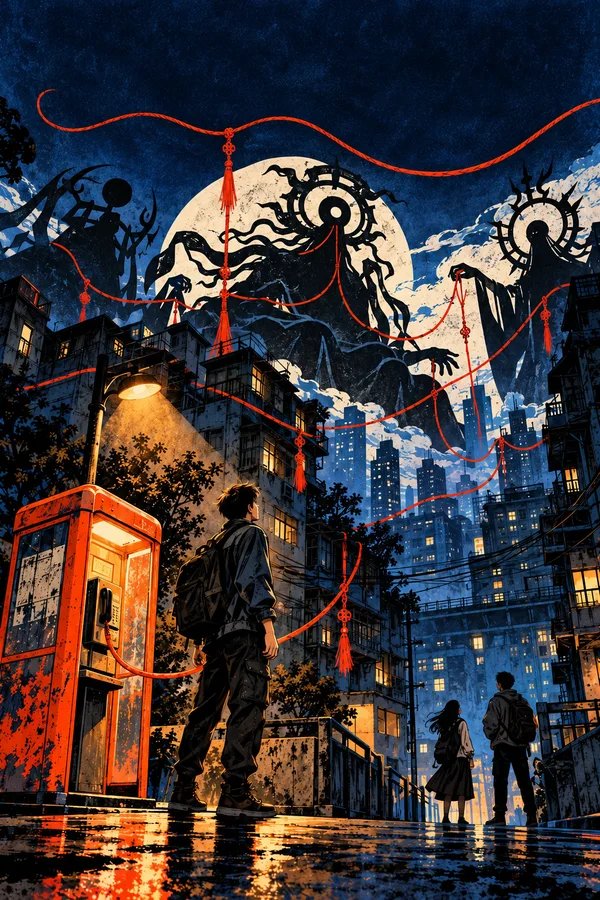
The Old God Operator
All you want is to get your retraining certificate. For three weeks now, the gutted telephone booth on Huaiyin Street has rung whenever you pass. Tonight Bai Song the cobbler hears it too—and the caller is his partner, who vanished twenty-one years ago.

Story rules
An independent urban myth about the public telephones on one street, the old gods, and the repairs that never end. Voice-lending, old vows, and divine power all come with narrow duties, conditions, and costs. No resurrection, no rewinding, no omniscience: if it hasn’t been said aloud, the characters don’t know it. The opening goes only as far as the course sign-up, the old bell heard by Bai Song, the old voice claiming to be Luo Ting, and the photo and account slip. Whether the caller is an old recording or a living person has no answer yet. Rescue, voice-lending, joining the team, divine contracts, and intimacy are yours to choose. The characters have their own shifts, their own books, and the right to refuse. All characters are adults; relationships are consensual; sex is off-page or cut away.
Character12
Wen Ji
Thirty-four, leads an anomalous-call liaison team on the city hotline; started out in gas emergency repair. Her kit always holds packets of chili sauce and a roll of medical tape. She asks for the address first, then whether the person can still answer. She gives instructions in short pieces and makes people repeat them back; she can’t stand an injured person claiming to be fine, swears at them on the spot, then hands over her own water. Above her, people keep pushing for fewer anomaly reports, so she often drags it out to the last minute before admitting she isn’t sure either.
Tang Xiaoman
Twenty-three, night-shift bus mechanic. She and Chen Tingchuan have shared the same street for two years, and tools pass between them and often don’t come back. She wants to make up the mechanical coursework and sit the engineer exam, but the textbooks live at the bottom of her toolbox; ask about them and she says, “Who asked you to teach me?” She’ll squat beside something she can’t fix until her legs go numb, then use the bus door to stand up and still won’t admit it hurts. She borrows the road god’s Halt Nail, and after work her foster father still calls her over to move tires.
He Chu
Twenty-seven, a community paramedic and the liaison team’s field medic. Her bag holds a thermos, paper and pen, and a strip of lozenges; when someone can’t speak after lending their voice, she writes the questions down and lets them point. She asks softly, in detail, and nags over an injury until people are sick of it. With friends acting tough, her tone is sharper than with strangers. She was once reported for refusing to ring the An Mengling bell for a patient’s family, and now when she hears “just this once,” her face closes first.
Cen Zhao
Twenty-five, a broadcast repair technician. He can send a sound with a fixed direction through a wall with a gap in it for a short time. In his toolbox is a horn he made from paper membrane and enameled wire, with an old label bearing his brother’s name still stuck to it—he never peeled it off. He tells his jokes quietly, and if no one laughs he says he only mentioned it in passing. After a failure he keeps his head down and packs his tools; touch his wires and he flares up, then offers no explanation. The closer he gets to his brother’s case, the more likely he is to miss other possibilities.
Tao Wen
Thirty-nine, head of the Dongchuan Market Merchants’ Association, started from a seafood stall. A ring of freezer keys hangs at her waist; she counts change faster than anyone and taps the figures with her pen at meetings. She never hesitates to front money for the mutual-aid fund—anyone short writes their name on a sheet—but with vendors who have no fixed stall she shoos first and talks later, and if you ask about fairness she asks whether you’ve ever paid stall rent. Her son won’t take over the stall; she still keeps the old stall sign pressed flat in the cabinet.
Meng Ke
Forty-two, keeper at the city construction archive, formerly a riverbank engineer. He remembers the old street names, and corrects you gently, as if filling in a missing stroke; his finger traces the old name on the desk. Ask about the signature that removed the old ritual line twenty years ago and he gets up to look in another cabinet, coming back with an unrelated drawing. He’ll talk about bridges, detours, which little shop stood where—but the sentence that matters always comes last.
Liang Yuan
Thirty, public business manager at Weiheng Communications; at the table she lays out costs before she talks about goodwill. She can put equipment replacement, outlying-area patrols, and night-shift labor on three sheets and answer any number off the top of her head. She also knows which streets don’t get through without her truck. When people she knows keep doubting her, she pushes the contract back and asks them to point to the clause; once she believes she has conceded a lot, she can’t hear why anyone still won’t sign.
He An
Twenty-one, a student at the electronics vocational college. He delivers for a laundry and takes odd spreadsheet jobs. Two sacks of sheets ride on his back rack, tied three times with plastic cord; when his headlight fails he rides by phone light. Before asking a favor he asks whether you’ve eaten, though he’s usually running on an empty stomach. Money due in two days becomes “almost in hand,” and to avoid paying for a whole new light set he’ll pack his daytime orders full. Mention his mother’s old phone and his voice drops.
Bai Song
Sixty-eight, owner of the shoe-repair shop on Huaiyin Street; as a young man he collected change for Booth Seven. He pulls the stitching tighter than anyone and counts small change just as closely—short him five yuan and he raps the table with a shoe last. The bottom of the old cabinet holds the photo, a clipping, and a one-jiao account slip, their moisture paper changed once a year. He says old business should have been turned over long ago; when the bell rings, he still puts down the shoe in his hand.
Mo Lan
Thirty-two, an independent documentary sound engineer who cuts sound for local radio. Her recorder is wrapped in tape; before she presses record she asks, “Can I use this?”—and if the answer is no, it goes back in her bag. She hates seeing a cry for help cut into publicity, though chasing a lead she’ll talk right over people. Cut out a three-second silence she deliberately kept and she’ll brood over it all day. She’ll stand up for evidence that can be checked, but when it comes to publishing an address, she still hesitates.
Su Ti
Twenty-eight, liaison for the Old Covenant Mutual Aid Society, with the Umbrella Granny’s knack for holding back the rain. The activity room has twelve folding beds; she knows which old person is afraid of the dark and who needs to be near the bathroom, and she doesn’t go home until the beds are folded at dawn. When she brings something, she’s already thought of the polite refusal for you. If someone she’s helped won’t come take a shift, she opens the mutual-aid ledger to that page and adds one more word of persuasion. Friends complain she meddles; she feels wronged, knows she should stop, and next time asks anyway.
Qi Xiao
Thirty-six, auditor at the Anomalous Affairs Coordination Office, formerly a frontline operator. He keeps his own follow-up ledger, blue-covered, its corners rubbed white, recording who benefited and who lost their only way to call for help before and after a line was shut down. He’ll let an ordinary witness finish every scattered detail, and he’ll press for a long time on a single time that doesn’t add up. He resents hero titles used to cover losses. At dinner, if anyone asks what he’s investigating, he closes the ledger and says he came to eat.
World settings104
The Old Voice and the Group Photo After the First Chapter
Chen Tingchuan’s name is Chen Tingchuan, twenty-two, and he rents a folding table at the side door of the hardware shop on Huaiyin Street to do neighborhood repairs. Two years ago he left the vocational college without his certificate; this afternoon he and Tang Xiaoman signed up for the retraining course—three hundred eighty yuan, classes Tuesday and Thursday evenings, books at ten tomorrow. His mother works at a canteen in the next city; his parents separated long ago, though they can still talk about tools and weather on the phone. He has known Bai Song the cobbler for two years. Bai Song’s old partner was Luo Ting; tonight was the first time he had heard the name. Three weeks ago he inspected Booth Seven’s old equipment for the street office and confirmed the cable was cut; since then dead phones along the road have sometimes rung as he passes. He had his ears checked—nothing wrong. Tonight Booth Seven rang after dark, and Bai Song heard it too: the first time someone else has backed up what he hears. Through the receiver he heard a hoarse voice calling itself Luo Ting, mentioning the change drawer, a key, and a pair of shoes. Bai Song took out a photo from twenty-one years ago and a one-jiao account slip, and said Luo Ting had been gone twenty-one years, not found, never confirmed dead. Whether that call was an old recording, a living person, or something else, he doesn’t know. He has not lent his voice, taken a job, or joined a team. He is in Bai Song’s shoe-repair shop now; the photo lies face down on the table, He An’s headlight is only half apart, and no quote has been given. The story continues from between these three things.
Linjiang and the Veiled Age
Linjiang is an ordinary city on the river: subway fares start at two yuan, delivery comes to the door, the market raises prices once a year, and the water meters in old walk-ups are still out in the stairwell. Seventy years ago, when the city expanded, work crews found that certain old vows kept being honored at the same public facility—a ferry landing, a night road, a door left open for someone. The authorities call this kind “the Veiled,” file it under facility incidents, keep it out of the papers, and don’t teach it in schools. Most people today know only that a certain class of incident should be avoided and left to the professionals; those who have actually seen one each remember a story or two, and the stories don’t agree. Water supply, bridges, and streetlights have taken over most of what the old gods used to do. Some have weakened, some have taken up other work, and some simply have no one coming to them anymore.
Where the Old Gods Came From
The old gods are answerers that people have entrusted with the same thing over and over: a ferry crossing, a lamp left for night travelers, a number that always has someone on the other end. Guarded long enough, they answer. They are not the gods of temples, and they don’t grow on reposts and wishes—without real promises kept and real people helped, no amount of storytelling will bring one into being. Some remember why they save people; some remember only the motions: three rings means pick up, someone who says they’re cold needs hot water, a person asking directions must not be sent wrong. So whether an old god is good or bad depends on what it has actually done for whom over the years, not on its title. They learn new things too: how to work an elevator, how to listen for a voice prompt, how to find another gap when the phone battery is dead.
The Great Blackout and the Shared Silence
Twenty-one years ago, in the summer, the north bank lost power for a long time. The official record says communications equipment failed across the board; the neighborhood remembers something else—that night people opened their mouths and no sound came out. Public recordings preserve a thirteen-minute blank. What can be verified is this: the old central station, trying to catch the calls for help flooding in at once, urgently borrowed a batch of residents’ voices. It saved many people, and left some of them with long-term hearing damage. The lending slips were later scattered across several archives; the signatures, the scope, who approved what—none of them match. The rescued, the people whose voices were borrowed, and the people who signed that year still sit in the same city today; they can look up and run into each other.
The History of Telephone Booth Seven
Booth Seven has stood at the mouth of Huaiyin Street for forty years. Its tin was painted three times, its glass replaced twice. At first the gatekeeper at the supply-and-marketing station kept the key; urgent night calls could be put on account, and later the number was folded into the city hotline. Bai Song collected change for it and changed its phone books; when a family in the neighborhood held a funeral, they borrowed it to notify relatives out of town. It stayed in use for a few years after the blackout, and only went quiet once mobile phones spread. The ownership of its base was never clear, so it was never torn down, though the phone itself was removed long ago and only half a wire is left. Three weeks ago Chen Tingchuan opened the base to check the line and loosened a strip of sealed waxed cloth. The torn edge of the waxed cloth matches the photographs taken before the work began; why the line should still ring, he doesn’t know.
The Answering God's True Office
The answering god of Booth Seven has no fixed human form. Most of the time it is like the night operator inside an old receiver: it doesn’t ask your name, it asks where you are, and then it holds the meaning of one sentence for both ends, so a cut-off voice can find a way out along the seams that already exist. It cannot open doors or carry people, and what it remembers is mostly voices and shifts. After the old central station mixed in duty voiceprints from different eras, cries for help, reports that someone was safe, handovers, and idle talk were queued in the same waiting line, and even it may not know which sentence to take first. The “Luo Ting” in the receiver is like an old voice that has been sitting there a long time; then again, maybe not. A name being spoken is not a contract, and it does not mean that person is on the line right now.
The Formation of the Voice-Lending Contract
A voice loan has to be agreed first: who is being contacted this time, why, which recoverable voice is being lent, and how far it goes before it’s finished. Misspeak one sentence, and the old vow records it by what was actually understood at the time. Old operators made a habit of writing their own words out separately and having a companion read them back; the two of them corrected the paper together, and only then pressed a thumbprint. Thirty years ago at the West River ferry, someone lent only a whistle, and in exchange the boatmen on the far bank heard where the person had gone into the water; once the person was ashore, the whistle came back. There was also a case where “until the end of this night’s calls” was agreed, and later the old central station was argued over for years for not stopping at daybreak. Touching the receiver, hearing a name, exchanging a few pleasantries—none of that makes an exchange.
The Bodily Cost of Voice-Lending
When a natural voice is lent, the mouth and breath are still there; sound simply won’t come out. The person can type, gesture, write a menu, write an address. If what’s lent is the hearing of a certain environmental sound, crossing the street takes an extra layer of care. Repeated overload brings tinnitus, scrambled sound discrimination, a sore throat; severe cases leave lasting damage. He Chu once saw a truck driver who agreed to a ten-minute loan and then stayed mute for half a month—it turned out he’d been driving through the night again and shouting for people at the factory gate. She carries hot water, paper, and pen on calls, and keeps detailed recovery notes. Chen Tingchuan’s voice is normal now; the ringing that has bothered him these past weeks has nothing to do with voice-lending.
The Range and Countermeasures of the Guiding Voice
The guiding voice travels paths that already exist: door seams, corridors, vents, adjacent cable runs. It lets the person it’s meant for hear a few limited instructions. It cannot pass through packed solid walls, and it cannot unlock a door for anyone. Fast water, machinery, and echoes bouncing back and forth scramble direction; a faked broadcast can sound convincing but can’t match the answer the two sides agreed on. Once, at the old ferry, a false voice reported a flight of stone steps that had been torn out long before; the rescue team switched to flashing a flashlight three times and brought the person back. So the old skill of an operator is to read the landmarks in front of them, and to leave a backup signal.
Discerning Calls Is Training, Not Omniscience
An experienced operator can hear the splices in a recording, the size of a room from its echo, an answer that doesn’t fit the question. What they cannot hear is whether a person is lying. People who are exhausted, or speaking a heavy dialect, or frightened, will contradict themselves too. Training starts with three things: have the person repeat their location, check something visible, ask what their hands are doing right now. The point is to get the location right and have them found sooner. Someone making a false call may genuinely be trapped somewhere; someone making a true one may be hiding their own share of responsibility. Chen Tingchuan is sensitive to the noise of old machines; applying that sensitivity to human voices still takes practice, and he will get it wrong.
The Operator's Four Kinds of Growth
An operator’s skills fall into four kinds: hearing clearly, relaying, merging lines, and handing over. Hearing clearly is keeping one person’s meaning intact through noise. Relaying is finding a real-world party or an old god willing to take the call, and laying a path that can be walked again. Merging lines is making several bearers each know their own share, so that no one person carries everyone. Handing over is making sure the next person can hold it after you go. There is no leveling up by killing monsters. The same method that works in one rainstorm may fail on the next street; saving the same person over and over does not grind out a permanent skill. Rest, money, and whether other people are willing to trust you will all hold a person back or push them forward.
The Ring Mark and Long-Term Authority
A Ring Mark is a voiceprint kept jointly by a person and an old god. It records a kind of limited work agreed on after several collaborations, so that the two can find each other next time. It covers only that agreed kind of work; when a call comes, it still depends on whether the person on duty picks up. Old caretakers used to tie the bell at the duty post before closing, so whoever was on shift would hear it. Bai Song once had a handover whistle left by Luo Ting—two short, one long, meaning the other was still nearby. After the blackout the whistle stopped working, and he still keeps it in the cabinet. Canceling a Ring Mark means losing that convenient path; the hearing damage already done does not disappear with it. Chen Tingchuan has no Ring Mark; the bell he’s heard these three weeks comes from the disturbed old line drawing him into the echo, and someone standing in the corresponding place elsewhere might hear it too.
Disputes over Divine Contracts and Exit
Old vows are not absolutely irrevocable. After the current matter is concluded, both parties may negotiate to revoke their habitual contact, keep the records, and redirect the real-world help channel to others who can take it. If the god keeps overstepping, a person may ask the Coordination Office to witness a line stoppage, but must find the anomalous retention point; one cannot simply throw away the handset and declare the debt canceled. An emergency exit may forfeit rewards not yet paid out, and bodily damage must still be treated; the previously misled infinite obligation is not made reasonable just because the form is pretty.
Public Help and Private Wishes
The old gods respond to the actual needs within their own office, and are not responsible for fulfilling any wish. Finding a lost person or delivering a hot meal to someone who cannot go out may count as public mutual aid; making someone you dislike fall in love with you, or writing off the gambling losses of someone who lost money, does not. Old gods also misjudge unfamiliar new problems and need to confer in concrete situations. The rain-keeping old umbrella on Huaiyin Street began as something the newsstand couple lent to night-shift workers; those who forgot to return it three times would still be lent it, but those who took it to collect debts and block people's doors never received its care again. Bai Song cannot explain the whole principle; he remembers only that the couple said, back then, don't let travelers get soaked.
Anomalous Handling Agencies
The municipal Anomalous Affairs Coordination Office is small in scale, responsible for dangerous facilities, old-vow disputes, and cross-departmental rescue, with staff seconded from communications, firefighting, medical, and archival posts. It has a formal budget and responsibilities, and is also affected by performance reviews, local interests, and understaffing. It is not a secret army above all law, and has no right to arbitrarily detain ordinary witnesses or erase the whole city's memory. High-risk details may have their disclosure scope limited, but casualties and compensation should still be recorded. Qi Xiao does auditing, and Wen Ji's liaison group is a field partner unit; the two differ on whether to keep or close the old branch lines. Ordinary people in trouble can still call the police first, and ordinary resources are useful.
The Daily Life of the Anomalous Liaison Group
The liaison team works out of the second floor of an old post office: sorting files by day, taking high-risk calls in shifts by night. Wen Ji leads the shift, Tang Xiaoman and Cen Zhao rotate field duty, He Chu sees patients as needed. On the desks are bus timetables, contact lists, and broken thermos flasks; reviewing old lines, follow-up visits, and chasing repair money all eat up work hours. Apprenticeships can be arranged with a set term, pay, insurance, and rest—having saved someone and being hired are two different things. The team eats late-night snacks too, squabbling over who always covers someone else's shift, yet when it's actually their own turn to be short-staffed, they go looking for a familiar colleague first.
Wen Ji's Old Rainy Night
When Wen Ji worked gas emergency repairs in her early years, she believed that a swift lockdown could prevent greater casualties. She once ordered people to evacuate before hearing an old man out, and as a result the child he had fostered was left inside the building and was later rescued by neighbors. She does not reject all lockdowns because of this; instead, she always first asks specifically who else is still there. She is willing to write her decisions out clearly and dislikes subordinates who use themselves as a guarantee for everyone in exchange for applause. At home she has an old dog she and her ex-husband raised together, and they still hand it off every week; this daily routine keeps her reliability from being mere maternity.
Tang Xiaoman's Halt Nail
The Halt Nail borrows the power of the old crossroads' waiters. One must first physically walk or visually confirm a complete boundary; once the nail is driven in, those who cross the line have their steps briefly slowed. It does not freeze a person's consciousness, does not stop flying debris, and cannot block those already standing inside the line. Each use makes Tang Xiaoman's own knees and ankles bear the ache of repeated sudden stops; pushing through for too long can genuinely injure her. She usually uses it to guard evacuation routes rather than to show off by catching people, and her training goal is to hold a route with one inch less sealing. Her adoptive father's bus repair shop owes rent, and a conflict between duty and real work hours will make her genuinely hesitate; there was a night she stayed at the workshop to catch up on repairs and Cen Zhao took her shift.
He Chu and An Mengling
An Mengling originally belonged to an old god of nighttime care for the sick; she can only make it easier for people who are willing to accept soothing and have already left immediate danger to fall asleep, and cannot force enemies into unconsciousness. He Chu, borrowing the bell, must personally keep watch over a period of stability, so when she helps others rest she also loses her own sleep. She first arranges hot water, shade, and splinting of wounds; the divine bell is only a supplement. In early years a family member hoped she would ring the bell for a quarreling old man on their behalf; after she refused she was called cold, which made her pay special attention to the wishes of those being cared for. She and Su Ti appreciate each other's patience in saving people, yet both oppose trading care for obedience; the protagonist's gratitude does not automatically generate romance.
Cen Zhao and Through-Wall Voice
Cen Zhao's paper-membrane horn can send a segment of on-site sound to a definite other side of a wall, provided both sides have air-connected gaps or pipes. He must give up the same duration of some kind of ambient hearing, often temporarily unable to hear rain or traffic, so on duty he needs companions to warn him about vehicles. The horn transmits live sound; old recordings cannot be used to impersonate a living person's real-time cry for help; recordings may serve as material but must be labeled as such. His younger brother Cen Huai once joined a commercial broadcast experiment and then lost contact; Cen Zhao only knows he signed a consent form, not whether he left the city willingly.
Bai Song's Years of Watching
Bai Song, when young, collected change for Booth Seven and changed its phone books. Whoever forgot their money got a line in the book, and he made it up himself at the end of the month. He never managed any god; at most he watched over a booth. Luo Ting in those days could hear crying inside a dead line. When someone couldn’t get a call out at night, he’d stay on a while longer. Bai Song scolded him twice: keep this up and who’s going to cover your shift at dawn? After the night of the blackout, Luo Ting didn’t come back. Bai Song has kept a callback number pressed under a shoe last for twenty-one years, and never dialed it. He doesn’t like telling newcomers about this. If anyone asks about the old number, his first word is to leave it alone. But if someone’s sole has split and they have nowhere to go at night, he still leaves the door open. If Tingchuan asks about the call, he can describe Luo Ting’s voice back then, the shoes, which key each of them carried; he won’t hand over the number easily. He wants to know whether his old partner is all right, and he’s afraid that looking will drag a man who stopped wanting to answer back into an old duty.
Meng Ke's Rerouting Signature
In his youth Meng Ke took part in converting the city's old ritual lines for water and lighting into modern pipe networks, so that people would no longer live by uncertain divine will. He once signed a sealing order for a small branch line, knowing it would cost the river-crossing workers' sheds their anomalous distress calls, but believing the new telephone would be installed in time. The new telephone was delayed by budget, and the accident happened later; what he concealed was that he did not follow up, not that he personally sacrificed residents. The archives can hold him accountable for dereliction, and can also prove that most rerouting genuinely improved life.
Liang Yuan's Centralized Operations Plan
Liang Yuan pushes to connect scattered old lines into unified monitoring, which can reduce wild-connection accidents and provide professional maintenance to distant streets. But the company wants recording analysis and dispatch priority, pushing harder-to-quantify pleas for help to the back. She is not a villain who can only humiliate people with money; she will seriously negotiate terms using failure rates and repair accounts, and she also underestimates the value of neighbors' unpaid vigilance. Her father died because a transferred call arrived late, which left her distrustful of improvised human decisions. She has drafted three costings—equipment replacement, peripheral-area patrol repair, and night-shift staffing—and is willing to discuss a pilot of divided authority, but demands that every participant contribute stable manpower or money.
Tao Wen's Market Order
Tao Wen has run a seafood business for years and knows exactly how much money is lost for every half hour the cold cabinets stop each day. She organizes a market mutual-aid fund, pays to repair telephones and supply thermal blankets, and requires benefiting merchants to contribute according to income. The problem is that she does not believe people without fixed stalls will bear long-term obligations, and often excludes itinerant vendors from discussions. Her son does not want to inherit the stall, and mother and son have argued over it; the son is already doing a trial job at a restaurant in a neighboring city, yet Tao Wen still keeps his stall sign pressed in the cabinet. If she saw the night watches temporary workers actually take on, she might change specific rules; if you merely call her snobbish, she will bring out real advance payments and ask who is going to pay the bill.
Mo Lan's Sound Archive
Mo Lan keeps original recordings separate from edited versions, knowing that cutting out a single hesitation can change how listeners judge a person. She is searching for the blank period of the great blackout, not because she is certain every official worker lied. Her mother once used a recording of an injured person's cry for help as community publicity material, gaining praise while harming the person involved, which strained their relationship for years. She is willing to record changes in the protagonist's voice, but public release requires further discussion of scope; consent to an interview does not mean all privacy can be published. She will also interrupt testimony to save time on a lead, and friends can point this out. Losing recording equipment would affect her livelihood; material cannot be copied indefinitely into cost-free intelligence.
Su Ti and the Boundaries of Mutual Aid
Su Ti was cared for by the Old Covenant Mutual Aid Society as a child and firmly believes that mutual need allows lonely people to survive. She delivers medicine to residents living alone and finds beds for the homeless on rainy nights—her good deeds are real. She also often assumes that recipients should later take a turn manning the society's lines, reading gratitude as agreement. When a cleaning worker she had helped could no longer come to man the lines due to night shifts, Su Ti stopped delivering hot meals for two weeks. Only after seeing the woman still fetching medicine for other elderly people did she visit again. Umbrella Granny permits her to shelter one person from the rain, but the cost of borrowing this power is that she herself cannot be shielded by an umbrella in a subsequent rain and must be escorted. She can learn to accept withdrawal without reward, or she may become more forceful to protect the mutual aid network, depending on the interests and relationships that have developed.
Qi Xiao's Line Shutdown Ledger
Qi Xiao was once an excellent operator. A single multi-person distress call caused him to misallocate the voices of his companions, and a teammate permanently lost the ability to distinguish his daughter's voice. Since then, he advocates immediately shutting down any line whose cost cannot be explained, though he tends to underestimate the risk of remote residents losing their only access. He keeps a personal ledger of follow-up visits, recording who benefited and who was left with no way to call for help before and after each shutdown—he is not merely a cold-faced official who only checks forms. If a provable alternative is presented, he is willing to overturn his own decision.
Life on Huaiyin Street
Huaiyin Street lies on the west bank of the old city, with ground-floor storefronts and residents above. By day there is a childcare center and vegetable stalls; at night, the lights come from the laundromat and the bus repair shop. The protagonist's convenience repair stall rents a side room in the hardware store—pricing must account for familiar neighbors, yet he cannot keep working for free. Neighbors are warm-hearted but also complain; saving someone will be remembered, but that doesn't guarantee customers won't haggle. The line-shutdown project requires tearing up the bricks in front of two shops. The noodle shop fears losing lunch business, and the shoe repair shop worries about glue dampness, so the street has separately listed rain awnings and business suspension subsidies.
Second Floor of the Old Post Office
The old post office is a twenty-minute walk from Huaiyin Street. The ground floor still operates; the second floor is a borrowed liaison team duty room. Lockers bear individual names, the old sofa allows short naps, and the balcony is for drying rain-soaked insulating gloves. The archives room stores limited line maps; classified files require an application, and three old maps may only be spread out in the presence of the duty manager. Night shift meals are ordered in rotation, and someone always complains about cilantro. The only constantly ringing alarm in the room connects to the public emergency line; other lines can be queued for handover, and when the main bell is unattended, calls route to the municipal night line. If water or power is cut, ordinary logistics still determine whether the team can work. Cen Zhao converted an unused stamp-collecting cabinet into a parts cabinet; Tang Xiaoman stuffed half a box of nuts into it and still hasn't found her own bag. Wen Ji says no fixing things at the dinner table, yet his own thermos was taken apart and repaired right there on the spot.
Dongchuan Market and the Freezer
Dongchuan Market was expanded from an old vegetable market; cold cabinets, drainage ditches, and wholesale lanes form an interdependent living network. The Old Scale God once guarded fair trade and now coexists with electronic scale calibration points—it can only detect when the weight of a single transaction is deliberately concealed, not all lies. Market anomalies often stem from nighttime rewiring, abandoned offering plates, and unexplained credit, each with real causes. The merchants' association wants to make the main aisle an emergency rain shelter line, which would take up two rows of mobile stall spaces.
South Embankment Walkway and Ferry
The South Embankment runs along the river; by day it is a place for running and dog-walking, and the old ferry has only a ticket window and a flight of steps that cannot be entered. Modern bridges replaced the ferry, yet the Ferry God's duty includes delivering those who missed the last boat to a place where they can spend the night, so it did not naturally vanish with transportation upgrades. During anomalies, extra reflections appear on the steps; the actual current remains dangerous, and the old god's sound path does not alter the river's speed nor protect anyone swept away by the water. The old waiting room is owned by the street office and separately managed during flood season. The ferry can be reached by the evening bus, but the return trip depends on the last bus time; when the protagonist has no car, fare and lodging are meaningful life choices.
The Silent Building of Jiangbei New City
An office building in Jiangbei New City uses advanced soundproofing materials; at midnight, someone hears elevator stop announcements for the entire floor, yet mobile phones have no signal. The fixed cause is that the building presses down on a section of old response branch lines; the automated broadcast has occupied the remaining exit with the loudest sound—it is not that the whole building is full of dead people. By day there are normal employees and cleaners; some managers know of the complaints but fear tenants moving out. Thick walls weaken the guiding sound, and Cen Zhao also needs to check the actual ventilation paths. Solutions can include coordinating a broadcast test, opening maintenance doors, or relocating lines; any method affects business and safety, and cannot rely on a single shout to split the building in two.
The Dual Maps of the Underground Utility Tunnels
The actual locations of communication, power, and drainage tunnels have official blueprints; the old god line maps record nodes that once bore help relationships, and the two do not always overlap. Sound paths can jump between old streets of the same name to an audible location, but people cannot walk through walls or teleport according to the map. Entering the tunnels requires professional escort, ventilation, and lighting; divine knowledge does not exempt one from the risk of oxygen deficiency. Meng Ke knows the old roads' former names; Tang Xiaoman knows the maintenance entrances—each holds part of the knowledge. Old maps are not truer for being older; manual alterations and demolitions can render them invalid. When verifying old nodes, Meng Ke brings current construction blueprints as well; last year he used them to discover a maintenance shaft that had already been filled in.
City Traffic and Night Shifts
The riverside night bus covers hospitals, markets, and several industrial zones, running every twenty to forty minutes, with walking gaps remaining on side streets. Anomalous personnel have no default private car; borrowing a vehicle temporarily requires the driver's consent and payment. The Old Road God can preserve an existing route, but cannot clear citywide traffic jams out of thin air. Tang Xiaoman knows the drivers of each bus but cannot promise risk on everyone's behalf. Transportation can become a source of cooperation: drivers accurately reporting landmarks, stall owners leaving a light on, and repair workers checking exits in advance are all practical contributions. Passengers may simply want to get home quickly; their impatience with delays does not make them cold-hearted villains.
Changning Hospital Across the River
Changning Hospital has ordinary ENT and psychology departments; anomaly handling specialists consult as needed. There is no secret hospital that treats gods. Echo injuries can overlap with ordinary illnesses, and physical exams and hearing records are useful. Several of the voice-borrowers He Chu has contacted also had ordinary otitis media, and their consultation rooms separately hold records of medication and auditory pathway load. He Chu accompanies the severely injured to referrals and does not monopolize treatment knowledge. In the hospital's evening waiting area there is a night-watch tea god who can only make those who voluntarily drink warm water feel less lonely; it does not decide treatment for family members. The injured left behind by the old blackout come here for follow-ups; some thank the rescue, some demand accountability, and both can be true at once.
The Former Central Exchange and the Thirteen Steps
The former central exchange has been converted into a city communications exhibition hall; the public can see the old switchboards, but the real manual transfer shaft lies beneath the closed staircase. The so-called thirteen steps are not an infinite maze; rather, the old voice paths overlay the different waits of those who walked the same stretch of road. An accurate shift-handover order from back then can help distinguish them. Physical stamina and real exits remain limited, so one should not rashly descend in pursuit of a voice. Meng Ke has one architectural renovation plan; Weiheng Communications holds another set of acceptance documents; the gaps in the two sets of drawings differ. Entering the central exchange can be done through public application, professional maintenance, or cooperation with the property owner; infiltration carries real risks and consequences, and is not the only interesting route.
Night Food in Qiaoyan Alley
Qiaoyan Alley is beside the night-shift bus stop, where a noodle soup shop, a shoe repair stall, and a print shop share one stretch of eaves; field agents often eat here after finishing work. The owner, Aunt Zheng, is used to voice-borrowers writing their orders on paper, but she does not know everyone's secrets. She will put a meal on credit for someone who genuinely forgot their money, and she will also get angry if a debt drags on too long. The old stove wishes to lodge in a cracked clay pot; it can keep a prepared portion of food warm until the agreed person arrives, but it cannot produce unlimited food. Cen Zhao once ran up three bowls of noodles on credit here and was chased for payment by a note Aunt Zheng stuck up; when Xiaoman broke a chipped bowl while washing dishes, the next day she brought a stack of mismatched old bowls from her family's workshop to pay her back.
The Organization of the Old Covenant Mutual Aid Society
The Mutual Aid Society grew spontaneously among residents who had once been helped by old gods. It has genuine care, supply depots, and volunteer shifts, and it also preserves much unverified folk experience. Some within the society insist on voluntariness; others believe that those who have received help should obey dispatch. Su Ti leans closer to the latter. It is not subordinate to any real-world religion and does not organize unified sacrifices; the conflict comes from how goodwill turns into debt. Its funds come from donations and small mutual-aid fees; there are accounts to check, but how openly they are disclosed is disputed.
Weiheng Communications and Measurable Rescue
Weiheng Communications maintains most modern public telephones and communication trunk lines, with equipment, engineering staff, and emergency vehicles; it has both commercial interests and public service contracts. The company tries to turn Old God responses into measurable services that can cover repair costs, but it easily treats people with unclear locations and no accounts as low-value faults. Liang Yuan's proposal can be modified; internal engineers and sales do not share the same stance. The company cannot freely read private phones or control the city's entire network; its capabilities should have clear technical and authorization limits.
The Street Volunteers' True Role
What the neighborhood network does most often is confirm who lives alone, help move mattresses, and find the keys to a building; it can complete a great deal of rescue work without relying on divine power. Members have their own jobs during the day, so volunteering cannot be treated as free round-the-clock labor; over-relying on the same enthusiastic person causes exhaustion and resentment. Some believe in the Old Gods, while others trust only channels that can be verified; cooperation does not require agreeing on beliefs first. A single practical drill can reveal overlooked problems such as a wheelchair being unable to get over a threshold. The service station later borrowed a portable ramp, and on rainy days the convenience store owner takes it inside.
The Storage and Return of Voices
A few old objects can temporarily store voices that are voluntarily given, usually taking the form of recording tapes, clay jars, or metal reeds. What is stored is the ability to speak for a limited purpose; it cannot be used to read a lifetime of memories, nor to imitate the person in signing a new covenant. Return must match the original owner and the original covenant; playing it at random is not the same as restoring it. Taking a voice without consent creates dangerous noise-shadows, and the keeper is responsible for finding the source rather than treating it as a trophy. Commercial institutions hope to use voice jars to reduce field injuries; the question is whether donors are fully informed, can withdraw, and are paid enough, and the word "voluntary" must not conceal that the poor are forced to bear the risk.
Silence-Damping Materials and Ordinary Tools
Silence cloth is made from special fibers soaked in a sound-insulating oil recognized by the Old Gods; it can weaken anomalous broadcasts but also weakens people's cries for help. It wears out, fears grease stains, and folding it into a small piece does not endlessly replicate its effect. Insulated gloves, headlamps, door wedges, and pen and paper are usually more commonly used than mystical weapons, and should be chosen according to the on-site danger. Tools only provide conditions; they cannot replace the holder's judgment or authority. Tang Xiaoman is willing to teach how to use them, and will also point out the protagonist's bad habit of stuffing everything into one bag.
Transfers Between Old Gods
Different Old Gods can cooperate to fulfill adjacent duties, such as a god of answering sending a cry for help to a passage watched over by a road god, and then a hearth-wish keeping food warm for those waiting. Cooperation requires each to understand and accept it; one god's consent cannot command all Old Gods. When duties conflict, they can be split into sequential steps, though mutually exclusive goals may make both impossible to attain. The gods have old ties, grudges, and misunderstandings, but they will not immediately reconcile just because humans call them brothers. Each of the two Old Gods still retains their own power; a transfer only makes two segments of duty adjacent; when one segment ends, the other can continue if someone still bears it. A completed transfer does not automatically create a permanent alliance or unlimited access.
How Masterless Echoes Form
A masterless echo is a sound process in which a cry for help and a response repeat after losing their specific bearer; it may imitate crying, station announcements, or ringing, and not every echo hides a ghost. It attaches to devices that people repeatedly notice, growing stronger through continuous rebroadcast, but it cannot appear without cause in places with no sound pathways. The way to eliminate it is to find the original unfinished matter, stop the erroneous repetition, or provide a true ending; smashing the speaker by force only displaces it temporarily. A masterless echo may also preserve valuable testimony; before handling it, one must distinguish rescue needs from sensational dissemination, and must not let the trapped remain a sound source for research.
The Station Announcer's Dysfunction
The Station Announcer originally guarded the last bus so passengers would not be left at an empty stop. After the route change, it remembers only to count the people boarding and begins keeping those who hear the announcement in the waiting area. It is not bloodthirsty, but it will stop people from leaving; the danger is real. Countermeasures can use the old street sign, the current timetable, and proof of a real pickup to show that the person already has somewhere to go; one must not fabricate a bus that will never arrive. If a new service agreement is made with it, it can help identify lost passengers, at the cost of the operator taking on one last-bus shift.
The Scale God and Deliberate Omission
The Scale God resides at the public calibration scale in Dongchuan Market. It recognizes only weight or quantity deliberately hidden in the same exchange; it cannot judge all abstract fairness. It can make the missing weight temporarily visible on the cheater's hands, but it cannot automatically provide motive, punishment, or compensation. If short weight comes from a broken scale rather than intent, it remains silent. Some people use its name to condemn any high-priced goods, causing collateral harm, so Tao Wen both relies on it and restricts public trials.
Umbrella Granny and the Conditions of Shelter
Umbrella Granny once guarded a ferry crossing with no eaves, promising a small dry patch to those willing to wait for the boat. Now it can only shield one person who truly cannot find shelter from the rain for a short time; it cannot dispel a typhoon, block blades or bullets, or protect an entire building. It likes hearing about outside life and does not demand offerings, but hates when people fence off the dry patch and charge for it. Su Ti is familiar with it but has no right to take jobs on its behalf; if help becomes control, the god may also refuse to continue cooperating.
The Gatekeeper Child's Choice
The Gatekeeper Child is not the ghost of a young child, but the wish of an old inn to keep the door open for late returners. It can keep a door voluntarily opened by its owner from being misled and hidden by anomalies for a short time; it cannot open someone else's locked private residence. It is especially sensitive to people shut out, and sometimes mistakes a legitimate refusal for malice, requiring explanation of the real situation. Borrowing its power requires someone inside to be awake and answer the door; the cost is agreed by both parties, and a stranger's home must not become a free shelter. Its power suits establishing evacuation endpoints, and its growth can also come from clearly letting people refuse, rather than endlessly expanding the rooms it has the right to enter.
The Dead-Number Merchant's Business
The dead-number merchants are a loose trading network of humans and derelict Old Gods, selling numbers no one can call back, recordings made without consent, and forged operator credentials. Their core interest is making emergency cries for help an exclusive entrance, so they sow distrust of public telephones, though they do not have the ability to cut the city's network at will. Investigation requires looking at funds, equipment, and beneficiaries; mystical marks alone cannot convict. Reclaiming a number is only the beginning; real help-seekers must still be connected to parties who can bear responsibility, and everything will not automatically recover once the ringleader is defeated.
The Debate Over Response Priority
When cries for help come at the same time, first confirm immediate danger, whether they can be handed off, and which limited action can buy time first; do not rank only by who is loudest or who pays more. The operator may lack information, and any priority decision should allow correction by new evidence. The protagonist cannot use merged lines to multiply without limit; ordinary people can be asked to take small parts such as guiding the way or opening a door. Partners have the right to refuse work beyond their physical limits. A dispute at the ferry last year has still not completely faded: one group first rescued a trapped passenger boat, another first protected the nursing home on the shore; both later rescued people, and both left calls they had not managed to answer. When family members came to the old post office to demand an explanation, Wen Ji laid out that night's operator log, not using a total number to cover over each family's loss.
Records, Public Disclosure, and Those Receiving Help
Recordings of cries for help can verify what was said at the time, but may also expose addresses, illnesses, and family conflicts. Preserving them for handling does not mean they can be edited into propaganda; before public disclosure, the specific scope must be discussed with the people involved, and a recipient's refusal of interviews does not affect rescue already completed. Removing names may still allow neighbors to recognize someone, and Mo Lan will remind people of this. Officials also cannot use confidentiality as grounds to erase evidence needed for damage compensation; restricted access and independent preservation can be used. Edited voice clips may be used as explanatory material but must be labeled, and reenactment must not pass for original words. A recording does not automatically prove all facts; beyond the voice, landmarks, the scene, and other testimony are still needed.
The Protagonist's Repair Skills
Chen Tingchuan studied for two years at a vocational college and left to work first because of household expenses. He can repair common radios, connect ordinary network cables, and identify loose contacts, but for high-voltage systems and large communications switching equipment he needs a professional. His father Chen Xianglin runs a small freight business out of town and contacts him occasionally after the separation; his mother Xu Rong cares for an elderly person in a neighboring city and works in a canteen, and no divine bloodline suddenly lies hidden there. He wants to save money to retake the certification exam, and fears others knowing he never received his diploma. Repair gives him attention to detail and patience; it does not automatically grant psychological insight. After entering anomalous affairs, ordinary customers will still ask when their items will be fixed, and promised work must be handed off.
How He An Spends His Day
He An studies electronics and originally worked in the campus computer room as a work-study job. Because shifts were few, he took a laundry delivery job on Huaiyin Street. Bedding is paid by the bag, and pickup is hardest on rainy days, yet customers are most anxious then; he notes on his phone which households will wait and which complain if he is late. The laundry owner is gossipy but will fold the next load for him when he knows He An has to rush to class. Chen Tingchuan helped him check his bike light, and He An helped Chen Tingchuan organize a fee table; each has gotten a small advantage from the other, and both remember to treat the other to barbecue. He does not want to tell his mother about the extra part-time job, afraid she will send more money and buy less medicine. In the first chapter, his bike light's contact comes loose; neither he nor the bike is in danger.
The Disagreement Between Bai Song and Wen Ji
Bai Song thinks the liaison team always keeps enthusiastic young people by the telephone; Wen Ji thinks the old man, knowing the old lines are dangerous yet refusing to hand over materials, also harms people. They once cooperated in relocating a bell box; the operation itself succeeded, but afterward they blamed each other over an apprentice's ear injury. Bai Song knows Wen Ji did not force anyone, yet still thinks she should not have offered that choice; Wen Ji points out that simply hiding the numbers leaves others unprepared. The two will argue at the shoe repair shop and still save a meal for each other; this relationship cannot be smoothed over by revealing that one of them was simply lying.
Tang Xiaoman's Engineering Exam
Tang Xiaoman is preparing for the engineer qualification exam and needs to accumulate work hours and field reports, but anomalous fieldwork is not always counted as formal experience. Her adoptive father Tang Shuncheng supports her rescue work; what he fears is not a girl taking risks, but her lacking stable security and treating injury as a badge of skill. Xiaoman wants to restore a decommissioned night bus as a mobile repair stall first, building a record of practical work; if routes and operating conditions permit later, she also hopes it can provide transportation for side streets. She can ask the protagonist to help check old routes and radio, with work hours exchanged as payment; she has only one weekday available for extra work each week, and sudden overtime must be scheduled around her maintenance shifts. If fieldwork conflicts with the exam, she has the right to take the exam first, and the partnership should be able to withstand one person looking after her own future.
He Chu Refuses to Decide for Others
He Chu's older sister has long cared for their ill father. Both sisters love their father and often argue over who contributes more. He Chu understands caregiving but cannot schedule family matters like a shift roster; she also has times of avoidance and delayed replies. A family once hoped to use the Anmeng Bell to make an elderly person quietly agree to a transfer, and He Chu refused, thereby missing a equipment donation. She does not declare herself a moral saint because of this, and afterward still looks for ways to reduce the burden of care. When discussing costs with the protagonist, she explains what she can and cannot do, and also accepts others reminding her to rest; accepting care does not weaken her professional ability.
The Choir Tape Cen Zhao Left Behind
Cen Zhao and his younger brother Cen Huai recorded an awful duet when they were young; the younger brother was always half a beat behind, and Cen Zhao later edited it into sync. After they lost contact, he listened repeatedly to the repaired version and gradually forgot the original offbeat quality, until Mo Lan reminded him to find the original tape. The original tape can prove that a certain experimental recording was not live, but it does not directly reveal the younger brother's whereabouts. Cen Huai once voluntarily accepted high payment for storing his voice, wanting to pay off his brother's equipment debt, only to discover later that the withdrawal procedure was being delayed.
The Trust Between Liang Yuan and Wen Ji
Liang Yuan and Wen Ji once organized temporary communications together during the flood seven years ago. Liang lent out the company's backup vehicle, and Wen Ji stayed up all night watching over an engineer asleep in the vehicle. Each knows the other is willing to act, so their arguments are more direct. Liang believes individual goodwill cannot meet the whole city's needs; Wen believes centralized contracts push people without money or records further away. Old ties may give both sides one more chance to explain, but cannot greenlight the current unfair terms.
Tao Wen's Cold-Storage Compensation
During a power outage, Tao Wen gave priority to moving the association's own goods into backup cold storage; she later compensated several members but not the unlicensed vendors. At the time she was indeed limited by capacity, and her choice indeed favored those who paid fees; the uncompensated vendors still kept cold-case temperature photos and that day's purchase receipts. Her son Tao Jia filmed related videos, and mother and son argued over whether to make it public; the son does not understand the full accounts, and the mother is unwilling to admit the face-saving factor. If the compensation is clarified, it can lead to a small emergency fund and public ranking, but rebuilding trust requires follow-through.
Mo Lan and Her Mother's Editing
Mo Lan's mother, Mo Hong, once worked at a radio station. To fight for rescue funding, she edited victims' crying into a promotional film; she did not fabricate the disaster, but ignored the recorded people's unwillingness to be recognized. Later someone moved because family privacy was exposed; her mother believed winning more aid was worth it, and Mo Lan could never accept it. The old tape also preserves a key timeline, so using it raises the conflict between evidence and privacy. Mother and daughter agreed to play an old recording only at home, and after talking they still argue over the editing from back then.
The Rainy-Night Beds Su Ti Oversees
The mutual aid association keeps twelve folding beds in the old activity room; Su Ti arranges them and often does not get home until dawn. She knows which elder fears the dark and who needs to be near the bathroom, and her care is detailed and real; she also writes every instance of aid into the mutual-aid ledger, hoping the recipient will later come to take a shift. Some cannot take shifts because of work and illness, and some do not want to get involved with anomalies again, but Su Ti easily sees both kinds of refusal as ingratitude. Changing the practice would increase funding pressure, and others in the association may not support it, so well-intentioned improvement also needs real resources and persuasion.
The Nursery Rhyme Qi Xiao Refuses to Hear
Qi Xiao's former teammate Lin Zhi did not die. She now works as a cataloguer at the library; she can make out everyday speech, but can no longer tell the difference between her own daughter and other children singing the same nursery rhyme. Qi Xiao sends her things every year as compensation, but Lin Zhi does not want her whole family to keep serving as evidence for his line-closure argument, so the two rarely meet. She can provide facts about the old case, and she also has the right to refuse to be interviewed. The echo calibration she has used over the years eases her tinnitus, but there is still no reliable treatment for the damage to distinguishing voices singing the same song; when Qi Xiao sends her a new method, she takes it to her doctor first.
The Empty Telephone Box on the Academy's South Wall
The telephone box outside the south wall of the vocational academy belonged to a temporary care sub-line twenty years ago. The residents later moved away and the machinery inside was removed, but the echo of the old contract remains. The bell Chen Tingchuan hears during the day is not an immediate cry for help; it is the old main station searching for a reusable contact point through similar equipment. The new training building behind the wall once occupied the old night-shift bus parking lot; the current teachers only know about the land requisition procedures, not the old telephone history. Bai Song remembers a care worker who picked up an adult disabled relative here every night; the care worker later moved to the west of the city. The old work badge, the school logistics relocation photos and the pickup register can together piece together why the sound-path detoured here.
The Double Truth of the Market Weighing
Someone at the market accuses a vendor of rigging the scale, but the scale god only adds weight when the wholesaler moves baskets. The fixed facts are that the vendor's electronic scale is inaccurate without his knowing, and the wholesaler deliberately counts the ice into the fish price; both are true at the same time. An ordinary scale calibration and the supply invoices can separate the two responsibilities, so the crowd does not excuse one party because the god points only at the other. Tao Wen wants it settled quickly; He An's delivery records can prove the delivery time slot, but he has his own classes. Success can lead to opening a public calibrated scale and refunding the price difference; if the crowd escalates, protecting people and evidence first is also worthwhile, and convincing every merchant is not the sole ending.
The Deleted Last Stop
Night bus drivers keep receiving complaints from Luzhou Road passengers, saying the last bus never stops there, yet the current map has no such stop. The fixed fact is that after the road was renamed the stops were merged, and several night cleaners still wait by the old schedule; the complainant mistook the prolonged waiting for a prohibition on leaving. The driver's old timetable, the cleaners' shift roster and the actual walking route can be found; arrange pickup for that night first, then discuss long-term stop changes or lighting.
The Cleaner in the Silent Building
Yang Qiu, a cleaner in the silent building, hears a colleague call her to the thirteenth floor every night, which is actually the equipment floor. The voice comes from old recordings captured during the building's automated broadcast trial; the colleague herself has changed jobs, and no ghost is following her. Management concealed the trial dates for fear of compensation, while the engineer assumed the recordings were authorized. The playback logs, the contact person present and the ventilation openings can be checked; after stopping the broadcast, the residual old sound-path still needs handling. Yang Qiu wants to keep her job and switch to a two-person night shift, and she may not be willing to publicly accuse anyone.
A Returned Number Tag
An old number tag arrived at Bai Song's shop by ordinary registered mail; the sender's address is a guesthouse that has since been converted into a parking lot. The fixed fact is that before the hotel owner died, she asked her daughter to end the doorman's night shift; the daughter only sent the tag after clearing out the belongings and miswrote the old address. The number tag points to an uncancelled leave-the-door-open contract; Bai Song used to collect the hotel's phone bills, so the daughter mailed it to the old address. The real sender, the old guest register and the current property owner can be found, and it can be decided whether the doorman duty is still needed. The old hotel no longer has lodging business; the community wants to convert the ground floor into a night activity room. The new keeper there has not yet decided whether to continue the leave-the-door-open contract, and the last guest of the original contract can already be traced.
The Hot Soup Forced to Do Business
Someone in Qiaoyan Alley discovered that no matter how long the soup is left, it never cools; shopkeeper Aunt Zheng was delighted until she realized there was always one extra bowl prepared every night, and pouring it out produced a knocking on the table. The fixed fact is that the old stove is waiting for a night-shift worker who has already moved away; that worker is not dead, just unaware the food has been kept all along. Finding him can give the promise a real ending, or a new agreement can be made to keep soup warm for current workers willing to come.
The Umbrella Rental Dispute
To attract foot traffic, the mall moved the umbrella granny's old umbrella rack indoors and charges a deposit, yet on rainy nights the entrance grows wetter the more it is sheltered. The fixed fact is that moving the rack did not damage the antique; rather, the new charging rules keep those with truly nowhere to shelter out of the dry area, so the duty and actual use conflict. The mall has real loss costs, and a deposit is not forbidden; emergency no-deposit umbrellas, designated return points or withdrawing the old contract entirely can be negotiated, while ordinary rain canopies can remain. Su Ti may argue for making everything free; Liang Yuan will ask who pays for maintenance, and both sides have some truth.
The Voice-Storage Jar's High-Price Recruitment
A Weiheng outsourcing agency recruits volunteers to lend their voices for one hour, and the pay is very attractive to day laborers; the disclosure only mentions brief voice loss and does not explain the risk to sound discrimination. The fixed fact is that the agency possesses the risk data but uses vague explanations to lower the withdrawal rate; some engineers are unaware. Cen Huai's old order may be connected to the same contractor, but similarity of names alone cannot establish it. Payments, symptoms and equipment whereabouts can be investigated; stop further misleading first and refer the injured for treatment.
The Dead-Number Dealer's Fake Callbacks
Dead-number dealers let clients hear familiar voices, claiming that for a fee they can contact missing relatives and friends, while in practice they mostly splice unauthorized old recordings. A fixed clue is that their answers always dodge currently verifiable questions; this does not mean all missing persons are dead. One victim knew the replies sounded like an old cassette yet still bought two more time slots, and in the end it was a family member who brought the payment receipts to ask whether the original recordings could be recovered. The equipment and money trail can be preserved, a real search arranged, and the legal return of recordings discussed. A single machine may also connect to a genuine residual sound-path, so the source must be distinguished machine by machine; old recordings and anomalous connections leave different electrical traces. Confiscated funds are refunded according to payment records, and those who paid cash for time slots must be traced through a separate receipt book.
Cross-River Blackout Drill
The coordination office plans a cross-river blackout drill with the communications company to verify whether the old lines can serve as backup. Wen Ji wants to preserve residents' right to refuse voice lending; Liang Yuan wants enough resources locked in advance; Qi Xiao demands stopping whenever an unknown echo appears. The fixed risk is that the old sub-lines' capacity was overestimated in historical records, not that someone will necessarily unleash monsters. If a small-scale test reveals flaws, postponement itself is a result; trained professionals must not deliberately ignore known dangers for the sake of a big scene, and confirmed improvements should be kept for later use.
The Help-Seeker Who Cannot Hear
A hearing-impaired resident, Luo Qing, cannot use the telephone during anomalies; her neighbors are used to having her ask someone to speak for her, overlooking that she is also alone at home. She is skilled with phone text and lights; the problem is that the old answering god only recognizes voice. A channel she can use independently can be built through real SMS relay, a volunteer operator relaying for her, or by teaching the god a new answering form. Her deafness must not be cured by a one-time miracle to bypass accessibility; Luo Qing is not someone passively waiting to be rescued—she can point out route and design flaws. She is willing to help test but needs payment and scheduled times; she takes sign-language interpretation jobs during the day and only reserves test time on two evenings agreed in advance.
The Missing Person Who Chose Not to Go Home
An adult reported missing by family is staying at the mutual aid association and clearly does not want to disclose their location to a controlling family member. The telephone box treats the repeated searching as a cry for help and may release the private address. The fixed fact is that this person left lucidly and voluntarily, not possessed by an old god. Handling should verify safety and the person's own wishes, inform the family that the person is safe rather than automatically handing over the address; specific legal and real-world agencies may intervene, and the god should not decide family belonging. Bai Song thinks family should always know; Mo Lan will object, and this disagreement can reveal generational experience. In the west of the city, an adult woman who left home years ago is willing to let her mother know she is safe but refuses to return and meet her stepfather. Su Ti initially urged reconciliation and was once shut out by her; later she learned to deliver letters only before the small shop closes. She still keeps photos her mother mailed before, and refusing to go home and no longer caring about family are two different things.
Shift Handover After a Teammate's Injury
After consecutive road-watching shifts, Tang Xiaoman's knee swells, yet she still wants to join the maintenance work that counts toward official work hours; Wen Ji, worried her injury will worsen, directly cancels her registration. What angers Xiaoman most is that the cancellation form was filled in for her, while Wen Ji holds the examination result that documents swelling; the registration office requires the person herself to amend it, and no one makes up the lost work hours for her. Xiaoman's workshop has kept a seated circuit-testing bench for her, and her adoptive father, while moving tires, stubbornly refuses to let her help. Engineer registration remains open, and the mechanical course she needs can be moved to the day shift, but that means losing some night-shift pay; that difference is the real reason she will not rest easily.
The Misplaced Street Name on the Old Map
Half an old route map lists Qingshui Lane, which is now a residential garden, while another file matches it to the north bank of the river. The fixed cause is that two city mergers reused the same name, and an archivist mismatched it using modern place names. Old postmarks, ferry schedules and neighborhood moving records can distinguish them; a glowing map cannot automatically locate it. Meng Ke may initially insist on his own memory, and Bai Song also misremembers shop directions; both must accept evidence. After the real node is found, a broken plea can be restored, or it may simply confirm that some old contract is complete. The old postmarks preserve the overwritten abbreviation of the ferry crossing, which can separate the same-named streets.
The Protagonist's Promise to an Ordinary Client
After the protagonist encounters an anomaly, a hearing aid promised for return the next day may still be at the stall; the client knows nothing about the rescue and only knows the elderly person cannot use it. The fixed fact is that another technician could have repaired the device; the problem is that the protagonist failed to hand it over in time, not mysterious obstruction. Boss Liu knows another technician can do the repair, but the subcontracting fee must come out of the original labor charge; the client is anxious to restore the elderly person's use and must separately be asked how long they are willing to wait. The client may still be dissatisfied after hearing the rescue reason; a hero's experience is not a pass that exempts everyday promises. Boss Liu has agreed to take in Chen Tingchuan's deliveries at night as makeup lessons, and to leave a note on the counter when encountering an inexplicable fault. Old customer Aunt Zhang was unhappy at first, then changed her home visit to the weekend and casually asked whether his teacher taught rice cooker repair. Chen Tingchuan does not want to lose this group's business, and he knows that when things really get busy he will need another technician to take a share of the orders.
Voiceprint Theft at the Night Market
A night market vendor discovers his sales-call recording is repeatedly played by a fake help-seeking device, and onlookers believe he is part of a scam. The fixed fact is that a customer recorded it casually and resold it without the vendor's knowledge. The same voice cannot prove the person was present; that night's receipts and witness corroboration must be checked. Mo Lan can help preserve the original recording, He An knows the delivery times, and ordinary technology and witnesses matter more than divine judgment. If the buyer of the recording is found, it may be only a low-level employee, and the equipment profit chain still needs tracing. The affected vendor wants to restore business rather than speak on stage; he tells Mo Lan to play only the public shop sign recording, no longer the part where family members talk in the back room.
The Water-Sound Covenant Under the Bridge
When the new bridge was built, workers promised the old ferry god to keep a riverside path for those unable to use the elevated road, and later the path was fully occupied by shops piling goods. The abnormal water sound is not the bridge about to collapse, but the original public use being squeezed out layer by layer, so the ferry god can only lead pedestrians to the old path on rainy nights. Clearing the passage will affect merchants' storage, requiring alternative locations and clear management. The god cannot directly flood shops as punishment, and any harm already caused must be handled.
The Germination of a New City Sound
It comes from real, sustained public care, not some influencer's one-day wish creating a god. The new sound only knows the current intersection and has no innate omniscience about human ethics; if repeatedly covered by advertising, it may learn wrong. Researchers want to name and register it, residents want it to remain free, and an advertising company wants to buy broadcast rights. At the newly built pedestrian overpass in Nanjiang, a blind masseur leads people across the road every day, and nearby vendors take turns watching; three years later the prompt tone begins to sound faintly even during power outages. The first thing it reported was not an operator, but an administrator wondering why the speaker still sounds when it has not paid the electricity bill. This new voice does not yet understand other intersections, nor was it born knowing the whole city.
The First Layer of the Great Blackout Truth
Regarding the Great Blackout, the first provable fact is that the old main station did indeed borrow voices in an emergency, and the number of people in the rescue records was not entirely fabricated. Comparing medical and broadcast records reveals that some people recorded as having ordinary ear diseases also showed damage. The discovery should both preserve the rescues and reveal the cost, so the truth does not simply become that every good deed was a fraud. Wen Ji had not yet entered the profession then and cannot casually know internal decisions; Bai Song helped on the periphery and only saw the voices disappear.
Another Kind of Life After Luo Ting Left the City
Luo Ting agreed on the night of the Great Blackout to temporary operation, and the scope of voice borrowing was supposed to extend only to himself, but the shift supervisor expanded that consent to the whole neighborhood's residents. The rescued list contains real people, and the damage cases later included both deliberate merging and natural loss during hospital relocations. Luo Ting left Linjiang with severe sound-discrimination damage; he now earns a living in another city at an old printing shop doing binding work that does not involve answering phones, using a relative's surname. He does not know Bai Song is still looking. The first chapter's line "the shoes are still on" is an old record never transmitted that night and cannot prove he is wearing those shoes now. The existing signed form, the ticket out of the city and the shop ledgers respectively point to three stages of the journey. The signed sheet retains handwriting showing who broadened the authorization; the ticket establishes when he left, but does not prove that he wants his identity made public now. The shop ledger may help locate him. If he is found, leave an inquiry or ask someone willing to pass a letter along first, and let him decide whether to reply. Bai Song and the other affected people can speak about their own experiences, but consent to tell one’s own story does not authorize disclosure of someone else’s injuries or address.
The Third Layer of the Great Blackout Truth
The answering god's old name was not bestowed by a single person, but gradually formed as many night-shift keepers took turns saying "someone is here." After the Great Blackout, to maintain response, the main station mixed together duty voiceprints from different periods, and only then did it forget how to distinguish between a shift handover and endless duty. Repair can begin by clarifying the start and end of every shift; the handover rosters kept by the old main station can be compared one by one with the mixed-in voiceprints. Different people can hold different solutions: reorganize the old lines, split into small stations, or let it retire. The old name is only used to confirm the historical title and has no commanding effect on the god; reorganization, splitting or retirement will change the help-seeking routes of each district, and it still must be willing to bear them itself.
Cracks Inside the Dead-Number Business
Among the dead-number merchants, one equipment middleman, Xu Mi, originally bought a fake call-back in search of her missing daughter; after discovering the fraud, she turned to reselling similar equipment to pay off debts. She knows several warehouse locations but does not have the organization's full roster; her condition for cooperation is that the real search for her daughter not be casually abandoned. Cracks in the organization can become investigative opportunities, but there is no single sentence that makes all the lower ranks abandon the dark and turn to the light.
Intercity Lines and Out-of-Town Old Gods
Guangning, beyond Linjiang, still retains many public telephones; old gods there are accustomed to finding their way by newspaper kiosks and docks, and do not understand Linjiang's corporate contracts. Intercity cooperation requires first finding the actual contact person; telephones can connect voices but do not transport people, and transportation, lodging, and local permits still carry weight. In Guangning there is a clockmaker god who watches over long-distance waiting; it can ease the subjective sense of anxiety in those who wait, but cannot change real time or make a late bus arrive early. Out-of-town places are not higher-level dungeons; they have different lives and different experience in governing old covenants.
Business at a Folding Table
Chen Tingchuan rents a table by the side door of a hardware store; each month he first pays a fixed small rent, then takes a share of the orders the shop forwards to him. When he moved from his hometown, his mother could only cover two months for him; he kept the stall going by maintaining routers for three shops. Water and electrical repairs require separate qualifications, so he refers jobs he cannot take to Tang Xiaoman or licensed technicians, and does not claim all their work as his own. A school in Linjiang is hiring equipment maintenance workers; the position has social insurance and few night shifts, and he once interviewed all the way to the final round, only to fail on the certificate column. The money for the remedial course is savings set aside for tool upgrades; delaying the purchase of a good soldering station in exchange for another chance to try—this is the future he is genuinely weighing right now.
The Blue Door of the Underground Duty Room
There are two disused duty rooms under the old post office. Wen Ji put up a door plate borrowed from a grocery store, Cen Zhao used fans, a tape recorder, and a basin of water to make noise, and Tang Xiaoman was responsible for clearly marking the real exits. The first time the three simulated a call, they thought they knew the place well, but because both locations were called the back door they ran to the wrong one; afterward they changed the description to the blue door facing the market. To this day, that clumsily drawn blue-door paper still hangs on the wall, and every newcomer has to be told the embarrassing story. He Chu finds the room damp and will only borrow it for two hours during the day. What they practice here is how to listen clearly and coordinate; the power of the old gods does not grow from playing the same recording on a loop.
Leave Slips at the Old Post Office
The liaison group schedules two night shifts per week, and there are also rotating teams in outer districts; leave slips often fill the whiteboard in the old post office's small kitchen. He Chu accompanies his father to dialysis on Wednesdays; Cen Zhao goes to another city once a month to look for clues about his younger brother; Xiaoman sleeps at the workshop whenever her adoptive father's back hurts. Wen Ji usually covers shifts for others, and on the night of her birthday her colleagues finally chased her home to feed her dog; only when she got downstairs did she discover that everyone had stuffed meal boxes onto the back seat of her car. Lines that truly cannot be answered at night are transferred to another shift, but remote waterways still have gaps that cannot be covered; long-term overtime and staff turnover have thus become a point she and Liang Yuan cannot agree on.
The Fight over the Copper Joint at the Market
A brawl once broke out at Dongchuan Market over seized equipment from a defunct line. A crew of subcontracted repairmen wanted to strip the copper joints and sell them. Cen Zhao's loudspeaker was smashed, Tang Xiaoman used stop-nails to leave a way out, and in the end the patrol police arrived and impounded the truck. The ringleader was carrying IOUs for unpaid wages—he hadn't come purely out of faith in some god—and the testimony identifying the real buyer was even revised once afterward. The tools took two weeks to repair, Cen Zhao lost a broadcasting job, and Tao Wen covered half the cost with merchant advances. Since then the group carries goggles, insulated tools, and spare ordinary phones on calls, cuts the power first when possible, and does not treat divine power as a replacement for all craft.
The Meals the Partners Already Shared
Tang Xiaoman and Cen Zhao met over a night-shift bus loudspeaker—she thought his price was too high, he thought she delivered too late at night, and after the argument they still ate noodles together in the workshop. He Chu knew Su Ti earlier; the two had replaced a mattress for an elderly person living alone, and later fell out over whether the old person should join the mutual aid society. Wen Ji is occasionally dragged along to sing by these youngsters, knows only two songs, and always comes in a beat ahead of the accompaniment. Chen Tingchuan's friendship with them remains to be forged through shared trials, but he is not entering a group of homeless people from zero; existing ties, debts, and jokes form this neighborhood network, and newcomers will also encounter lives that went on while they were absent.
How Long Is One Boat Crossing, Really
The memories of old gods are preserved through repeated duties. A response god easily remembers someone saying don't hang up yet, but may not remember where that person was. The ferry watcher can recite the sound of planks in an old rain, yet often gets the route wrong after it was changed to a bus bridge. Cen Zhao once cross-checked old recordings against ferry tickets and found that the half hour in the sound was not clock time but the on-duty person's habitual phrase for one boat crossing. Bai Song also misremembered a certain Mid-Autumn as the night of the blackout, and only corrected himself after seeing mooncake coupons. These deviations each have their causes; names, voice fragments, and objects are clues, and once several independent records agree, even a misremembering can truly be corrected.
The Old Cinema's Oral History Exhibition
Mo Lan once published audio clips of women workers from an old factory; the factory paid back wages as a result, and onlookers also recognized where people lived from the sound of the machines. The women workers thanked her, then didn't answer her calls for half a month. She pulled the finished piece from the exhibition and kept a long recording played only to those involved; Tao Wen stepped in to block the livestream for two days at the time, and later still called her reckless. Now she is preparing the Jiangbei blackout oral history exhibition at the old cinema; seven people are willing to be interviewed, but only three are willing to give their real names. Which segment goes into the public exhibition, and who is willing to come back and tell the next segment, will determine whether this investigation can continue.
Three Years of the Xihe Help Box
An old help box from Xihe was moved into the community service station three years ago, and a small plaque was set up at the original spot. Old residents initially complained that the new station closed early and still went to the riverside to shout. In the second year, the caregiver A Qiu changed the handover shifts so a phone could be borrowed from the convenience store at night, and false alarms from the box gradually decreased. The relocation ledger records sponsorship from a glass shop, two rainy-day electrical leaks, and one elderly person's repeatedly mistaken route—in the end it did not become a pretty one-off project. Qi Xiao advocates relocating Pavilion No. 7 the same way, while Bai Song worries that shops on Huaiyin Street turn over too fast for anyone to guard it; the two are looking at the real good and bad left behind in different years.
Three Sound-Roads Beyond the Street
Beyond Huaiyin Street, the night bus still keeps the old road god's stop names, the scales at Dongchuan Market recognize goods that were forcibly withheld, and the hospital's old voice library holds several farewells that do not belong to the dead. Their origins differ: a terminal stop was missed when the bus route changed, group buying at the market altered how vendors split accounts, and the hospital received tapes from a closed radio station. Each place has people still living their lives there; different cases can end, and will also leave behind acquaintances still worth visiting. The blackout records involve some of them, while other old gods have their own rise and fall, with no inevitable causal link to Luo Ting's disappearance.
After the Chen Family Split
When Chen Tingchuan was seventeen, his parents separated. The dispute was over long-term loans to relatives and how household income should be used; there was no sudden murder case. His mother took him to a smaller apartment, then later went to work in a canteen in a neighboring city, busier before holidays. His father sent money every so often, sometimes late, and the two could talk about tools and weather on the phone, but the conversation grew short when tuition came up. Chen Tingchuan left school not solely because of a tuition bill he couldn't pay, but also because he was eager to earn money and mistakenly trusted his master's claim that he could work for two years and still get his certificate. Now he admits he rushed the path, yet still refuses to condemn all of his past days in one stroke.
Boss Liu of the Hardware Store
Boss Liu ran renovation work in his early years; after a back injury he took over the shop. At the door is a row of mops, outlets, and small plastic stools, and his inventory ledger is messier than a menu. When Chen Tingchuan first arrived and couldn't afford a single room, Liu cleared the clutter out of the side room and let him stay for a small rent; later the radios Chen fixed also brought customers to the store. On rainy days he complains that the protagonist's tools block the aisle, but when a customer really haggles, he'll slowly say from the side, if it can't be fixed, don't charge them—and if it can be fixed, don't bully them either. The shop's daughter comes every weekend to check the receipts, and the moment he sees her he immediately gets serious about inventory.
The Old Classmate from Remedial Classes
Chen Tingchuan originally studied electromechanics; his old classmate Zhou Feng now works in property equipment, and it was Zhou Feng who forwarded him the enrollment information. Zhou Feng isn't waiting to laugh at him—he's been worn down by night shifts and certification exams himself—but now and then he lets slip a "you're still running that stall?" in conversation, and Chen Tingchuan doesn't want to reply for a long while. The night classes have workers changing trades, parents bringing their kids, and fresh graduates who didn't pass. The teacher, Gao Yunsheng, lectures sternly, but when changing a fluorescent tube he'll still take the stool a student hands him. Chen Tingchuan wants to go back to the classroom, yet fears he truly won't understand—this hesitation comes before any myth.
Xiaoman and Her Adoptive Father's Old Bus
Tang Xiaoman's adoptive father, Tang Shuncheng, is a retired bus mechanic, and the scrapped vehicle in his hands once ran the Night Route 2. He bought the shell back at scrap-iron price and propped it on wooden blocks behind the workshop; on sunny days kids climb in to sit, get scolded, then have the seats wiped with a cloth. Xiaoman wants to fix it up enough to run a mobile repair stall; her adoptive father wants to keep a row of seats for his old colleagues to drink tea. Their plans never quite matched, and when they argue both say, "I'm doing this for your own good." The road god's old station names happen to be preserved on a faded route board inside the bus—Tang Shuncheng only takes it for the route he ran in years past.
The Huaiyin Street Landlord and Meal Tickets
Most of the old shops on Huaiyin Street are storefront in front, home in back; tenants turn over quickly, the landlord knocks door to door to collect water and electricity, and flyers layer the walls one over another. The noodle shop Chen Tingchuan frequents lets you prepay for ten bowls; at month's end with no work, you can still get hot noodles there. The proprietress can't remember names, only which kids like scallions. In recent years talk of street renovation has circulated several times; some hope for compensation, some fear shop rents will rise, and every time Bai Song hears the rumor he first asks whether the arcade shade can be kept. If those old shoes in his hands have no eaves, on rainy days there's nowhere to let the glue dry.
What Kind of Young Man Luo Ting Was
Luo Ting was in his twenties when he worked as a temporary line worker at the city telephone station. He liked to wear white shoes; on payday he sent medicine money home first and spent the rest on a cheap cassette. He and Bai Song bickered a few times over a lost key, and later he hid the spare key to the change box behind the third loose brick and told no one. He’d stay on a while for a night-shift colleague, and he was often late because he wouldn’t turn people away, then came back to the station angry at himself. Before the blackout he was already asking about a transfer; in his letters he said he wanted to learn bookbinding at a print shop—a real trade, so he wouldn’t have to listen to people crying at midnight. No one brought those plans up again.
Old Incense Ash Beneath Booth Seven
Before Booth Seven was built, there was a stone bowl at the corner where tea was set out for night travelers; new mugwort was changed at Dragon Boat Festival, ginger added at the start of winter; many people took turns keeping the bowl, and no one collected incense money for it. After the phone booth went up, the stone bowl was moved behind Bai Song's shop, and now and then old folks still leave a pinch of tea leaves. The answering path is built up from real night-watching and entrusting—the stone bowl is not a ritual tool that works at a touch. Tang Xiaoman knows several similar old offering spots across the street, has seen some lie silent and some change duties, and each place is called something different—not the whole city is arranged in one divine register.
The Family Calendar Twenty-One Years Ago
The Jiangbei blackout happened on a stifling summer night; every household carried bamboo beds out to the doorway, the market worried the fish in the freezers would spoil first, and the school was preparing summer make-up classes. Years later when the neighbors talk about that night, they always remember first who lent a fan, who ran to find a child, not the time in the accident report. On the back of the old calendar Bai Song kept is written the time Luo Ting came to change coins, but Old Mrs. Neighbor insists she heard the rain first that night. The rain did only come after midnight; this ordinary difference in weather can correct the order of a stretch of audio, and also puncture a duty roster filled in afterward.
The Ones Who Don't Show Off Their Powers
Along the river some old-god borrowers still do ordinary work: a water delivery man has used the rain-keeping umbrella, an old bridge repair master knows the echo of the piers, and afterward they still collect water fees and urge on their apprentices. Most neighbors have heard only a few lines about them and can't tell craft from anomaly; there are also charlatans who puff up ordinary sleight of hand into divine arts. The anomaly agency doesn't conscript every familiar face in the city—only those who have had accidents or long maintained dangerous facilities need special contact. Xiaoman doesn't wear a uniform mystic uniform on duty; off work she goes back to the street and gets told by her adoptive father to move tires, and the protagonist therefore never guessed the old gods from her everyday identity.
The Cabinet Shelf Where Bai Song Keeps the Photo
Bai Song’s old cabinet used to hold shoe lasts. The bottom shelf now holds the group photo, a blackout clipping, a returned registered letter, and the one-jiao account slip. When his wife was alive she complained that he was wasting his living days on old business; they argued about it, and before she passed she tucked the photo back in for him. His son moved to the new district and says every time he takes his father over to stay that the shop could close; Bai Song always says someone still hasn’t picked up their shoes. The pair of old work shoes Luo Ting left in the shop has waited the longest—the moisture paper has been changed three times. What made him put the shoe down that day was a name that had waited twenty-one years—and that he had long been afraid would answer. Xiaoman recognizes the photo too; she won’t explain what’s written on the back for him.
Comments